How to Brand a Startup: The Founder’s Playbook, Stage by Stage
What your brand needs at each funding stage: what to build, what to skip, when to invest and how to choose a partner.

Summarize with AI
Key takeaways
- Build your brand in three layers, in order: a credible core at pre-seed, a full identity and guidelines at seed, and a scalable brand system at Series A.
- Invest just before the brand has to carry weight: a raise, a public launch, a hiring push, a move upmarket or a new market.
- Clear the name before anything else. Every other branding mistake can be fixed with design work; a trademark conflict can force you to throw the name away.
Branding for startups works best when it grows with your funding stage. At pre-seed, you need a clear name, a simple wordmark and a core palette that make you look credible to early users and investors. At seed, you need a full brand identity and usable guidelines so a growing team ships consistent work. By Series A, you need a scalable brand system and an honest answer on whether a rebrand is due before you scale spend.
Most founders don’t get branding wrong because of bad taste. They get it wrong because of bad timing.
Both versions are common. A pre-seed team pours months and a large slice of its first check into a full identity, then pivots and starts over. A seed-stage team raises on a deck with a placeholder logo, hires ten people, and soon has three versions of the brand in market and nobody who knows which one is right.
I’m Masuder Rahaman, a brand designer and the founder of Wolfpixel, where I lead the design team. In more than eight years of design and 350+ projects, most of my clients have been startup founders in the US, the UK, the UAE and Saudi Arabia. The founders who get the most from their brand rarely spend the most. They spend at the right moment, on the right layer.
This playbook maps what your brand needs at each funding stage: what to build, what to skip, what drives the investment, and the signals that tell you it’s time to level up. Want a fast read on where you stand? The free 10-question Brand Readiness Scorecard near the end takes about five minutes.
What Branding for Startups Actually Includes
Branding for startups is the work of deciding what your company stands for and expressing it the same way everywhere, from your pitch deck to the empty state in your product. It has three layers. Most early mistakes come from buying one layer and assuming you bought all three.
| Layer | What it includes | Who feels it first |
|---|---|---|
| Brand strategy | Positioning, audience, value proposition, personality, messaging pillars | Investors and first hires |
| Brand identity | Name, wordmark or logo, color palette, typography, imagery, icons, voice and tone | Users and prospects |
| Brand system | Brand guidelines, templates, design tokens, product UI patterns, governance | Your team, then every customer |
A logo is not a brand. Here’s a quick test: hide the logo on your website and ask whether a visitor would still know it’s you. If not, you have a logo, but not yet a brand. The thinking layer is its own piece of work, brand strategy, and it’s the one most often skipped.
Why branding matters more for startups
Established companies can lean on a track record. A startup can’t, so it borrows trust from how it presents itself. A clear, consistent brand tells investors you sweat details, tells candidates you’re worth joining, and tells buyers you’ll still be around next year.
Branding won’t fix a product nobody wants. What it does is make a good product easier to understand, remember and choose. That’s why the right amount of brand depends on your stage.
The Startup Brand Map: What You Need From Pre-Seed to Series A
Each funding stage asks your brand to do a different job, so each stage needs a different scope. Use this map to decide what to build now and what to leave for later.
| Stage and the brand’s job | Build now | Skip for now |
|---|---|---|
| Pre-seed: remove doubt | Positioning one-liner, cleared name, wordmark, core palette, one or two typefaces, deck and landing page | Symbol-heavy logos, illustration systems, a full guidelines book, merch |
| Seed: stand out and stay consistent while the team grows | Brand strategy, full visual and verbal identity, brand guidelines, website, deck, social and sales templates | Sub-brands, big campaigns, markets you’re not entering yet |
| Series A: scale across teams, products and markets without diluting | Brand system (tokens, libraries, templates), brand architecture, governance, a keep, refresh or rebrand decision | Rebranding just because you raised |
How to read the map
Stages describe what your company needs, not what your term sheet says. A bootstrapped company with enterprise customers may need Series A-level brand work. A Series A company that pivoted may need to go back to pre-seed basics.
The pattern is simple. The brands that hold up are built one layer at a time, each layer just before it has to carry weight. The ones that break were either over-built before product-market fit or under-built right before a raise.
Not sure which row you’re in? The Brand Readiness Scorecard places you in about five minutes.
Pre-Seed Branding: Name, Wordmark and Core Palette
At pre-seed, an early-stage startup brand has one job: remove doubt. You’re asking people to trust a company that barely exists, so the brand should look intentional, not expensive. Three assets do most of that work.
1. A name you can actually own
Your name is the one brand asset that’s painful to change later. Before you fall in love with one, run it through this check:
- Shortlist five to ten options that fit your positioning, not just your taste.
- Say each one out loud on a call. If people ask you to spell it, note that.
- Run a knockout search in the USPTO trademark search system, the WIPO Global Brand Database and the registry in each market you plan to sell in.
- Check the domain and social handles. You don’t need the exact .com on day one, but you need a clean path to it.
- Test the meaning in every target language. For Gulf launches, check how the name reads and sounds in Arabic.
- Get a trademark attorney’s clearance before you file or print anything.
The USPTO’s own guidance says a comprehensive clearance search goes beyond its database to state registries and common-law use, so treat steps three to five as filters, not a green light. If you still need the name itself, brand naming takes 1–2 weeks and includes a preliminary trademark search.
2. A wordmark before a symbol
Many pre-seed founders want a symbol first. A strong wordmark, with a simple monogram for the favicon and app icon, usually works harder. Nobody knows your name yet, so the name has to do the work. A symbol only earns meaning through repetition you can’t afford at this stage.
A pre-seed wordmark passes these tests:
- Reads clearly at 16 pixels as a favicon and at full width on a deck title slide
- Works in one color, on light and dark backgrounds
- Has a monogram or initial that fits a square app icon or social avatar
- Doesn’t lean on a trend that will look dated in two years
3. A core palette and type that pass accessibility
Keep it small: one primary color, one or two neutrals and one accent. Check that body text meets the WCAG 2.2 contrast minimum of 4.5:1, because your palette will end up in your product UI sooner than you think. Pick one typeface family with a few weights, or a pairing of two, and confirm the license covers web, app and print use.
What your pre-seed brand kit should contain
- Wordmark and monogram in SVG and PNG, light and dark versions
- Color codes in HEX, RGB and CMYK
- Font files and license details
- A one-page brand sheet: positioning line, logo do’s and don’ts, colors, type
- A pitch deck template and a simple landing page
A logo design project covers the wordmark, monogram, color and type in 1–2 weeks. If you’re unsure what to brief first, read logo, identity or guidelines: what to ask for first.
What to skip at pre-seed
Skip the thick guidelines book, illustration systems, custom motion, merch and sub-brands. If your product might change, your brand should be easy to change with it.
Seed-Stage Branding: Full Identity and Brand Guidelines
At seed, the brand’s job shifts from credibility to consistency and differentiation. You’re hiring, selling and marketing at the same time, and every new person makes brand decisions. This is usually the right moment for a full brand identity, built on a real strategy.
Start with startup brand strategy, not a mood board
Strong seed identities start with a one-page strategy the founders agree on before any design work. It covers:
- Positioning: who you serve, the alternative they use today, and why you’re better for them
- Messaging hierarchy: one core message, three supporting proof points, and the words you’ll always or never use
- Personality and voice: where you sit on each of the Nielsen Norman Group’s four tone-of-voice dimensions: funny or serious, formal or casual, respectful or irreverent, enthusiastic or matter-of-fact
When founders disagree about a logo, the disagreement is usually about strategy. Settling strategy first saves rounds of revisions later.
Build the full visual identity
A seed-stage identity extends the pre-seed basics into a complete toolkit:
| Element | What to include |
|---|---|
| Logo suite | Primary logo, stacked and horizontal versions, monogram, favicon and app icon |
| Color | Extended palette with clear roles: brand, UI, feedback states and data visualization |
| Typography | Type scale for web, product and print, with fallback fonts |
| Imagery | Photo direction, illustration style if it fits, and icon set |
| Layout | Grid, spacing and composition rules for marketing and social |
| Motion basics | How the logo and UI elements enter, move and transition |
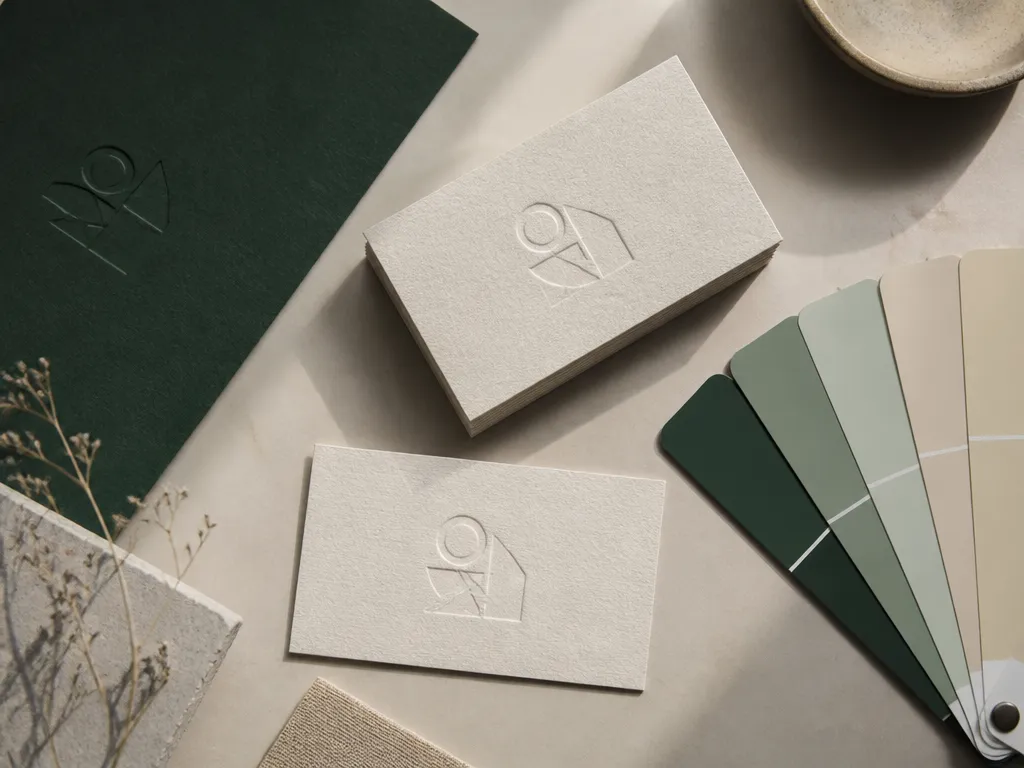
At seed the logo becomes a kit: the mark, its stationery and a palette with clear roles.
Write brand guidelines people actually use
Most guidelines fail for the same reason: they live in a PDF nobody opens after launch week. Good brand guidelines are a living reference, usually a shared Figma library plus a short web or Notion page, with:
- Real do and don’t examples, not just rules
- Ready-made templates for the things your team makes every week
- Voice examples for common situations, the way the Mailchimp Content Style Guide shows voice in practice
- Clear file names and one place to download every asset
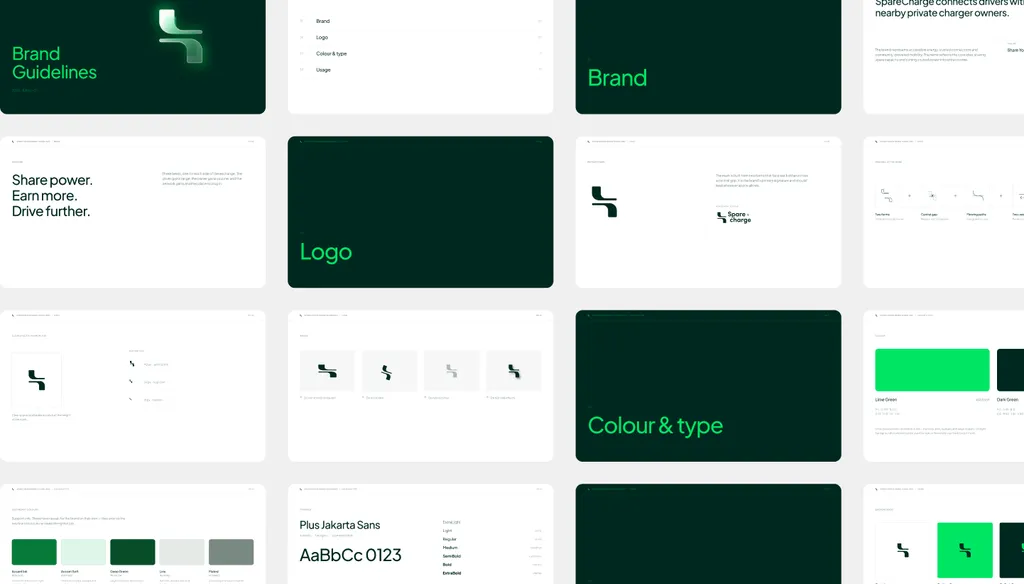
SpareCharge’s brand guidelines: logo, color and type rules on pages the team uses every week.
Apply the brand where it earns money
Roll the identity out to the touchpoints closest to revenue first:
- Website and product onboarding (brief the web designer from the finished identity: why the identity comes first)
- Pitch deck and investor updates
- Sales one-pager and proposal templates
- Social templates and email signatures
- Product UI details, such as empty states, error messages and notifications
Series A Branding: Brand System and Rebrand Readiness
By Series A, your brand stops being a set of files and becomes infrastructure. More people make brand decisions than any founder can review, so the brand has to work without you in the room. Two jobs matter most: turning guidelines into a system, and deciding honestly whether the brand you have can carry the next stage.
From brand guidelines to a brand system
A brand system is your identity broken into reusable parts that marketing, product and sales all pull from. In practice that means:
- Design tokens: colors, type, spacing and radius stored as named values that design and code share. The Design Tokens Community Group published its format as a stable specification in October 2025, so tokens can move between tools.
- Shared libraries: one source of truth in Figma for logos, components, icons and templates
- Brand architecture: a clear rule for how new products, features and markets are named and branded, whether as one masterbrand, endorsed sub-brands or separate brands
- Governance: a named brand owner, a simple request and review process, and a changelog
Public systems like the Atlassian Design System show how brand and product can share one foundation. If your team creates with AI, an AI-ready brand system adds what those tools need: tokens in JSON, an AI image style guide and brand voice for AI. For one example of brand and product built together, the SpareCharge brand, charging app, smartwatch companion and a design system with tokens were designed in eight weeks.
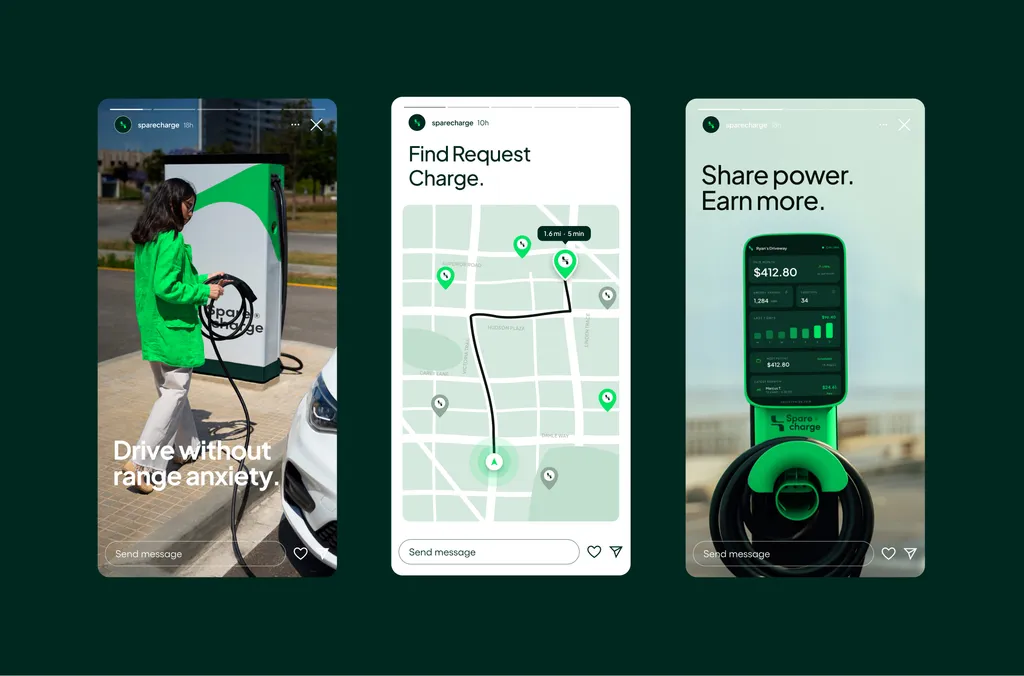
SpareCharge’s charging app, designed from the same brand system and tokens as the identity.
Keep, refresh or rebrand?
Raising a Series A is not by itself a reason to rebrand. Use the signals below to decide.
| Decision | Signals | Protect from the old brand |
|---|---|---|
| Keep: fix execution, not identity | The brand fits your positioning, people recognize it, and the problems are inconsistency or missing templates | Everything. Invest in the system and governance instead |
| Refresh: evolve the identity, keep the core | Positioning holds, but the identity looks dated, fails in product UI, misses contrast standards or doesn’t scale to new channels | Name, core color and any asset customers recognize |
| Rebrand: change the brand at its core | A trademark conflict, a pivot to a new category or buyer, a merger, a name that fails in a new market, or a brand that’s actively losing deals | Whatever equity research shows customers value |
Start with the rebrand row. Only when the name or the core identity itself blocks growth is a full rebrand justified; otherwise a refresh or a stronger system usually does more. Our guide to rebrand or refresh walks through the questions.
Protect brand equity during the change
If you do refresh or rebrand, plan the rollout like a product release:
- Audit every touchpoint where the current brand appears, from the app store listing to invoice templates.
- Rank touchpoints by impact and roll out in waves, starting with the product and website.
- Keep distinctive assets your customers already recognize, unless they’re the problem.
- Tell customers and investors why the brand changed, in one clear story.
- Retire old files so nobody keeps using them by accident.
When to Invest in Branding (and When to Wait)
Invest in branding just before a moment when your brand has to carry weight: a raise, a public launch, a hiring push, a move upmarket or a new market. Not after, when first impressions are already set, and not a year early, when the product may still change.
Signals it’s time to invest now
- You’re raising in the next few months and your deck doesn’t look like the company you’re describing
- You’re launching publicly, on Product Hunt, in an app store or with press
- You’re selling to enterprise or government buyers who judge risk partly on how you present
- You’re hiring designers, marketers or salespeople who need something to build on
- You’re entering a new market, especially one that needs an Arabic or bilingual identity or one as crowded as New York
- Prospects confuse you with a competitor, or can’t repeat what you do
- You hesitate before sending someone your website
Signals it’s smarter to wait
- You’re still testing whether the problem is real
- The name, audience or category might change in the next few months
- You’re reaching for branding to avoid harder product or sales work
- You can’t yet describe your customer in one sentence
Waiting doesn’t mean looking amateur. A clean wordmark, a two-color palette and one good typeface will carry you until the signals above show up. If a raise is close, branding your startup before the seed round covers the short list, and personal branding for founders covers the founder’s side.
The Startup Branding Checklist, Stage by Stage
Use this startup branding checklist to see what’s done, what’s missing and what can wait. Each stage assumes the one before it is complete.
Pre-seed checklist
- Positioning written in one sentence: who it’s for, what it does, why it’s different
- Name shortlisted, said out loud and screened in each target market
- Trademark attorney clearance before filing
- Domain and core social handles secured
- Wordmark and monogram that work at favicon size and in one color
- Core palette with text that meets WCAG contrast
- One or two licensed typefaces
- One-page brand sheet, deck template and landing page
Seed checklist
- Brand strategy signed off by all founders
- Messaging hierarchy and voice guidelines
- Full logo suite, extended palette and type scale
- Photo, illustration and icon direction
- Living brand guidelines with do and don’t examples
- Website rebuilt on the new identity
- Deck, sales one-pager, proposal and social templates
- Brand applied inside the product, not just around it
- All source files, font licenses and IP transferred to the company
Series A checklist
- Brand audit across every touchpoint
- Keep, refresh or rebrand decision made on evidence
- Design tokens shared by design and engineering
- Shared Figma library for marketing and product
- Brand architecture rules for new products and markets
- Named brand owner and a review process
- Localized identity for every market you sell in
- Trademarks filed in each priority market
Investing in Startup Branding: Budget, Partners and Evaluation Criteria
The right budget is whatever it takes to build the layer your next 12 months depend on, and nothing above it. Founders who scope by stage spend less overall, because they don’t pay twice for work that a pivot or rebrand throws away.
What professional branding support gives you
- Strategy before pixels: someone who asks hard questions about your market before drawing anything
- Distinctiveness: an identity built to stand apart from your category, not to follow it
- Fewer legal surprises: names and marks developed with trademark risk in mind
- Systems thinking: assets built to scale into product UI, not just to look good in a mockup
- Founder time back: fewer weekends spent pushing pixels in slide software
What drives the cost
- Scope: strategy, identity and system are separate layers, each with its own effort
- Research depth: customer interviews, competitor audits and stakeholder workshops
- Naming: usually a separate project from identity design
- Touchpoints: each website, product surface and template set adds work
- Languages and scripts: a true bilingual identity means designing a second wordmark, not translating the first
- Timeline: a compressed deadline before a raise or launch costs more
- Seniority: who actually does the work, not who pitched it
Ask any partner for a staged proposal that maps to your funding stage. You should be able to buy the pre-seed or seed layer on its own. For reference, my fixed packages are logo design $999, brand identity $3,499 and Premium $6,999 with an AI-ready brand system and website design (pricing); typical market ranges are in how much a brand identity costs in 2027.
Comparing your options
| Option | Best for | Watch-outs |
|---|---|---|
| DIY and AI logo tools (lowest cost) | Testing an idea before pre-seed | Generic results, no strategy, real trademark risk |
| Freelance designer (low to medium cost) | Pre-seed wordmark and brand kit | Quality and capacity vary widely; strategy is often thin |
| Specialist brand studio (medium to high cost) | Seed identity and guidelines; Series A systems | Check that seniors do the work |
| Large agency (highest cost) | Later-stage rebrands and campaigns | Cost, slower pace, junior hand-offs |
| In-house designer (ongoing salary) | Execution after seed | One hire rarely covers strategy and systems; works best paired with a studio |
To see what a logo alone gets you at each level, read what custom logo design costs.
Eight questions to ask before you hire
- Can you show work for startups at my stage, and what happened after launch?
- Who will actually do the work, and how senior are they?
- What happens before design starts? Show me your strategy process.
- How many concepts and revision rounds are included, and what’s out of scope?
- Do I get full IP ownership, editable source files and font licenses?
- How do you handle trademark risk when developing names and marks?
- Can you design a native Arabic or bilingual identity if I need one?
- What does hand-off include: guidelines, a Figma library, team training?
Red flags
- A “complete brand” promised in 48 hours
- No questions about your customers, competitors or business model
- A portfolio of concept mockups with no live brands behind them
- Vague or missing IP and file-ownership terms
- No clear process, just “we’ll send you some options”
Want a second opinion on scope? Book a free 30-minute call and I’ll tell you which layer to fund first, even if that’s nothing yet.
Common Startup Branding Mistakes and the Risks Behind Them
Most early brand problems trace back to one of these ten mistakes. Each one is cheap to avoid early and expensive to fix later.
| Mistake | The risk | The fix |
|---|---|---|
| Naming without trademark clearance | A forced rename after launch, plus legal costs | Screen early and get attorney clearance before filing |
| Designing for the founder’s taste | A brand that impresses the team but not the buyer | Anchor every design decision in positioning and customer research |
| Buying a logo and calling it a brand | Every touchpoint looks slightly different | Get at least a one-page brand sheet with the logo |
| Copying the category leader | You blend in and get mistaken for them | Audit competitors and own one distinctive asset |
| Over-building at pre-seed | Runway spent on work a pivot throws away | Scope to your stage using the brand map above |
| Rebranding right after a raise | Lost recognition and months of distraction | Run the keep, refresh or rebrand test first |
| Guidelines nobody uses | Brand drift as the team grows | Living guidelines plus ready-made templates |
| Treating Arabic as a translation | An awkward bilingual brand that feels foreign in both languages | Design the Arabic wordmark alongside the Latin one |
| Stopping at marketing | Your website and your product feel like two companies | Extend the brand into UI through shared tokens |
| Not owning your files | You can’t evolve the brand without the original designer | Put full IP assignment and source files in the contract |
The most costly mistake on that list is the first one. Every other mistake can be fixed with design work; a trademark conflict can force you to throw the name away.
Branding for Startups in the US, UK, UAE and Saudi Arabia
The stage map holds in all four markets. What changes is language, legal process and what local buyers expect to see. Most of my clients are founders in these markets, and these are the differences that shape the work.
| Area | US and UK | UAE and Saudi Arabia |
|---|---|---|
| Language | English-first | Arabic and English, often both from day one |
| Where to register a trademark | US: USPTO; rights can also come from use. UK: the Intellectual Property Office; a registration covers the UK and the Isle of Man | UAE Ministry of Economy and Tourism; Saudi Authority for Intellectual Property (SAIP) |
| Name checks | Pronunciation, spelling, existing use | Meaning and sound in Arabic, and a consistent transliteration |
| Layout | Left to right | Right to left for Arabic, with mirrored navigation and icons |
| Typography | Wide choice of Latin typefaces | Fewer Arabic families with full weight ranges, so choose the pairing early |
For US founders
US startup categories like SaaS, fintech and AI are crowded, so differentiation comes from sharp positioning and a distinct voice as much as from visuals. Because US trademark rights can arise from use, clearance means searching beyond federal registrations, including state registries and common-law use.
For UK founders
A trademark registered with the UK’s Intellectual Property Office protects your brand in the UK and the Isle of Man only. If you sell into the US or the Gulf, plan those filings too, and check whether the WIPO Madrid System covers the markets you need.
For UAE and Saudi founders
- Design bilingual from the start if you sell to local consumers, enterprises or government. Retrofitting Arabic later almost always shows.
- Design the Arabic wordmark, don’t type it. Match it to the Latin version in weight, contrast and rhythm instead of setting the name in a default Arabic font. Our guide to designing a bilingual brand in Arabic and English shows how.
- Plan for right-to-left in the product and website, including mirrored layouts and directional icons. The W3C’s Arabic and Persian Layout Requirements is the reference your developers will thank you for.
- Test your voice with local customers. A tone that feels friendly in a US consumer app can read as too casual for some enterprise or government buyers.
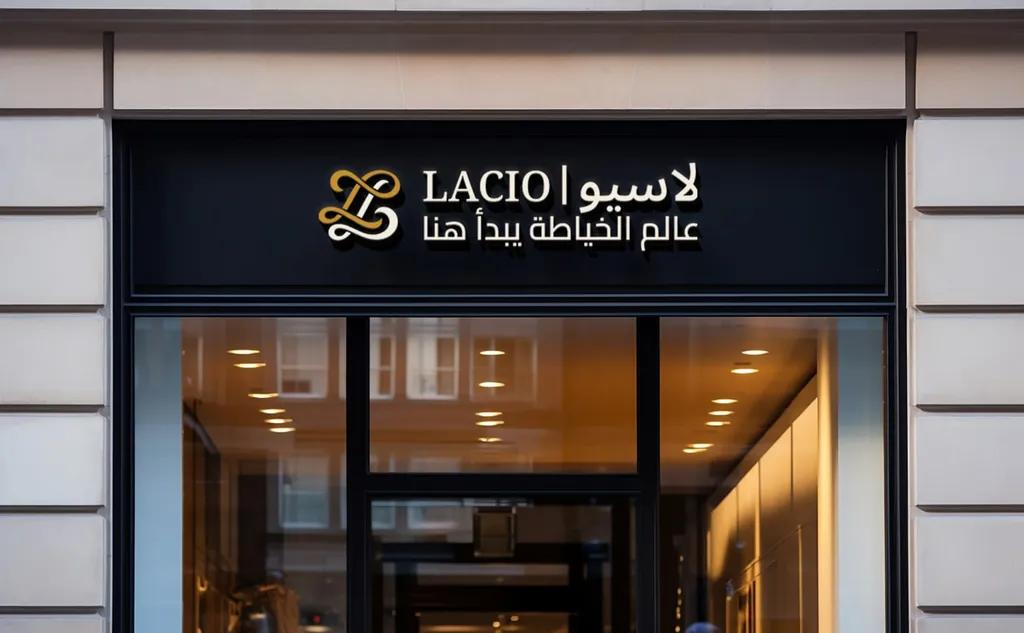
Lacio, a sewing and lace supplies shop in Iraq: the Arabic and English wordmarks designed as one sign.
Trademarks are filed with the UAE Ministry of Economy and Tourism and the Saudi Authority for Intellectual Property; your lawyer files, and the designer hands over clean files.
For cross-border founders
Gulf-based founders raising from US investors, and US founders expanding into the Gulf, need one masterbrand with a bilingual lockup system: Arabic-first and Latin-first versions, horizontal and stacked. For trademarks across several countries, check whether the WIPO Madrid System covers your target markets so you can file through one application.
Score Your Brand Readiness Before You Spend
The fastest way to know which layer to build next is to score the brand you have today. Answer these ten questions: yes is 2 points, partly is 1 and no is 0.
| # | Area | Question |
|---|---|---|
| 1 | Strategy | Can every founder describe who you serve and why you’re different in the same sentence? |
| 2 | Strategy | Do customers describe what you do the way you do? |
| 3 | Strategy | Is your voice defined well enough that someone else could write in it? |
| 4 | Identity | Is your name cleared for trademark in every market you sell in? |
| 5 | Identity | Does your logo work at favicon size, in one color, on light and dark backgrounds? |
| 6 | Identity | Does your palette meet WCAG contrast for text? |
| 7 | Identity | Do your deck, website and product look like the same company? |
| 8 | System | Could a new hire make an on-brand slide or social post without asking you? |
| 9 | System | Does your brand work in every language and market you plan to sell in this year? |
| 10 | System | Do you own all source files, font licenses and IP for your brand? |
What your score means
The total is out of 20, but the order matters more than the number. Your next layer is the first area with a no: strategy (questions 1 to 3), then identity (4 to 7), then system (8 to 10). Fix the noes in that area before you spend on the next one, and treat a partly as a no if your next raise or launch is close.
Talk it through in 30 minutes
If you’d rather get a direct answer, book a free 30-minute call. We’ll look at your current brand, your next funding or launch milestone and the one layer worth building next. You’ll leave with a clear recommendation, whether or not we work together. You can also browse my work before we talk.
The short version
Branding for startups isn’t one big project. It’s three layers built in order: a credible core at pre-seed, a full identity and guidelines at seed, and a scalable system at Series A. Build each layer just before it has to carry weight, and your brand will grow as fast as your company does.
FAQ
What is branding for startups?
Branding for startups is the process of defining what a new company stands for and expressing it consistently through its name, visual identity, voice and customer experience. It covers three layers, strategy, identity and system, built in stages as the company grows from pre-seed to Series A.
When should a startup invest in branding?
Invest just before your brand has to carry weight: a fundraise, a public launch, a hiring push, a move upmarket or a new market. Before product-market fit, keep it lean with a name, wordmark and core palette. Expand to a full identity at seed and a brand system at Series A.
How much should a startup spend on branding?
There’s no fixed number. Fund the layer your next 12 months depend on, and nothing above it. Cost depends on scope, research depth, naming, the number of touchpoints, languages, timeline and the seniority of the team. Ask for a staged proposal so you can buy one layer at a time. My fixed packages are logo design $999, brand identity $3,499 and Premium $6,999.
Should a startup rebrand after raising a Series A?
Only if the evidence says so. Rebrand when there’s a trademark conflict, a pivot to a new category or buyer, a merger, or a name that fails in a new market. If the brand still fits your positioning, a refresh or a stronger brand system is usually the better investment.
What’s the difference between brand strategy and brand identity?
Brand strategy is the thinking: who you serve, how you’re different and what you promise. Brand identity is how that strategy looks and sounds: your name, logo, colors, typography, imagery and voice. Identity without strategy tends to look good but say nothing.
Do I need a logo before raising pre-seed?
You need a credible wordmark, not an elaborate logo. A well-set name with a simple monogram, a small palette and consistent type is enough for a pre-seed deck and landing page. Save symbol design for when you have the reach to give it meaning.
How long does startup branding take?
With me, a pre-seed logo takes 1–2 weeks, plus 1–2 weeks of naming if you need a name. A seed-stage brand identity with guidelines takes 2–3 weeks, or 4–6 weeks with an AI-ready brand system and website design. At Series A, an AI-ready brand system takes 2–3 weeks and a rebrand 3–4 weeks.
Is an AI-generated logo enough before a seed round?
It’s fine for testing an idea, but risky as your real brand. AI tools tend to produce generic marks with no strategy behind them, which makes them harder to protect and easier to confuse with others. Once you’re raising or selling, invest in a distinctive, cleared identity.
Do startups in the UAE or Saudi Arabia need an Arabic logo?
In most cases, yes, if you sell to local consumers, enterprises or government. Design the Arabic wordmark alongside the Latin one so they match in weight and rhythm, plan right-to-left layouts, and register your marks locally.
Sources