Branding Before Website: Why the Identity Comes First
Web design and brand identity: why the identity should come first, what it settles for your web designer, when the order can bend, and who builds the site.

Summarize with AI
Key takeaways
- The brand identity is the brief for the website, and the website is the biggest single use of the identity. That’s why the identity comes first.
- An approved identity answers many website questions in advance, from the header logo and favicon to button colors, type styles, photo style and headline tone.
- Website design (how pages look and work) and website development (building them) are separate jobs, often done by different people.
- The order can bend: a holding page can go live early, and web design can start as soon as the logo, color and type are approved.
- My Premium package ($6,999, 4–6 weeks) adds an AI-ready brand system and website design in Figma to the brand identity. The build isn’t included.
When you need both web design and brand identity, design the brand identity first, then the website. The website is the largest single place your identity gets used. It needs the logo, color palette, typography, imagery and voice before any page can be designed properly. If the site comes first, the web designer has to invent those choices without a brief, and you redo pages once the real identity arrives. The one exception is a simple holding page, which can go live with a basic wordmark while the identity is designed.
I’m Masuder Rahaman, a brand designer and the founder of Wolfpixel, where I lead the design team. I design brand identities, and my Premium package adds website design in Figma. I don’t build websites. This article sets out which website decisions an identity settles, what goes wrong in the other order, when the order can bend, and who does which part of the job.
What does a brand identity settle for your web designer?
A brand identity is a system: strategy and positioning, a logo system, color, typography, imagery, icons and voice, written down in guidelines. (My article on what a brand identity includes lists every part.) Each part answers questions a web designer would otherwise answer alone.
| Identity element | Website decision it settles | Why it matters on the web |
|---|---|---|
| Positioning and messaging | Homepage headline, page order, what goes above the fold | The site’s structure follows what you want to be known for |
| Logo system | Header logo, mobile logo, footer, favicon, social share image | The browser tab and search results need a compact, square mark |
| Color palette | Backgrounds, buttons, links, alerts, hover states | Text colors must meet contrast rules to be readable |
| Typography | Heading and body styles, sizes, line lengths | Web fonts need the right license and affect page speed |
| Imagery direction | Hero images, team photos, product shots, illustration | A photo style decided once keeps the site from looking like a stock library |
| Icons | Navigation, feature lists, interface states | One icon style across the site, deck and product |
| Voice | Headlines, buttons, form labels, error messages | Interface copy is brand copy too |
Three of these have hard technical limits worth knowing before the identity is final:
- Favicon. Google’s favicon guidelines require a square favicon of at least 8×8 px, recommend going larger than 48×48 px, and ask that it visually represents your brand. A wide wordmark won’t read at that size, so the identity needs a compact mark or monogram that does.
- Contrast. The W3C’s WCAG contrast criterion asks for a contrast ratio of at least 4.5:1 for normal text and 3:1 for large text. Logos are exempt, but brand colors used for body text, buttons and links aren’t. A palette chosen only for mood can fail on screen, and checking it during the identity stage costs less than fixing it on a finished website.
- Fonts. Web fonts are files the browser has to download. web.dev’s guide to optimizing web fonts explains that they can delay text from appearing and shift the layout while they load, and that the fastest font is one that isn’t requested at all. Fewer families and weights help. Licensing matters too: some foundries license desktop, web and app use separately, so check that the brand typefaces cover your website before you approve them.
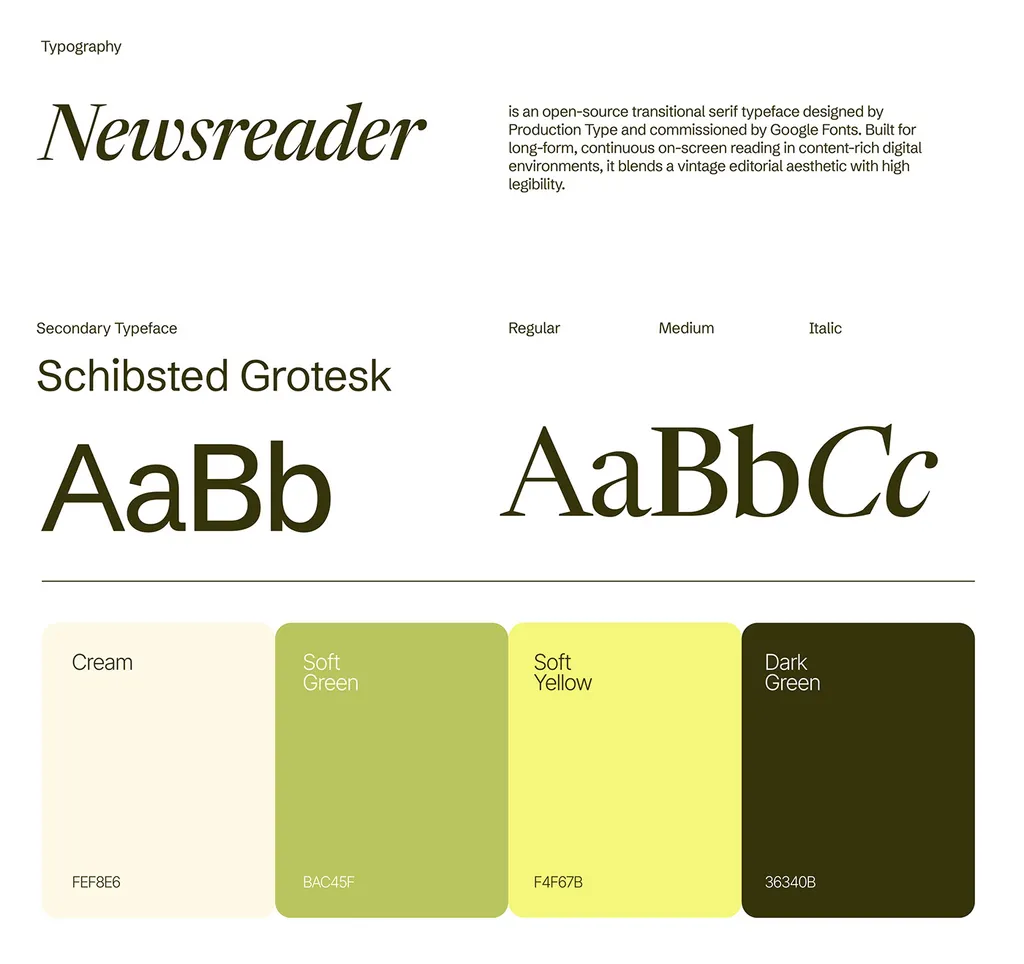
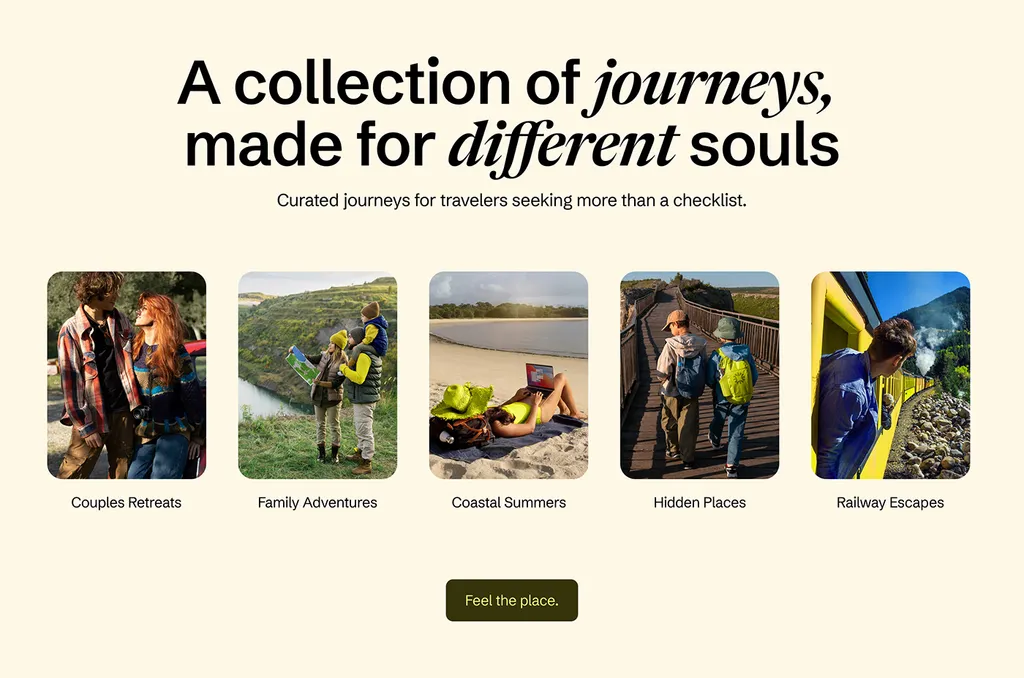
Both images come from the Wayfare project, a travel brand where the scope covered strategy, identity and website design. The website section reuses the serif and grotesk pairing, the cream and the dark green from the identity page. Nobody had to choose them again.
What goes wrong when the website comes first?
When a site is designed before the identity exists, the same problems tend to appear:
- A placeholder logo gets baked in. It ends up in the header, the favicon, the social share image and the email footer. When the real logo arrives, all of them change.
- Colors are picked for one screen. They look fine behind a hero image, then don’t work on a sales deck, a sign or a product screen, or they fail contrast for body text.
- Fonts are chosen without checking the license. The site launches with a font licensed only for desktop use, or with a different typeface from the deck and documents.
- The copy has no voice. Headlines and buttons are written in a generic tone, then rewritten once the brand voice exists.
- The website becomes the brand by accident. Later work, such as the deck, the product and the packaging, copies the website’s improvised choices, which were never designed to carry a whole brand.
There’s also a quieter cost. Nielsen Norman Group describes the aesthetic-usability effect: people tend to perceive attractive products as more usable. A website is often the first place people meet a young company. If it looks improvised, visitors may read that as a sign about the product, fair or not.
Web design and brand identity: the order that works
| Step | What happens | Usually done by |
|---|---|---|
| 1. Strategy | Positioning, audience, key messages | Brand designer or strategist |
| 2. Identity | Logo system, color, type, imagery, icons, voice | Brand designer |
| 3. Guidelines and digital system | Rules, examples and files for screens | Brand designer |
| 4. Site map and content | Which pages, what each page says | You, a copywriter or the web designer |
| 5. Website design | Layouts for the agreed pages, desktop and mobile | Web designer |
| 6. Website build | Turning the designs into a working site | Web developer or your in-house team |
| 7. Launch and upkeep | Hosting, analytics, updates, SEO | Developer, marketing team or agency |
Steps 1–3 belong to the brand, and steps 5–7 belong to the website. Step 4 is where most delays happen, because designers can’t lay out pages well without knowing roughly what goes on them. Start writing or outlining the page content while the identity is being designed.
When can the order bend?
Brand first is the right default, but there are common exceptions:
- You need a page live now. A one-page holding site or waitlist can go up with a simple wordmark, one color and a system font. Plan to replace it, and don’t pay for a full site until the identity is done.
- Your identity already exists and works. If you have a logo system, palette, type and guidelines you’re happy with, go straight to web design. The guidelines are the brief.
- You want both in one project. The identity and the website can overlap. Website design starts once the logo, color and type are approved, while the remaining applications, such as stationery, social templates and signage, are finished in parallel. What shouldn’t happen is page layouts being designed while the logo is still undecided.

Core.hr, an HR software company, is one project that covered both: the scope was a rebrand, the product interface and the website design. The resort brand Reva7 and the law firm JurisLex also had website design in scope alongside the identity.
Web design vs web development: who does what?
When you buy web design and brand identity, “website” can mean three different jobs. Knowing which one you’re buying avoids surprises.
| Role | Main job and output | Common gap |
|---|---|---|
| Brand designer | The brand system: logo, color, type, imagery, voice, guidelines | Not every brand designer designs websites |
| Web designer | How each page looks and works: layouts and components, usually in Figma | Not every web designer builds them |
| Web developer | Building a working site, in code or a builder such as Webflow or WordPress | Developers usually don’t design brands |
Some people do two of the three; few do all three well. When you compare quotes, ask each provider which columns they cover. “We do your website” can mean design only, build only or both.
Where I sit: brand identity in every identity project, and website design in Figma in the Premium package only. The build is a separate job. You hand the Figma files to your developer, your in-house team or a web development agency, and they build the site from them.
Web and brand design options, with costs
| Option | What you get | Price and timeline |
|---|---|---|
| Identity, then a web designer | Strategy, 4 concepts, identity and guidelines from me; web design from someone else | $3,499, plus the web designer’s fee; 2–3 weeks, then theirs |
| Premium package | Brand identity, an AI-ready brand system and website design in Figma for the pages agreed in your proposal | $6,999; 4–6 weeks |
| Website only | Web design from your existing guidelines | Quoted by your web designer; Varies |
All prices are in US dollars, as shown on my pricing page on 9 November 2026; if you’re planning a 2027 project, the pricing page shows the current figures. With either of my packages you get one fixed price in a written proposal after a free 30-minute call, you pay 50% to start and 50% before the final files are handed over, and you own all final files. The AI-ready brand system in Premium means design tokens in JSON, an AI image style guide, brand voice for AI and an AI review checklist; my article on the AI-ready brand system explains each part. The design tokens make the hand-off to a developer cleaner, because the colors and type values sit in a file a developer can use directly.
Neither package includes the website build or development, ad campaign production, font licenses (you buy them) or trademark filing (your lawyer files it; I hand over clean files).
What to hand your web designer
Whoever designs the site, give them this before the first layout:
| Item | Why they need it |
|---|---|
| Brand guidelines (PDF) | The rules for logo use, color, type, imagery and voice |
| Figma library and source files | The actual logo files, color styles and type styles to design with |
| Favicon and compact mark | For the browser tab, search results and app icons |
| Font names and license details | So the site uses properly licensed web fonts |
| Color values and contrast pairs | Which text and background combinations pass for body copy |
| Photo direction and approved images | So the site doesn’t fall back on generic stock |
| Voice notes and key messages | For headlines, buttons and forms |
| Site map and page content | So layouts are designed around real content |
If any of these are missing, the web designer will fill the gap, and you’ll get their taste rather than your brand.
Start with your brand identity
If you’re planning a new brand and a new website, book a free 30-minute call in your time zone. Tell me what you need live and when, and whether you already have a developer. I’ll tell you whether the Brand identity package plus a separate web designer, or the Premium package, fits better. Both are on the pricing page.
FAQ
Should I do branding or a website first?
Branding first, because the identity gives the website its logo, colors, type, imagery and voice. If you need something online right away, put up a simple holding page and design the full site once the identity is approved.
Can brand identity and web design happen at the same time?
They can overlap. Start the web design once the logo, color and type are approved; laying out pages while the logo is still undecided usually means redoing them.
What’s the difference between web design and web development?
Web design decides how each page looks and works, usually in a tool such as Figma. Web development turns those designs into a working site, in code or a site builder, and is often done by a different person.
Do you build websites?
No. The Premium package includes website design in Figma for the pages agreed in your proposal. Your developer, in-house team or a web development agency builds the site from those files.
How much does brand identity plus website design cost with you?
The Premium package is $6,999 and takes 4–6 weeks. It includes everything in the $3,499 Brand identity package, plus an AI-ready brand system and website design in Figma, but not the build.
What does a web designer need from my brand identity?
The guidelines, Figma library and source files, a compact mark for the favicon, font names and licenses, color values with text-safe contrast pairs, photo direction, voice notes, and the site map and page content.
Sources
- Google Search Central: Define a favicon to show in search results
- W3C: Understanding Success Criterion 1.4.3, Contrast (Minimum), WCAG 2.2
- web.dev: Optimize web fonts for Core Web Vitals (Katie Hempenius and Barry Pollard)
- Nielsen Norman Group: The Aesthetic-Usability Effect (Kate Moran, last reviewed 1 September 2026)