Branding a New York Startup in the Loudest Market
How to brand a New York startup: who judges your brand first, how to stand out among well-funded rivals, what to brand at each stage, and the name rules.

Summarize with AI
Key takeaways
- New York is loud in measurable ways: more new businesses, more venture money and more agency-polished competitors. A competent brand is the minimum; a distinct one is the goal.
- Three audiences judge a New York startup early: investors, enterprise buyers and talent. Each reads the brand differently.
- Distinctiveness comes from the idea, not from the budget. Polished and generic is the most common New York failure.
- Brand in stages: a name, a logo and a deck before pre-seed; a full identity at seed; a system that scales by Series A.
- Name before you form the LLC. Some words need state approval, and the LLC’s name is published.
- You do not need a designer in New York; you need one who works on Eastern time and understands who your buyers are.
To brand a New York startup, start with one sharp position rather than a logo, because in New York you are competing for attention with more funded companies, more agencies and more design-literate buyers than almost anywhere else. Decide who you are for and the one thing you do that others in your category do not, then build an identity that says it in a way nobody in your category already does, and apply it with discipline to the three places New York will judge you first: the pitch deck, the website and the product. Settle the name before you form the company, because New York’s rules put an LLC’s name in print and restrict some words without approval.
I’m Masuder Rahaman, a brand designer and the founder of Wolfpixel, where I lead the design team. I work remotely with founders across the US, including in New York, with calls on Eastern time; I have no office in the city. This article is for New York founders deciding what their brand needs to do in a market where everyone else is also trying to be noticed.
What makes New York loud
“Crowded” is a cliché, so here are specifics, from the city’s and the Census Bureau’s own numbers:
- More new companies. Census data show about 159,000 business applications across the five boroughs in 2025, up from about 130,000 in 2019. NYCEDC estimates about 1 in 8 of the city’s businesses started in the past year.
- More money chasing the same buyers. NYCEDC reports that New York City companies raised about $39 billion in venture funding in the first three quarters of 2026, more than double the same period of 2025, and the city was on pace for a record year. Nationally, AI companies took about 83% of US venture dollars over the same nine months, according to the PitchBook-NVCA Venture Monitor, so your competitors are often well funded and recently branded.
- Concentrated, sophisticated buyers. In September 2026, New York City had 514,300 jobs in finance, insurance and real estate, 210,700 of them in securities, and 215,400 in information. If you sell to finance or media, your buyer has seen thousands of decks and has a trained eye for the generic.
- A design-literate city. It is home to many well-known design studios and agencies, and agency directories such as Clutch keep a separate New York list just for branding agencies that work with startups. Your competitors have access to polished work.

These are the latest figures, from 2025 and 2026. If you launch in 2027, plan as if the market stays at least this crowded. The consequence is not that your brand needs to be louder. It is that it needs to be clearer and more specific, because polished and generic is what everyone else has already bought.
The three audiences that judge a New York startup
Investors
New York investors see a great many decks. The brand does not win the round, but it frames the first thirty seconds of the cover and the first impression of the website a partner opens before the meeting. What investors read from a brand is focus: does this company know exactly who it is for and what it does? A deck where the cover, the website and the product screenshots look like three different companies reads as a team that has not decided.
Enterprise buyers
If you sell to banks, insurers, media companies or large retailers, your buyer is risk-averse and procurement-driven. They need the brand to signal that you are a real company that will still exist next year: a consistent identity across proposal, website, security documentation and product, a professional email domain and signature, and no claims you cannot back up. The startups & AI page covers why claims matter more than ever: announcing a crackdown on deceptive AI claims in 2024, the FTC’s chair said there is “no AI exemption from the laws on the books”.
Talent
New York startups compete for engineers, designers and operators with every bank, media company and big tech office in the city. Candidates judge you on your LinkedIn page, your careers page, your product and the swag in the coworking space. A brand that looks like a real, intentional company is a recruiting asset; one that looks like a template is a reason to take the other offer.
The brand has to work for all three at once. That is a reason to keep the system simple and consistent, not to build three versions.
How to stand out without shouting
Start from one idea
Decide the single idea the brand should carry: what you do, for whom, that the alternatives do not. Write it in one sentence and get every co-founder to sign it. In New York this matters more than elsewhere because your category will have several well-funded companies saying almost the same thing. If your one idea is “the modern platform for X,” you have not found it yet.
Be specific about the buyer
“Small businesses” or “enterprises” is not a buyer. “Finance teams at mid-market logistics companies who still reconcile in spreadsheets” is. The more specific the buyer, the more specific the voice, the imagery and the product screens can be, and specificity is what generic competitors cannot copy.
Look like nobody in your category
Put your ten closest competitors’ logos, website headers and deck covers on one board. In New York fintech you will likely see navy, a geometric sans and a shield or abstract mark; in AI, a sparkle, a gradient and a node graph; in consumer, the same serif-and-beige look. Decide what to share with the category (enough to be recognized as a member) and where to stand apart. The AI startup logo article shows this method for one category in detail.
Execute consistently
In a crowded market, consistency is a differentiator in itself. Many startups’ decks, websites and products disagree with each other because they were made by different people at different times. One logo system, one palette, one type system and one voice, applied everywhere, looks like a company that knows what it is doing.
What to brand first, by stage
| Stage | What to have | What can wait |
|---|---|---|
| Pre-seed | A cleared name, a logo family that works as an app icon and favicon, a simple palette and type, a deck template, a one-page website | Full guidelines, illustration, photography standards, merch |
| Seed | A full brand identity with positioning and voice, guidelines and a Figma library, the website and product screens on the same system, LinkedIn and careers pages | Campaign identities, event systems, a design token pipeline |
| Series A | A system that scales: design tokens for the product team, templates for sales and recruiting, rules for partners and agencies, and, if your team creates with AI, an AI-ready brand system | A rebrand, unless the company has changed |
If you are raising soon, the guide to branding before the seed round covers what to build and what can safely wait. For how the brand gets made, step by step, see the logo design process.
The New York rules that affect the name
New York’s rules touch the name more than the logo, so they come first. Two matter most for startups, and the New York page has the detail:
- Some words need state approval. New York’s LLC law bars words such as bank, finance, investment, insurance, loan, mortgage and trust from an LLC name unless the Superintendent of Financial Services approves; others, such as school, university, academy or institute, need consent from the Education Department. This catches many fintech names, and the same limits apply to an assumed name. Check with your lawyer before you fall in love with one.
- The LLC’s name is published. Within 120 days of forming, a New York LLC must publish a notice once a week for six weeks in two newspapers, one daily and one weekly, chosen by the county clerk, then file a Certificate of Publication with the Department of State. Name first, then form the company. If you trade under a different name, an LLC or corporation files a Certificate of Assumed Name with the Department of State.
Then the name needs a trademark search and a domain. If you do not have a name yet, brand naming gives you a shortlist with domain and social checks and a preliminary USPTO search before you form the company.
If you sell to households rather than businesses, there is one more consideration: in the Census Bureau’s 2020 to 2024 survey, 47.7% of New York City residents aged 5 and over spoke a language other than English at home. Have native speakers check the name and tagline before the logo is drawn.
An example from New York: TORIX
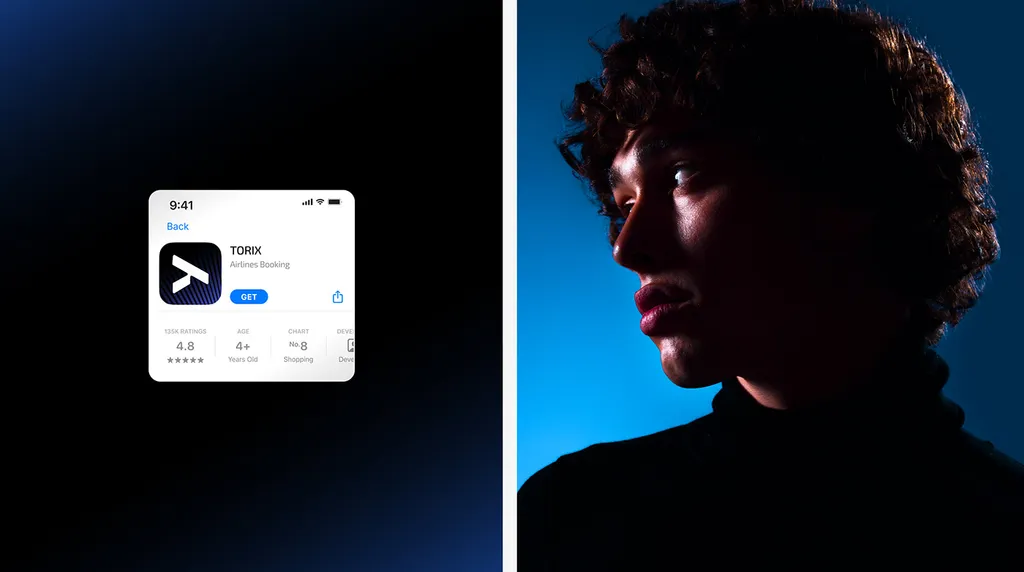
TORIX Airlines, a New York client, came to us for a 2025 rebrand covering the mark, color, pattern, icons, booking app, print and airport signs. It is not a startup, but it faced the same New York problem: standing out in a category where every competitor already looks polished. The answer was a single idea expressed in four words (“Velocity, Comfort, Trust, Mastery”), an angular, forward-pointing mark set on a measured grid so it holds up as a small app icon and on a large screen, bright blue and dark blue with diagonal stripes that fade into the dark, and a set of rounded line icons. The same system runs from the booking app and boarding pass to posters, billboards, lobby screens and airport signs, under the line “Modern flights, timeless values.”
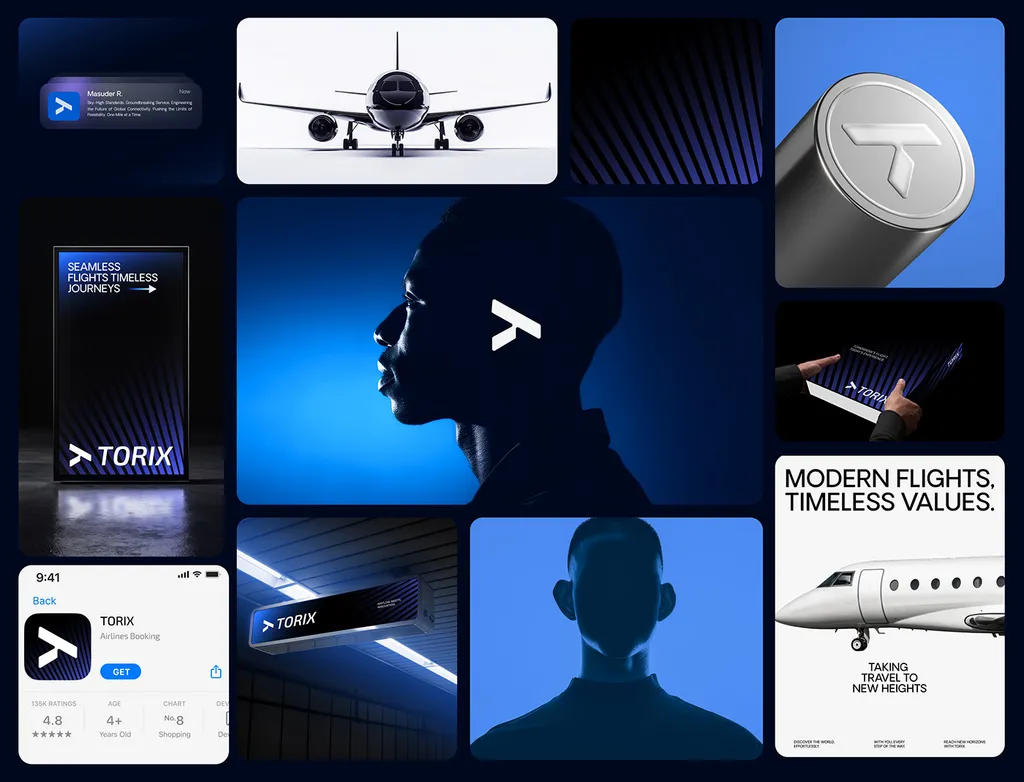
The lesson for a New York startup is the consistency: one idea and one system, carried from phone to gate, so that every touchpoint looks like the same company. See the TORIX case study.
Local agency or remote designer?
Many New York founders assume they need a New York agency. Sometimes they do: if you need in-person workshops with a large leadership team, a launch event produced in the city, or a full-service agency running brand and campaigns together, local presence helps.
For most startup identity projects, it does not. What matters is that the designer works in your hours, understands your buyers and category, and runs a clear process with a fixed price. New York agency rates reflect New York costs: as of October 2026, Clutch’s listing of New York branding agencies for startups shows minimum project sizes from about $1,000 to $50,000 and above, with most hourly rates between $100 and $300. Those are the latest listings to budget from for 2027; ask each agency for its current rates.
I work remotely with New York founders, on Eastern time, with a free first call and a fixed written proposal. A logo is $999 over one to two weeks; a brand identity is $3,499 over two to three weeks; the Premium package with an AI-ready brand system and website design is $6,999 over four to six weeks. For a fuller comparison of freelancers, independent designers, studios and agencies, including when an agency is the better choice, see brand designer vs branding agency.
Mistakes I see in New York startup brands
- Buying polish instead of position. A beautiful identity that says what every competitor says.
- Borrowing the category look. Navy and a shield in fintech; a sparkle in AI; beige and a serif in consumer.
- Branding for press, not for buyers. A launch look that impresses a tech blog and confuses a procurement team.
- Deck, website and product that disagree. The most common sign of a team that has not decided.
- Naming after forming the LLC. Then paying to file a change, or living with a name you would not have chosen.
- Waiting for Series A to brand properly. By then the inconsistencies are everywhere and the rebrand costs more.
How I work with New York founders
The process is the same for every US founder: a free 30-minute call on Eastern time about your company, buyers and where the brand must work first; a fixed written proposal in USD; strategy, identity and handover with weekly check-ins; guidelines and a Figma library at the end; full ownership on final payment. I do not file trademarks or legal paperwork; your lawyer does, with the clean files I hand over. The US page covers how I work with founders across the country.
If you are building in New York and your category is crowded, book the free call and bring your three closest competitors’ websites. We will look at where your brand can stand apart before anything is designed.
FAQ
How do you brand a startup in New York?
Start with one sharp position: who you are for and the one thing you do differently. Clear the name before forming the LLC, then build an identity that stands apart from your category’s look, and apply it consistently to the deck, the website and the product, which is where investors, buyers and talent judge you first.
Do I need a New York-based branding agency?
Not usually for a startup identity. Local presence helps for in-person workshops with large teams, live events or full-service campaigns. For most identity projects, what matters is a designer who works on Eastern time, understands your buyers and runs a clear, fixed-price process.
How much does branding cost for a New York startup?
As of October 2026, the latest listings and a sound base for a 2027 budget, New York agencies listed on Clutch for startups show minimum projects from about $1,000 to $50,000 and above. My fixed packages are $999 for a logo, $3,499 for a brand identity and $6,999 for Premium with an AI-ready brand system and website design.
Can my New York fintech’s name include “finance” or “bank”?
Not without approval. New York’s LLC law bars words such as bank, finance, investment, insurance, loan, mortgage and trust from an LLC name unless the Superintendent of Financial Services approves, and the same limits apply to an assumed name. Ask your lawyer before you settle on one.
Should I name the company before forming the LLC?
Yes. A New York LLC must publish a notice of its formation, with its name, in two newspapers within 120 days, and trading under another name requires a Certificate of Assumed Name. Choosing and clearing the name first avoids changing it later.
What should a New York startup brand first?
Before pre-seed: a cleared name, a logo family, a simple palette and type, a deck and a one-page site. At seed: a full identity with positioning, voice, guidelines and the website and product on the same system. By Series A: a system that scales across product, sales and recruiting.
Sources
- NYCEDC: New York City Economic Snapshot, October 2026
- US Census Bureau: Business Formation Statistics, annual county data
- New York State Senate: Limited Liability Company Law §204, Name of limited liability company
- New York State Senate: Limited Liability Company Law §206, Publication
- Clutch: Top Branding Agencies for Startups in New York (October 2026)