Arabic Brand Name for Saudi Arabia: 4 Ways to Create One
How to create an Arabic brand name for a Saudi company: transliterate, translate or create one, the 2025 trade-name rules, sounds to watch and how to test it.

Summarize with AI
Key takeaways
- An English trade name in Saudi Arabia needs an Arabic transliteration, and English names are assessed by their Arabic equivalents. Decide the Arabic name early.
- Four routes: transliterate, translate, create an Arabic counterpart, or transliterate plus an Arabic tagline.
- Some English sounds have no standard Arabic letter (p, v and hard g are the common ones), and Arabic usually leaves short vowels unwritten, so one English name can be spelled several ways. Choose one deliberately.
- Test the name with native speakers in Saudi Arabia for sound, meaning and readability.
- Use one Arabic spelling everywhere: trade name, commercial registration, trademark, sign, app listing, social profiles.
- The Arabic name becomes a wordmark drawn alongside the English, not text typed underneath it.
If your company has an English name and you are entering Saudi Arabia, you need an Arabic brand name: an Arabic form of the name, chosen on purpose. Saudi trade names can now be registered in English, but an English name also needs an Arabic transliteration, and English names are assessed by their Arabic equivalents. You have four routes: transliterate (keep the sound), translate (keep the meaning), create a separate Arabic counterpart, or transliterate the name and let an Arabic tagline carry the meaning. Transliteration is the usual choice for invented and founder names; translation works when the meaning is the point. Whichever you choose, test the spelling with native Saudi speakers, use exactly one spelling everywhere, and draw the Arabic wordmark from it.
This is general information, not legal advice. Your lawyer confirms the trade-name and trademark steps for your company.
I’m Masuder Rahaman, a brand designer and the founder of Wolfpixel, where I lead the design team. I design Arabic and English names and logos for companies entering Saudi Arabia and the UAE, and the Arabic name is the first decision in every bilingual project. This article is about that decision: how to make it, what the rules are, and where it goes wrong.
Does a Saudi company need an Arabic brand name?
In practice, yes, if you are setting up in Saudi Arabia or selling to Saudi customers.
For the trade name. Under the trade-name law in force since April 2025, Saudi trade names can be registered in English, but an English name also needs an Arabic transliteration, and the criteria for similarity are applied to English names through their Arabic equivalents. So the Arabic spelling isn’t a translation exercise for later; it is part of whether your name can be registered at all.
For signs, ads and documents. As the Riyadh page notes, the National Policy for the Arabic Language, approved by the Council of Ministers in February 2026, calls on the private sector to use Arabic on signs, contracts, invoices and ads. Regulated sectors have their own rules: if SAMA supervises you, for example, Arabic is the language of your ads, except ads aimed at non-Arabic speakers.
For customers. Even where English is widely read, an Arabic name makes the brand easier to say, search and remember for many customers, and it shows the brand was built for the market rather than imported.
How to create an Arabic brand name: four routes
You can transliterate the name, translate it, create an Arabic counterpart, or transliterate it and add an Arabic tagline.
| Route | What it is | Works best when |
|---|---|---|
| 1. Transliterate | Write the English name’s sound in Arabic letters | The name is invented, a founder’s name, or a word whose sound matters more than its meaning |
| 2. Translate | Use an Arabic word with the same meaning | The name is a real word and its meaning is the point (a quality, an object, a place) |
| 3. Create an Arabic counterpart | A different Arabic name that carries the same idea | The English name can’t be transliterated or translated well |
| 4. Transliterate plus an Arabic tagline | The transliterated name, with an Arabic line that says what you do or mean | You want one recognizable name and an Arabic message |
Transliteration is common. In a 2024 presentation to the American Name Society on 500 shop names in Saudi Arabia, Reima Al-Jarf reported that 39% were English names created by the owners and 25% were international brand names used without translation, against 24% pure Arabic names. Shop workers said foreign names sound more prestigious and attract more attention. The same research found that some transliterated names were hard for people to decode and suggested translating them. Both findings point to the same rule: transliterate if the sound will read clearly in Arabic; otherwise consider another route.
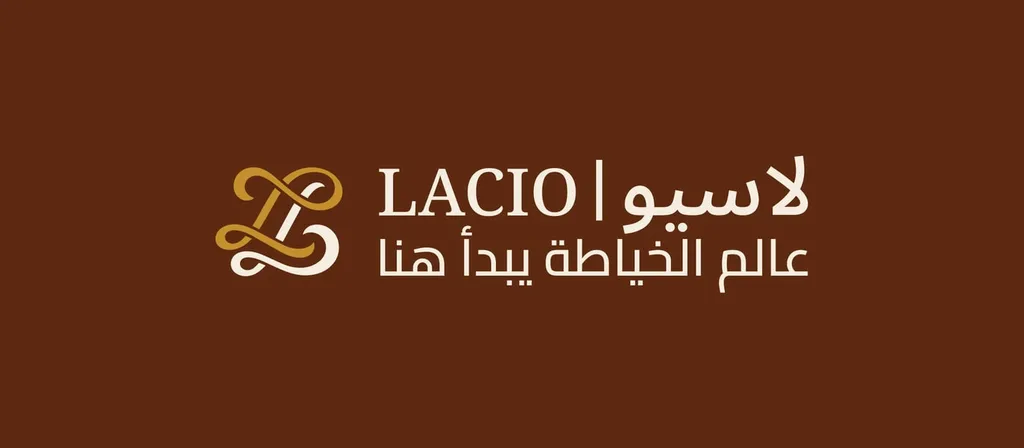
Route 4 in practice. Lacio, a sewing and lace supplies shop in Iraq whose identity I designed, is written لاسيو in Arabic so it sounds the same in both languages, while the Arabic tagline, عالم الخياطة يبدأ هنا, says what the shop is about. The full lockup is in the bilingual brand article.
Which English names are hard to write in Arabic?
Names with P, V or hard G, many short vowels, consonant clusters or spelling tricks. Arabic and English don’t share a sound system. Founders who don’t read Arabic rarely see these problems until a native speaker points them out.
Sounds with no standard Arabic letter.
| English sound | Usual Arabic spelling | What to watch |
|---|---|---|
| P | ب (b) | “Pay” and “Bay” can look the same |
| V | ف (f), or the modified letter ڤ | Not every font or keyboard handles ڤ well |
| Hard G (as in “go”) | Varies: ج (j), غ (gh) or ق (q) | Pronounced differently across dialects |
Short vowels are not usually written. Arabic normally writes long vowels and leaves short vowels to the reader. An English name with several short vowels can be read more than one way in Arabic, unless the spelling adds long-vowel letters to guide the reader.
Consonant clusters. English names that start with two or three consonants (str-, spr-, fl-) don’t fit Arabic syllable patterns easily, and the Arabic spelling often adds a vowel at the start or between consonants.
Silent letters and spelling tricks. Arabic writes what is said. Names like “Knyte,” or spellings in the style of “Lyft,” lose their visual cleverness completely.
Meaning by accident. A transliterated name can land on an existing Arabic word or sound like one, sometimes with an unwanted meaning, and sometimes in dialect rather than in standard Arabic. Only native speakers will catch this.
None of this means you can’t transliterate. It means you choose a spelling on purpose, with native speakers, instead of accepting whatever a translation tool suggests.
What are the Saudi trade-name rules for an Arabic name?
The 2025 regulations, as Clyde & Co summarizes them, set the points that matter for the Arabic name:
- English names are allowed, but need an Arabic transliteration.
- English names are assessed by their Arabic equivalents. Two different English names can collide if their Arabic forms are similar. Check the Arabic spelling, not only the English.
- Place names can’t be the main element. A city, region or public place can appear in a trade name only if it isn’t the primary or central element. “Riyadh” can be a descriptor; it can’t be your brand. The same applies to “Saudi.”
- Some words are reserved. In financial services, for example, the Banking Control Law bars anyone not authorized to carry on banking business from using the word “bank,” its synonyms or any similar term in any language in their name, papers or ads.
A trade name and a trademark are separate. The trade name is reserved with the Ministry of Commerce; the trademark is filed with SAIP by your lawyer. Ask your lawyer whether to file the Arabic form, the English form, or both, and in what layout. Brand naming includes a preliminary SAIP search before you reserve the name; final clearance is your lawyer’s.
How to test an Arabic brand name
With native Saudi speakers, before anything is drawn. Run every candidate spelling through these checks before you commit.
- Read aloud. Ask three or more native Saudi speakers to read the Arabic spelling cold, without hearing the English first. Do they say it the way you do?
- Write from hearing. Say the English name and ask them to write it in Arabic. If they write it several different ways, customers will search for it several different ways too.
- Meaning check. Ask what the Arabic spelling sounds like, in standard Arabic and in Saudi dialect. Any unwanted associations?
- Search check. Search the Arabic spelling on Google, the app stores and social platforms. Is it free? Is it close to an existing brand?
- Registry check. Run the Arabic form through the preliminary trade-name and SAIP checks.
- Typing check. Can people type it easily on a standard Arabic keyboard? Letters such as ڤ may not be on every keyboard.
If more than one spelling survives, choose the one most people wrote from hearing. That is the one your customers will type.
Why one Arabic spelling has to be used everywhere
Because customers search for the spelling they saw, and registries compare the Arabic form. Once the spelling is chosen, it is fixed. The bilingual logo service page lists spelling the Arabic name more than one way across the sign, the app listing and the social profiles as a common mistake. Use the same spelling on:
- the trade name and commercial registration
- the trademark application
- the shopfront sign and any printed materials
- the app store listings and your website
- every social profile
- invoices, contracts and email signatures
Write it into the brand guidelines, with the exact letters, and give suppliers the logo files rather than letting them retype the Arabic.
From Arabic name to bilingual logo
The Arabic name then becomes a wordmark, designed alongside the English rather than typed beneath it. The two are matched in stroke weight and contrast, not width; Arabic letters join, so stretching or letter-spacing them to match the English breaks them, and overusing the kashida (the stretched stroke that joins letters) makes the word uneven. You also need lockups: side by side, stacked, each script alone, and Arabic above English where a shopfront calls for it. A bilingual logo project delivers the Arabic name for native speakers in your market to confirm, the matched wordmarks, the lockups, a type pairing and right-to-left examples, in one to two weeks.
If you also sell in the UAE, the same Arabic spelling should usually carry across the Gulf; the UAE page covers how trade names and trademarks are registered there, and logo design cost in the UAE covers what bilingual work adds to a quote.
Arabic brand name mistakes to avoid
- Letting a translation tool choose the spelling. It picks one option without testing it.
- Translating an invented name. It has no meaning to translate, so the result is arbitrary.
- Checking only the English for similarity. English names are assessed by their Arabic equivalents.
- Using the city as the brand. Not allowed as the main element.
- Three spellings in the market. One on the license, another on the sign, a third on Instagram.
- Arabic typed in a default font under the English logo. It reads as two companies.
How much does an Arabic brand name cost?
With me, Arabic costs nothing extra: a bilingual Arabic–English name, logo and type are included at the same package price, $999 for a logo and $3,499 for a brand identity (see pricing). For market prices in riyals, see branding cost in Saudi Arabia. For an English startup entering Saudi Arabia, the bilingual logo project covers the Arabic name (transliterated or translated, for native speakers in your market to confirm), the Arabic and English wordmarks drawn together, lockups including Arabic above English, a type pairing and right-to-left examples, with files in every format. If your English name itself needs work, or you are creating a new name for the Saudi market, brand naming comes first, with domain and social checks and a preliminary SAIP search. Naming is not an Arabic meaning check, so the native-speaker tests above still apply. If you are replacing the name altogether, how to rename a company covers the rest of the switch, and café branding shows the Arabic name at work on a cup, a sign and a menu. I don’t reserve trade names or file trademarks; you reserve the trade name with the Ministry of Commerce, and your lawyer files with SAIP using the clean files I hand over. If you are choosing who designs it, how to hire an Arabic logo designer covers the portfolio checks.
Book a free 30-minute call and bring your English name and the Arabic spelling you are considering, if you have one. We will test it before anything is drawn.
FAQ
Does a Saudi company need an Arabic name?
If you register a trade name in English, it needs an Arabic transliteration, and English names are assessed by their Arabic equivalents. Arabic is also expected on signs, ads and documents, so in practice yes.
Should I transliterate or translate my brand name?
Transliterate if the name is invented, a founder’s name, or a word whose sound matters more than its meaning, and if it reads clearly in Arabic. Translate when the meaning is the point and the Arabic word is distinctive enough to own.
How do I write P, V or G in Arabic?
There is no standard Arabic letter for P (usually ب), V (usually ف, sometimes ڤ) or hard G (spelled in different ways across the Gulf). Choose one spelling with native Saudi speakers and use it everywhere.
Can my company name include “Riyadh”?
Under the 2025 rules a city, region or public place can appear in a trade name only if it isn’t the main element. Use it as a descriptor, not as the brand.
Do I need to register the Arabic name as a trademark?
Ask your lawyer. The trade name is reserved with the Ministry of Commerce and the trademark is filed separately with SAIP. Your lawyer will advise whether to file the Arabic form, the English form, or both.
Can you create my Arabic brand name?
Yes. A bilingual logo project includes the Arabic name, for native speakers in your market to confirm, and the matched Arabic and English wordmarks, at no extra charge on the $999 logo or $3,499 brand identity package. If you need a new name altogether, brand naming comes first.
Sources
- Clyde & Co: Regulations of the Commercial Registration Law and Trade Name Law (September 2025)
- Arab News: New laws simplifying Saudi business registration to take effect (April 2025)
- American Name Society: Reima Al-Jarf, To Translate or not to Translate: The Case of Arabic and Foreign Shop Names (2024)
- SAMA Rulebook: Banking Control Law
- King Salman Global Academy for Arabic Language: National Policy for the Arabic Language (Arabic)