Hiring an Arabic Logo Designer: What to Check in a Portfolio
How to hire an Arabic logo designer who draws Arabic and English as one brand: the skills, how to spot typed Arabic in a portfolio, questions, font licenses and trademarks.

Summarize with AI
Key takeaways
- A good Arabic logo designer draws the Arabic wordmark. They don’t type an Arabic font under a finished English logo. The portfolio shows the difference in a minute once you know where to look.
- The core skills: Arabic letterforms and how they join, knowing which script style fits a brand (Naskh, Kufi, Thuluth, Diwani, modern geometric Arabic), matching weight and height across scripts, and lockups that work right to left.
- Ask who reads the Arabic natively. A native speaker checks the spelling and the meaning. That’s a separate check from the designer’s craft, and you need both.
- Font licenses for Arabic typefaces differ by foundry. Some forbid modifying the font. Check before the font goes into your logo.
- Search the Arabic form of your mark as well as the English one, with the UAE Ministry of Economy and Tourism or Saudi Arabia’s SAIP. Your lawyer files the mark.
To hire an Arabic logo designer, look for someone who draws the Arabic and English wordmarks together. Typing an Arabic font under a finished English logo isn’t the same job. Check the portfolio for connected, correctly joined Arabic letters that match the English in weight and height. Ask who on their team reads Arabic natively, which font the Arabic is built on, and whether its license covers a logo. Then have native speakers in your market review the spelling before anything is final. I design bilingual Arabic and English logos for brands that sit next to Arabic in the UAE, Saudi Arabia and elsewhere in the Gulf. This guide covers what I’d check if I were the one hiring.
I’m Masuder Rahaman, a brand designer and the founder of Wolfpixel, where I lead a design team for founders in the US and the Middle East. I work remotely, with calls in your time zone. The examples below are Lacio, a bilingual identity for a sewing shop in Iraq, and Lyvio, an English-script identity for the Middle East market.
This article is about hiring. For the design rules themselves (type pairings, sizing, right-to-left screens and numerals), see designing a bilingual brand in Arabic and English. For the general hiring process (briefs, proposals, contracts), see how to hire a brand designer.
What an Arabic logo designer actually does
The job title covers three quite different people, and most hiring problems start with mixing them up.
| Who | What they’re strong at | Best for |
|---|---|---|
| Arabic calligrapher | Hand-drawn classical scripts, ornate compositions, Arabic-only marks | A heritage or luxury mark where the calligraphy is the brand |
| Graphic designer who “does Arabic” | Fast and cheap: an English logo with Arabic set in a font underneath | Not recommended for a brand you plan to register and build on |
| Bilingual brand designer | Arabic and English wordmarks drawn as one system, lockups, type pairing, files for signs and screens | Most Gulf businesses: shops, apps, startups, restaurants, real estate |
Marketplace listings often promise calligraphy styles and fast delivery, but they rarely say what files you get, who owns the work, or whether a font license covers the logo. A perfume house that wants a Diwani signature may need a calligrapher first, then a designer to build the system around it. A startup whose name has to work on a shop sign, an app icon and an invoice needs the third.
The skills to look for
Arabic letterforms and how they join
Arabic is cursive even in print. The W3C’s Arabic layout requirements list four forms a letter can take: isolated, initial, medial and final. Some letters, such as reh (ر), can only join to the letter on their right, so the gaps inside a word are part of its spelling. A designer who doesn’t know these rules will “fix” a gap that has to be there, or break a join that shouldn’t break.
Ligatures
The clearest test is lam followed by alef. The W3C document notes that “most Arabic fonts include mandatory ligatures” for this pair, and that ignoring it leads to incorrectly rendered text. If your Arabic name contains ل followed by ا, they should become one combined shape, لا, never two separate letters side by side. Lacio’s Arabic name, لاسيو, starts with exactly this ligature.
Knowing the script styles, and which one fits
A good Arabic logo designer can explain why your mark starts from one style and not another. The main ones, with what the W3C document says about each:
- Naskh. The name means “copying.” The document calls it “the default form of Arabic in most contexts, notably as a model for typography.” It reads easily, which is why most text typefaces are built on it. A safe base for brands that need clarity at small sizes.
- Kufi. An “umbrella term containing numerous variants,” marked by “angularity and stark graphic characteristics.” Its straight strokes and horizontal emphasis suit modern, geometric logos and sit well next to sans-serif Latin.
- Thuluth. One of the first rounded styles, traced back to the late 10th century. Grand and decorative. Complex Thuluth compositions are beautiful on a wall and hard to read on a phone.
- Diwani. The Ottoman court’s chancery script. Its complexity, the document says, “was intended to preclude forgeries of official documents.” In other words, a script designed to be hard to copy is also hard to read at a glance. That suits a signature-style luxury mark. It doesn’t suit a delivery app.
- Modern geometric Arabic. Contemporary type that simplifies the forms, often drawing on Kufi. Cairo, the typeface we used for Lacio’s Arabic, is one: Google Fonts describes it as Mohamed Gaber’s extension of the Latin family Titillium Web to the Arabic script, with a design based on the Kufi calligraphic style.
Listen for a style tied to your brand, your customers and where the logo will appear.
Matching the two scripts
Set at the same point size, Arabic usually looks smaller than Latin. A skilled designer balances the two by eye: stroke weight and contrast, the Latin x-height against the Arabic loop height, a shared visual baseline, and the rhythm of each word (Latin verticals against Arabic’s horizontal flow). The bilingual brand article explains each one. When you’re hiring, you only need to see it done.
Right-to-left lockups
A side-by-side lockup usually puts the Arabic on the right, following its reading direction. Expect stacked and single-script versions too, and Arabic above English where a shopfront needs it.
How to check a portfolio for real Arabic craft
You don’t need to read Arabic to run most of these checks.
- Look for Arabic that was drawn, not typed. Typed Arabic shows up as a thin, default-looking font under a heavy, custom English logo. Drawn Arabic shares the English’s weight, terminals and details. If every bilingual project in the portfolio uses the same Arabic font, the Arabic is being typed.
- Check that the letters connect. Arabic that appears as a row of separate letters, left to right, is broken. Software without proper Arabic support does exactly this. A quick comparison: ask for the Arabic name as plain text, paste it into a search box, and compare it with the logo. The letters should join the same way in both.
- Look for the dots. Several Arabic letters share a base shape and differ only by their dots. A designer who drops or merges dots “for style” can change the word.
- Watch for stretched or letter-spaced Arabic. Spreading Arabic letters apart to match the English width pulls the joins apart. Overusing the kashida, the stretched connecting stroke, makes the word uneven. The W3C document warns that excessive kashida “results in uneven color.”
- Ask to see the Arabic alone, small. A strong Arabic mark works by itself as an app icon or a favicon. If the Arabic only ever appears tucked under the English, it was never designed to stand alone.
- Look for real use. A shop sign, a bag, a live app or an Instagram account. Mockups are fine, but one project in the wild tells you the files held up with a printer or a sign maker.
- Ask why. For one bilingual project, ask the designer to explain the Arabic: which style, which font it started from, what they changed and why. A clear answer is the best proof of craft.
Questions to ask an Arabic logo designer
These are the Arabic-specific questions. Ask them alongside the usual ones about scope, revisions and ownership.
- “Who on your team reads Arabic natively?” If nobody does, ask how the spelling and the letterforms get checked.
- “Is the Arabic drawn, or set in a font? Which font, and does its license cover a logo?” A drawn wordmark often starts from a typeface. That’s fine if you know which one and who buys the license.
- “Which Arabic style is this based on, and why?” You’re listening for a reason tied to your brand.
- “How will the Arabic name be spelled, and who confirms it?” For an English name, there is usually more than one way to write it in Arabic letters.
- “Which lockups do I get?” Side by side, stacked, Arabic only, English only, and Arabic above English if you have a shopfront.
- “Can you show me one bilingual project in real use?” A sign, packaging, an app.
- “Do you check the Arabic form for trademarks?” A designer isn’t a trademark lawyer, but they should know a search covers the Arabic as well as the English.
For the full general list, see 23 questions to ask a brand designer.
Red flags in the answers: “we’ll add the Arabic at the end,” a spelling picked by a translation tool, “it’s just a free font I had,” and a logo mirrored on Arabic screens. The layout flips. The logo doesn’t.
Who should review the Arabic
Two different reviews, by two different people.
A native speaker in your market reviews the words. They check that the spelling reads the way you say the name, that it doesn’t land on an unwanted word, and that it reads naturally. Spoken Arabic differs across the Gulf, the Levant and North Africa, so the reviewer should be from the market you’re entering. Ask three or more people to read it cold, without hearing the English first. The Arabic brand name article has the full test, step by step.
The designer, and ideally an Arabic type specialist, reviews the letterforms. A native speaker can tell you a word is spelled right. They can’t always tell you a join is clumsy, just as most English speakers can’t judge kerning.
My brand naming service (name ideas, a shortlist, domain and social checks, a preliminary trademark search) isn’t an Arabic–English meaning check. That check belongs with native speakers in your market.
Font licensing for Arabic typefaces
The typeface is often the most overlooked cost in an Arabic logo, and the license is where it goes wrong.
- Open-source fonts. Many Arabic families on Google Fonts, such as Cairo, use the SIL Open Font License. Its official FAQ says you are “very welcome” to use OFL fonts in a logo, that “no additional license or permission is required,” and that the artwork itself isn’t restricted by the license.
- Commercial fonts. Each foundry writes its own terms. TPTQ Arabic, for example, says on its licensing page that the fonts “remain the exclusive property” of the foundry and that you “may not modify the fonts in any way.” Whether reshaping letters inside a logo counts as modifying the font depends on the license, so ask the foundry before the designer starts redrawing.
- Logo use. Ask whether the foundry needs a separate license for logo use, and read the license for the exact font before it becomes your brand.
Under my terms, you buy the font licenses in your company’s name. That way the license stays with the brand, not with me.
Trademark search in the UAE and Saudi Arabia
Search before you fall in love with a mark, and search the Arabic form as well as the English.
- UAE. Trademarks are registered federally with the Ministry of Economy and Tourism. The UAE page covers how trade names and trademarks fit together there.
- Saudi Arabia. Trademarks go to the Saudi Authority for Intellectual Property (SAIP), which offers an IP search engine and a list of registered IP agents. The UK government’s guide to IP in Saudi Arabia notes that a trademark is valid for 10 years, renewable, and that multiclass applications are not permitted, so each class is a separate application. Trade names are separate: English trade names need an Arabic transliteration and are assessed by their Arabic equivalents under the 2025 rules. The Saudi Arabia page has more.
Your lawyer advises whether to file the Arabic, the English or a combined lockup, and files it. This is general information, not legal advice. I hand over clean files of every version for that filing.
Freelancer, studio or local agency
You don’t need a designer in your city. A logo is a one-off project, and calls in your working hours matter more than sharing an office. What matters is who does the Arabic.
| Option | Arabic craft | Best for |
|---|---|---|
| Marketplace freelancer | A wide range: excellent calligraphers, and Arabic typed in a default font | A quick calligraphic mark or a test |
| Independent designer or small studio | Depends on the designer; check the portfolio as above | Bilingual logos and identities for startups and growing businesses |
| Local agency in Dubai or Riyadh | Often in-house Arabic speakers and copywriters | Large rebrands, campaigns, government and enterprise work |
The real difference is who checks the Arabic and what you own at the end.
What it costs and how long it takes
Price depends mostly on who designs the logo. Logo design cost in the UAE sets out AED ranges by provider type and what a bilingual logo adds to a quote. Compare whether the Arabic is designed or typed, because those are different jobs at different prices. Two wordmarks and extra lockups take longer than one, so build in time for the native-speaker review too. It’s quick to do and slow to schedule.
My prices are on the pricing page. The logo package is $999 (3 concepts, 3 revision rounds, 1–2 weeks). The brand identity package is $3,499 (4 concepts, unlimited revisions within the agreed scope, 2–3 weeks, brand guidelines included). With me, Arabic and English are included at the same package price, with no extra charge for the second script. If you already have an English logo and only need the Arabic added, that is the bilingual logo service, quoted after a free 30-minute call as a fixed written proposal.
Example: Lacio, a bilingual brand for a sewing shop
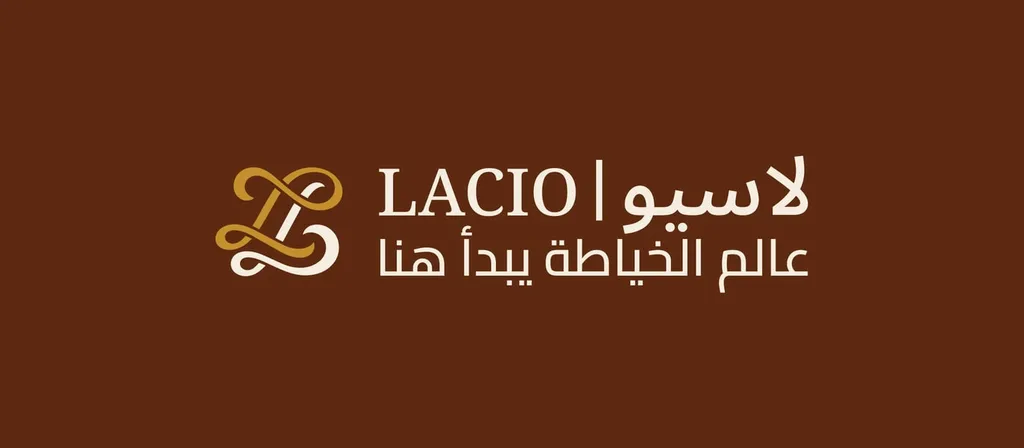
Lacio is a shop for sewing and tailoring supplies in Iraq. Its name comes from “lace,” and we designed its identity in Arabic and English from the start. Held against the portfolio checks above:
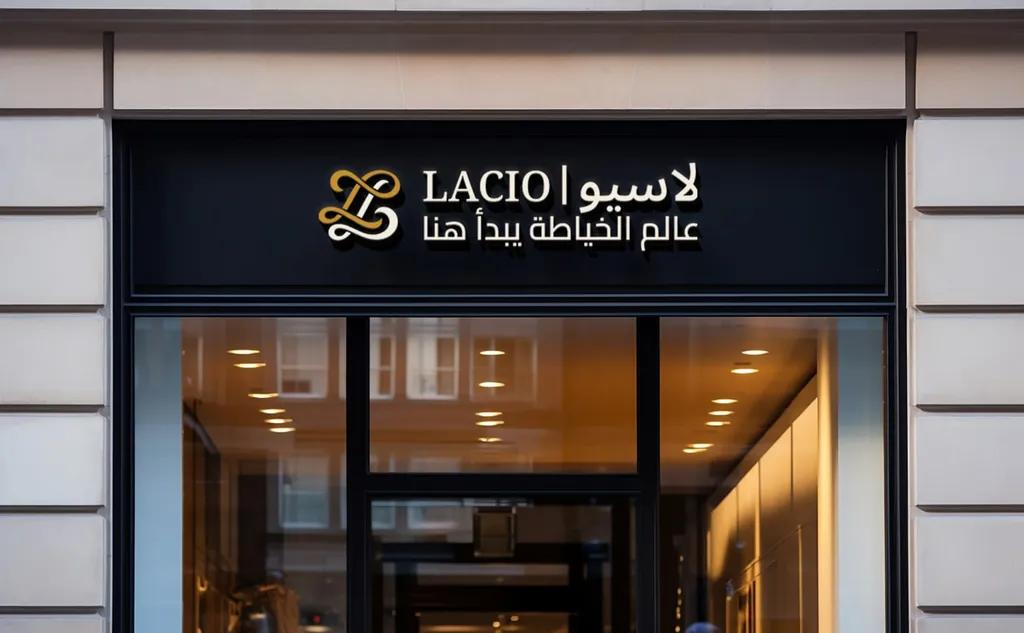
- Drawn as one lockup. The symbol sits beside the English name and the Arabic name, divided by a thin line, with an Arabic tagline underneath.
- Correctly joined Arabic. The name is transliterated as لاسيو, so it sounds the same in both languages, and it opens with the lam-alef ligature.
- A reason for the style. Montserrat for English and Cairo, a Kufi-based Arabic, as a matched pair in four weights.
- Real use. The same lockup runs on the shop sign, bags, stationery, ID badges and social posts. The full breakdown is in the bilingual brand article.
Closest work for the Gulf: Lyvio
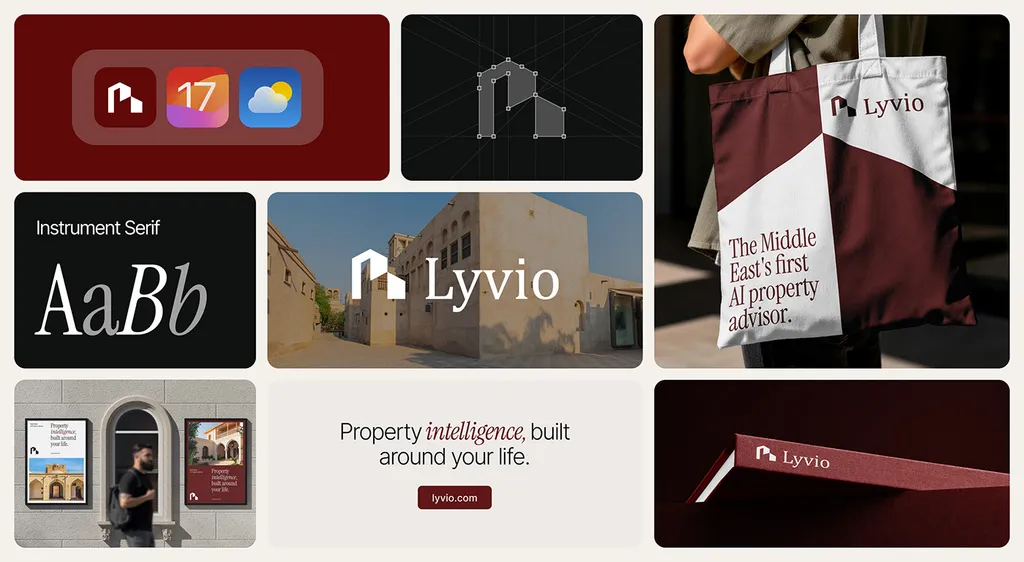
Lyvio is an AI property platform that recommends homes based on how people live. We designed its brand identity, app and website for the Middle East market. Its identity is in English script, so it isn’t a bilingual example. It shows the other half of the job: a doorway-shaped mark, a warm burgundy palette, Instrument Serif with Inter Tight, and a calm, personal voice, carried through the app, the website, print, posters and social. When you hire for the Gulf, look for both halves: Arabic craft, and a system that holds together across every touchpoint.
Common mistakes in hiring an Arabic logo designer
- Hiring for the English and hoping the Arabic follows. The Arabic gets typed in at the end, and it shows.
- Judging the Arabic by how it looks to someone who can’t read it. Pretty Arabic can still be misspelled, broken or unreadable at small sizes.
- Treating calligraphy and a logo system as the same job. A beautiful Thuluth composition still needs lockups, small versions and files for a sign maker.
- Accepting Arabic that is always smaller and lighter. It tells Arabic-reading customers which language came second.
- Letting the sign maker or developer retype the Arabic. Give them the logo files. Retyped Arabic is where broken letters creep back in.
- Searching only the English for trademarks. The Arabic form can collide with an existing mark too.
Checklist before you hire
- I know whether I need a calligrapher, a designer who adds Arabic, or a bilingual brand designer.
- The portfolio shows Arabic drawn to match the English, not typed underneath.
- The Arabic letters connect, the dots are intact and nothing is letter-spaced.
- At least one bilingual project is in real use.
- The designer can explain which Arabic style and font they used and why.
- I know who reads the Arabic natively, and I have native speakers in my market lined up to review the name.
- The font license covers logo use, and I know who buys it.
- The lockups I’ll get are listed: side by side, stacked, Arabic only, English only, Arabic above English.
- I’ve searched the Arabic and English forms, and my lawyer knows what to file.
- The proposal gives one price, one timeline, the revisions and who owns the files.
How I work with Arabic and English logos
The bilingual logo design service gives you an Arabic and English logo designed side by side and matched in stroke weight and contrast. You also get your name in Arabic letters, transliterated or translated, for native speakers in your market to confirm, and side-by-side, stacked and single-script lockups, including Arabic above English for shopfronts. On top of that come an Arabic and Latin type pairing, mockups on right-to-left screens, and SVG, PDF and PNG files for every lockup in color and in black and white.
It takes 1–2 weeks, with three revision rounds and weekly check-ins in your time zone, and you own all the final files. Brand strategy, naming, trademark filing and website builds aren’t included. If you’re designing a new logo or identity, Arabic and English come at the same package price: $999 for the logo package, $3,499 for brand identity. I sign an NDA if you ask.
Book a free 30-minute call and bring your English name, the Arabic spelling you’re considering (if you have one), and a photo of where the logo has to work first: a shopfront, an app icon or a label.
FAQ
What should I look for in an Arabic logo designer?
Arabic drawn to match the English rather than typed underneath it, connected letters with intact dots, a clear reason for the Arabic style, lockups for both reading directions, and at least one bilingual project in real use. Ask who reads the Arabic natively and which font the Arabic is built on.
Does my Arabic logo designer need to be a native Arabic speaker?
Not necessarily, but someone has to read the Arabic natively. The designer needs to know Arabic letterforms, joins and ligatures. Native speakers in your market check the spelling and meaning. Even a native-speaking designer should have a second reader from your market.
What’s the difference between Arabic calligraphy and an Arabic logo?
Calligraphy is hand lettering in a classical style such as Thuluth or Diwani. A logo is a system: a mark that works small, in one color, beside English, on a sign and on a screen. A calligraphic mark can be a logo, but it still needs that system built around it.
Can I use a free Arabic font in my logo?
Often, yes. Fonts under the SIL Open Font License, which covers many Arabic families on Google Fonts, can be used in logos without extra permission. Commercial fonts each have their own license, and some forbid modifying the font, so check before the designer redraws any letters.
How much does an Arabic logo designer cost?
It depends mostly on who you hire and whether the Arabic is designed or typed. My UAE logo cost guide gives AED ranges by provider type. With me, Arabic and English are included at the same package price: $999 for a logo, $3,499 for a brand identity.
Do I need to trademark the Arabic version of my logo?
Ask your lawyer. They’ll advise whether to file the Arabic, the English or a combined lockup with the UAE Ministry of Economy and Tourism or Saudi Arabia’s SAIP. Either way, search the Arabic form before you commit, not only the English.
Sources