How to Brand a Coffee Shop: Cups, Signs and What People Remember
Coffee shop branding built around one thing people remember: how to choose it and carry it to the cup, sign, menu and delivery tile, with costs and Gulf rules.

Summarize with AI
Key takeaways
- Choose one distinctive asset (a color, a character, a pattern, a phrase or a shape) and make it impossible to miss.
- Design the cup first. It is the brand’s most-seen medium, and it is small, curved and printed in few colors.
- The sign is read from a distance and, in Saudi Arabia and Dubai, has rules. Plan the lockup for them.
- The menu and the delivery tile are where customers decide. Keep them clear, and leave room for required information.
- In the Gulf, design the Arabic and English names together, and check the name against the trade-name rules.
Coffee shop branding works when it picks the one thing customers will remember (a color, a character, a cup shape or a phrase) and puts it everywhere they look. People don’t remember a café’s whole brand; they remember that one thing. So start with the cup, because it leaves the shop in people’s hands and shows up in their photos, then carry the same asset to the sign, the menu and the delivery app tile, in Arabic and English where the market needs both. The logo matters, but it is usually the vehicle for the one thing, not the thing itself.
I’m Masuder Rahaman, a brand designer and the founder of Wolfpixel, where I lead the design team. I design brand identities and packaging for cafés, restaurants and food brands in Saudi Arabia, the UAE and the US, remotely. Tong, a coffee shop identity on my site, is the worked example below, and the last sections cover the cost, a checklist and the mistakes to avoid.
What makes a coffee shop brand memorable?
One distinctive asset, used boldly and the same way everywhere. Think of the cafés you remember without trying. You probably recall a red cup, a cartoon character, a striped awning or a line on the wall, not the exact shape of the logo. That is the asset doing its job.
A café’s distinctive asset can be:
- A color, used boldly on cups, the fascia and uniforms, so it is recognizable across a street.
- A character or mascot, drawn simply enough to work on a sticker and a sleeve.
- A pattern, printed on cups, wrapping paper and tiles.
- A phrase or voice, on the sleeve, the menu and the wall.
- A shape, of cup, sign or interior detail.
How to choose it. Start from the feeling customers should leave with: fast and friendly, slow and serious about coffee, playful, neighborhood. Then walk the street and look at your competitors’ cups and signs. Choose the asset that fits the feeling and that nobody nearby owns. One is enough. Two can work if one is clearly the lead. Five is a collage.
What usually doesn’t work. A coffee bean, a steaming cup and a script wordmark in brown. They say “café,” which every café already says. Other local businesses have their own version of this, such as the tooth in dental practice branding.
Why design the coffee cup first?
The cup is the café’s most important brand surface. It travels, it gets photographed, and it is in the customer’s hand for the whole visit.
Constraints to design for:
- Curved and small. A wide horizontal logo wraps around the cup and is never fully visible. A compact mark, a character or a pattern works better.
- Few colors. Many cups are printed in one or two colors, especially at low quantities. Make sure the asset works in one color on white, kraft and colored stock.
- Many sizes. Small, medium, large and espresso cups share one design that scales.
- Hot and cold. Paper cups, clear cold cups and lids may come from different suppliers and print processes.
- Sleeves and stickers. At early stages, a branded sleeve or sticker on a stock cup gives most of the recognition for much less.
Check the material rules. In the UAE, a ban on single-use items, including drinking cups and lids, cutlery, plates, straws, stirrers and Styrofoam food containers and boxes, took effect on January 1, 2026, as the second phase of Ministerial Decision No. 380 of 2022. Choose the cup material with your supplier before you design the cold-drink cup.
A cup-first test: put the cup design on a table with five competitors’ cups, photograph them with a phone at arm’s length, and look at the photo. Which cup can you name at a glance?
How should a café sign work?
A café sign has to read from across the street, and in Saudi Arabia and Dubai it also has to follow sign rules. The shopfront tells people what you are before they come in. It is read from across a street or a mall corridor, often at an angle, sometimes at night.
Design for distance. A simple, bold lockup, generous letter spacing, the distinctive color or character, and a lit version.
Saudi Arabia. The Ministry of Municipalities and Housing’s commercial sign requirements (in Arabic) limit a shop sign to the trade name, the commercial registration number and the logo, in raised letters with hidden lighting; other designs need the municipality’s approval. That favors a clean lockup over a busy illustration on the fascia. Put the character on the window, the menu board and the cups instead.
Dubai. Dubai’s shopfront framework allows one trade name, horizontal, with Arabic above English, and its lighting guidelines ask shops to avoid bright white backgrounds. A café whose brand lives on white needs a version on its color. The Dubai page covers the rest of what a Dubai brand needs.
The food and beverage page has the sources for both, and your sign contractor or municipality confirms what applies to your site. This is general information, not legal advice.
What does a café menu board need?
Readability from the queue, and room for the labels the law requires. The menu board is where people decide. Keep it readable from the queue: few categories, clear prices, generous type size, and the brand in the frame rather than in every line.
If you sell from a truck or a cart, the same rules apply outdoors; see food truck branding.
Saudi Arabia. Since July 1, 2025, the SFDA requires cafés and restaurants to show caffeine content (per 100 ml or per cup) on paper and digital menus, with a statement that the maximum daily caffeine intake for adults is 400 mg, a “Salt” icon on items with more than 5 g of salt, and icons showing the activity needed to burn the calories. Design the icon set and the space for it into the menu template, so the board doesn’t look patched later.
United States. Under FDA menu labeling rules, chains with 20 or more locations doing business under the same name, with substantially the same menu, must show calories on menus and menu boards. If you plan to grow, build the template with space for calories from the start. If growth means franchising, franchise branding covers the trademark, standards and templates to lock before you add locations.
How should a coffee shop look on delivery apps?
On delivery apps, your café is a small tile: a logo in a circle and one photo. In Saudi Arabia, the Transport General Authority counted more than 132 million orders in the delivery sector in the second quarter of 2026, up 30.5% on a year earlier, so for many cafés the app is a major storefront.
- Logo in a circle. Test the mark as a circular avatar at small size. A character or monogram usually works better than a long wordmark.
- The hero photo. One photo, shot to your brand’s style, ideally with the cup visible.
- Consistent name. The same name and spelling, in Arabic and English, as on the sign and the trade license.
- The bag. The delivery bag and sticker are the cup’s equivalent for delivery orders.
Naming a café in Arabic and English
In Saudi Arabia and the UAE, design the Arabic and English names and logos together, so the cup, sign and menu read as one brand in both scripts. Two naming points specific to cafés in Saudi Arabia:
- Trade names. Under the trade-name law in force since April 2025, a trade name can be in English, but it needs an Arabic transliteration, and “Saudi” or a city or region name can’t be its main element.
- “Saudi coffee.” In January 2022, the Ministry of Commerce directed (Asharq Al-Awsat, in Arabic) restaurants, cafés and roasters to use the name “Saudi coffee” instead of “Arabic coffee,” and asked businesses not to use “Saudi coffee” as a trade name or trademark. It is a product description, not something to build a name on.
The bilingual logo service covers the Arabic name, the matched wordmarks and the lockups, including Arabic above English for a shopfront. If your café’s name started in English, giving it an Arabic name for Saudi Arabia goes through the choice step by step.
A coffee shop branding example: Tong
Tong is a coffee shop built around one idea: “Coffee isn’t just a drink, it’s an adventure.” It set out to break the monotony of traditional cafés with bold flavors and playful energy.
The one thing people remember is red, and a character. The logo is bold, funky handwritten lettering, joined by a cast of doodles led by the Coffee Rebel, described as “loud, bold and never afraid to break the rules.” Red runs across the shopfront, the cups, the paper bags, a pattern wrapping paper, a tote, a sweatshirt and a T-shirt, a phone case, a business card, stickers, posters, social posts and a billboard across a train station. A clean, modern font handles body text, with a retro display face for posters and merch, and lines like “No bad days, just good coffee” and “Let’s talk coffee!” carry the voice. There is even a branded pour-over dripper.
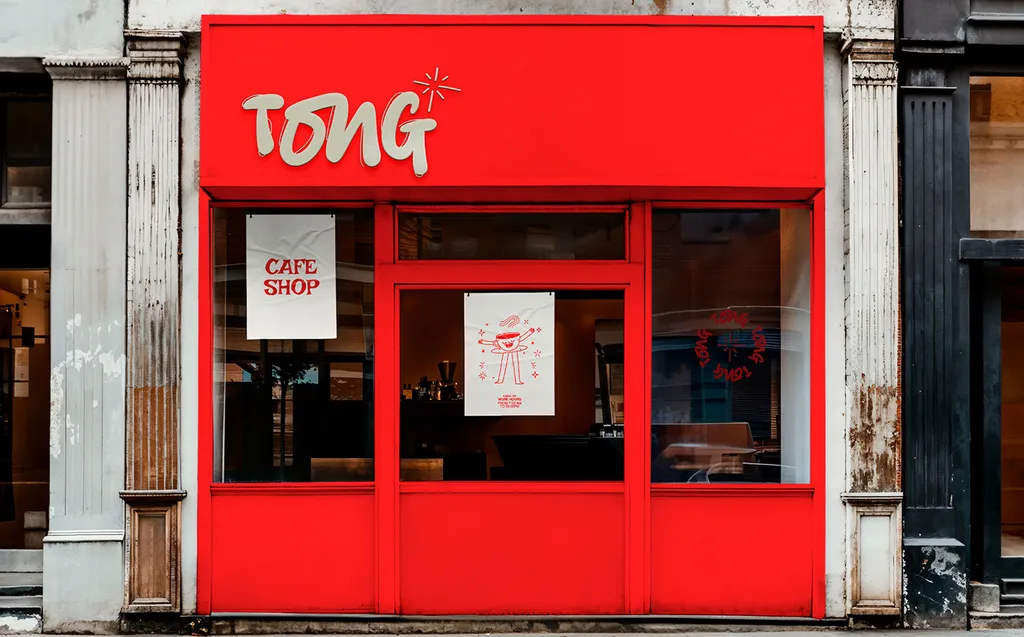
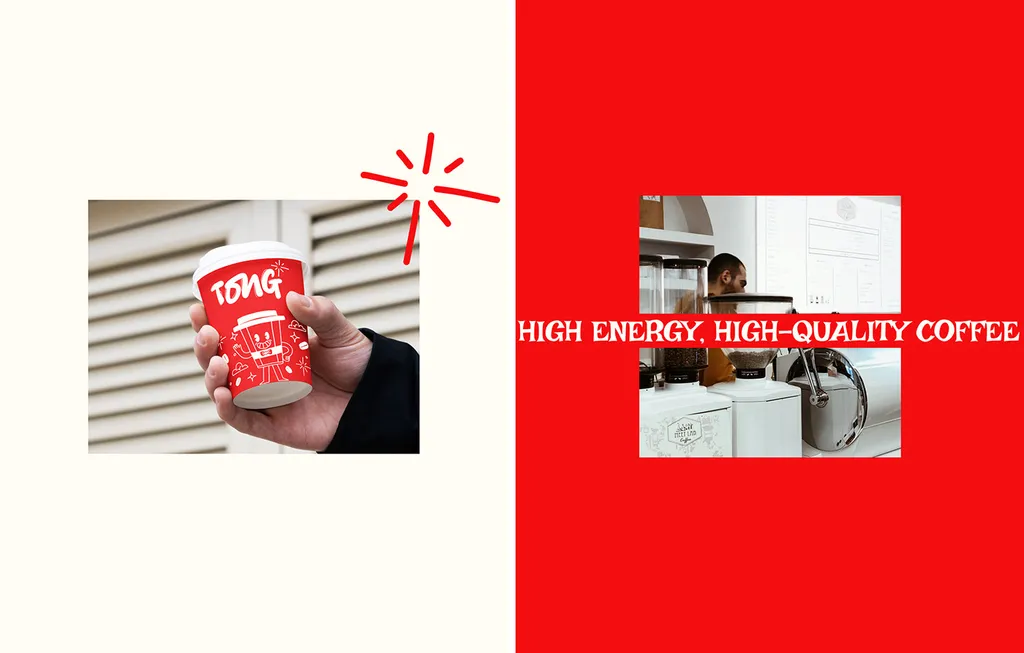
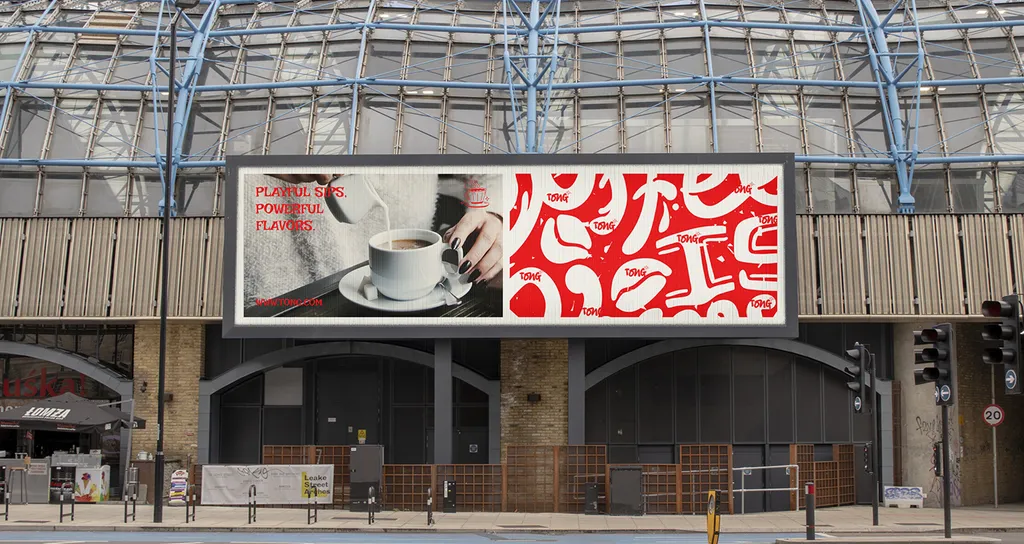
The lesson for a new café is commitment: one color and one character, used on everything, so a red cup in someone’s hand on the street is recognizably Tong. See the Tong case study, or more hospitality brands and food and drink packaging in my work.
Café branding mistakes to avoid
- A bean, a steaming cup and brown script. The category, not the café.
- A wide wordmark on the cup. Half of it is always around the back.
- A logo that only works on white. Dubai asks shopfronts to avoid bright white backgrounds, and kraft cups shift colors.
- Five brand ideas at once. A character, a pattern, a slogan, a color and an illustration style, all competing.
- A menu with no room for required icons or calories. Patched later with stickers.
- Arabic added at the end. A typed Arabic name under a designed English logo.
- A different name on the delivery app. Customers search for the name on the sign.
Coffee shop branding checklist before you open
- One distinctive asset chosen, and checked against nearby competitors
- Logo, plus a compact mark or character for cups and app avatars
- Cup design tested in one color on white, kraft and colored stock, at every size
- Cup material confirmed against local rules (single-use items in the UAE)
- Sign lockup that fits local rules, with a lit and an on-color version
- Menu template with room for caffeine and salt icons (Saudi Arabia) or calories (US chains)
- Delivery tile: circular avatar, hero photo, same name and spelling
- Bags, stickers and sleeves in the same system
- Arabic and English names and logos designed together, if you are in the Gulf
- Guidelines and source files for your printer, sign maker and cup supplier
How much does coffee shop branding cost?
With me, a full café brand identity is $3,499 and a logo alone is $999; cups and other packaging are quoted by scope. A brand identity for a café takes two to three weeks: strategy, logo, type, color, imagery, voice, guidelines and a Figma library, shown on a cup, a sign, a menu and an app tile, in Arabic and English where needed. A logo on its own takes one to two weeks. All packages are on the pricing page, and what a brand identity costs compares market ranges if you are weighing other quotes. Cups, bags, sleeves and coffee-bag ranges can be added as packaging design, two to four weeks, quoted by scope, with print-ready files on your supplier’s dieline. Naming, with a preliminary trademark search, takes one to two weeks. I work remotely with calls in your time zone; proposals are in USD, or in AED or SAR in the Gulf. I don’t produce signs or cups; your sign maker and suppliers do, with clean files from me.
If you are opening a café, book a free 30-minute call and bring photos of the street or mall where it will be, and of the two cafés nearest to it. We will start by finding the one thing nobody there owns.
FAQ
What is coffee shop branding?
Coffee shop branding is the name, logo, color, type, voice and the one distinctive asset (a color, a character, a pattern, a phrase or a shape) that customers remember, used the same way on the cup, the sign, the menu and the delivery tile.
What should a coffee shop brand identity include?
A logo and a compact mark, color, type, imagery and voice, applied to cups, sleeves, bags, the shopfront, the menu board, the delivery app tile, uniforms and social, with guidelines and source files.
How do I design a café logo?
Start from the feeling customers should leave with, check competitors nearby, then design a mark that works on a small curved cup in one color, as a circular app avatar and on a sign read from across the street. Avoid beans, steam and brown script.
Do café signs have rules in Saudi Arabia and Dubai?
Yes. In Saudi Arabia, shop signs are generally limited to the trade name, the commercial registration number and the logo, in raised letters, with other designs needing approval. In Dubai, a shopfront shows one trade name, horizontal, with Arabic above English, and shops are asked to avoid bright white backgrounds.
Does a café menu need special labels?
In Saudi Arabia, since July 2025, menus must show caffeine content with a note on the 400 mg adult daily maximum, a salt icon on high-salt items and activity icons. In the US, chains with 20 or more locations must show calories. Leave room in the menu template.
How much does coffee shop branding cost?
With me, a café brand identity is $3,499 and takes two to three weeks; a logo alone is $999 and takes one to two weeks. Cups and other packaging are quoted by scope after a free call.
Sources
- SFDA: The SFDA Issues Three New Regulations to Promote Healthy Community Nutrition (February 2025)
- Ministry of Municipalities and Housing: Commercial sign requirements (Arabic)
- Dubai Media Office: Shopfront advertising framework continues to enhance quality of Dubai’s urban landscape (May 2026)
- Gulf News: UAE to ban more single-use plastic items from January 2026 (December 2025)
- FDA: Menu Labeling Requirements