Bakery Branding: From Logo to Pastry Box and Shelf Label
Bakery branding, piece by piece: the one asset people recognize, the logo, pastry boxes, bags and seals, display case labels and allergen labels for the US and UK.

Summarize with AI
Key takeaways
- The box is a bakery’s most-seen brand surface. Design the box, bag and sticker system early, not after the logo is “done.”
- Choose one distinctive asset a customer can spot from across the room: a box color, a seal, a tape, a pattern on the tissue, a drawing of your signature bake.
- A full package is the core identity (strategy, logo, color, type, voice, guidelines) plus a packaging scope: print-ready boxes, bags, stickers and labels.
- Leave room for the rules: nine major allergens in the US (sesame since 2023), a full ingredients list with emphasized allergens for UK food prepacked for direct sale, Arabic labels in Saudi Arabia.
- Plan the custom-cake, seasonal and wholesale versions from the start, so the system flexes without a redesign every December.
Bakery branding is your bakery’s logo, color, type and voice, carried onto the things customers actually take home: the pastry box, the bread bag, the sticker that seals it, the label in the display case and on the shelf. A full package is the core identity (strategy, a logo and a compact mark, color, type, voice, guidelines) plus a packaging scope that turns it into print-ready boxes, bags, stickers and labels. For a bakery, the box does what the cup does for a café: it leaves the shop, sits on desks and dinner tables, and gets photographed. So design the box system early, build every label with room for allergens and ingredients, and choose one asset people will recognize from across a room.
I’m Masuder Rahaman, a brand designer and the founder of Wolfpixel, where I lead the design team. I design brand identities and packaging for food and beverage brands, working remotely with calls in your time zone. There is no bakery case study on my site yet, so the examples below are my closest work: ChocoBloom’s chocolate bars and Tong’s café packaging.
The one thing people recognize
Customers don’t remember a bakery’s full identity. They remember the pink box, the striped tape, the gold seal, the drawing of a croissant on the bag. That one thing is the distinctive asset. I wrote about choosing one for cafés in café branding and for trucks in food truck branding; for a bakery the candidates are different, because your brand travels on paper and card, not on cups.
Good distinctive assets for a bakery:
- A box color. One strong color on every box, bold enough to spot on an office desk.
- A seal or stamp. A round sticker that closes the box or bag. It is cheap, works on stock packaging and doubles as a rubber stamp for kraft bags.
- A tape or ribbon. Printed tape or a colored ribbon on every cake box.
- A pattern. On tissue, wrapping paper or inside the lid, so opening the box feels like a gift.
- A drawing of your signature bake. Your sourdough or cardamom bun, drawn in one style and used on the bag, the window and social posts.
How to choose. Start with what you are famous for, or want to be: a dark-crust sourdough, a neighborhood breakfast bakery, a wedding-cake studio, a French patisserie. Then line up the boxes and bags from the bakeries nearest to you, and choose the asset that fits your feeling and that nobody nearby already owns. If they all use white or kraft with a small sticker, a committed color or seal stands out quickly.
What usually doesn’t work. A wheat sheaf, a whisk, a rolling pin or a chef’s hat in brown script. They say “bakery,” which every bakery already says.
What a full bakery identity package includes
| Part | What it includes | Why a bakery needs it |
|---|---|---|
| Strategy | Who you sell to, what you are known for, your feeling and your distinctive asset | Decides the box color, the voice and what goes on the bag |
| Logo system | Primary logo, a compact mark or seal, a one-color version | The seal closes boxes and bags; the one-color version works as a rubber stamp and on kraft |
| Color and type | A palette with print values, a display face and a readable text face | Box board, kraft and stickers shift color; labels need legible type at small sizes |
| Imagery and illustration | A photo style for your bakes, optional drawings of signature products | Your bakes are the product; consistent photos sell them online and in the window |
| Voice | How you name products and write labels, signs and posts | Product names and short descriptions on case labels |
| Packaging system | Pastry box, cake box, bread bag, paper bags, stickers and seals, tape, tissue | The most-seen surfaces of the brand |
| Labels | Display case labels, shelf labels, packaged-product labels, wholesale labels | Where customers choose, and where the rules apply |
| Store and digital | Shopfront lockup, window, menu board, social templates, online-order avatar | The first impression before anyone tastes anything |
| Guidelines and files | Brand guidelines and source files for your printer and packaging supplier | So the next box, label or sign matches the first |
With me, the strategy, logo system, color and type, imagery, voice and guidelines are the brand identity package. The boxes, bags, seals and labels are packaging design, quoted by scope, with print-ready files on your supplier’s dieline. Signs, menus and social templates are agreed in your proposal. For a deeper list of identity files, see the brand identity deliverables checklist.
The packaging system: box, bag, sticker, wrap
Treat your packaging as one system whose parts share the same asset. The parts most bakeries need:
- Pastry box. The lid is your billboard. Put the asset here, big.
- Cake box. Often a stock size. If custom printing is too expensive at your volume, a printed band, tape or large seal on a plain box does most of the work.
- Bread bag or band. A paper bag, or a printed band around a wrapped loaf, with the bread’s name readable.
- Paper carrier bags. One or two sizes, with the asset large enough to read from across a street.
- Stickers and seals. The cheapest high-impact item: a round seal for closing, a rectangular sticker for product names.
- Tissue, wrap and tape. The opening moment, especially for patisseries and gift boxes.
Design to your supplier’s dielines. Ask your packaging supplier for the dielines (the flat templates) of the box and bag sizes you will order, and design on those. Ask, too, how many print colors are affordable at your quantities. A design that only works in four colors on a custom box is no use if your first order is stock boxes with a sticker.
Plan for grease and heat. Butter-rich pastries mark paper and card. Ask your supplier about board and coatings for oily or warm products, and check the colors on the actual board, not only on screen.
Display case and shelf labels
The display case is where customers decide, often in a queue, in a few seconds. Case labels are a brand surface you design once and print every week.
A good case label system:
- Name first. The product name in the largest type, in your voice (“Morning bun,” not “Cinnamon pastry item”).
- One short line. What makes it good: “Brown butter, sea salt.”
- Price. In the same place on every label.
- An allergen line. A consistent spot for allergens or a “Contains” note, so it never looks patched on.
- Readable under glass. Matte stock, strong contrast, type large enough to read from the queue.
- Easy to update. A template your team can fill in and print, because the case changes daily.
Shelf labels for packaged goods (granola, cookies in jars, sliced loaves) follow the same system, smaller.
Allergen and ingredient labels on packaged baked goods
Once you package a product before the customer orders it, food labeling rules apply, and your design has to leave room for them. This is general information, not legal advice; your food safety advisor or regulator confirms what applies to your products.
United States. Packaged foods must declare the major food allergens. Since January 1, 2023, under the FASTER Act, sesame is the ninth, alongside milk, eggs, fish, crustacean shellfish, tree nuts, peanuts, wheat and soybeans, according to the FDA. The allergen’s source is named either in parentheses after the ingredient or in a “Contains” statement right after or next to the ingredient list, unless the ingredient’s common name already names it. The FDA says these requirements extend to retail and food-service establishments that package, label and offer products, but not to food placed in a wrapper or container after a customer’s order at the point of purchase. So the croissant bagged at the counter is different from the box of cookies packed that morning and set on a shelf. If you bake at home, check your state’s cottage food rules too.
United Kingdom. Since October 1, 2021, Natasha’s Law has required food prepacked for direct sale (PPDS) in England, Wales and Northern Ireland to carry the name of the food and a full ingredients list, with allergens emphasized, according to the Food Standards Agency’s guidance for bakers. The emphasis can be bold type, capital letters, contrasting colors or underlining. The guidance gives bakery examples: a cake completely wrapped in cling film, rolls in a sealed bag and leftover cupcakes boxed before anyone orders them are PPDS; loose loaves on shelves, slices of cake packed at the customer’s request and a cake on an open tray are not. Home bakers who sell in person are covered too. The UK list has 14 allergens, including celery, lupin, mustard, sesame, and sulphur dioxide and sulphites, so a US template doesn’t carry over unchanged.
Saudi Arabia. The SFDA points to its technical regulation SFDA.FD/GSO 9,“Labeling of Prepackaged Food Stuffs”: labels must be in Arabic, and any other language sits alongside it with identical information. If you sell packaged goods in Saudi Arabia, design the Arabic label panel with the English one, not as a sticker added later. For the UAE and other Gulf markets, check the current rules with the relevant food authority.
What this means for the design:
- A fixed label zone. Every packaged-product label gets a back or side panel sized for the full ingredients list and allergen statement, with type that is readable, not squeezed.
- An emphasis style. Pick one way to emphasize allergens (bold is the simplest) and put it in the guidelines, so every label your team prints matches.
- A template, not one-off labels. Set type sizes keep every new bake’s label consistent and readable.
- Bilingual from the start, where needed. Arabic and English panels designed together, with matched type.
Custom cakes and seasonal ranges
Custom cakes and seasonal ranges are where bakery brands lose consistency fastest. Each Ramadan box and holiday tin gets designed in a hurry, and a year later the shelf looks like five different shops.
Build the flex into the system:
- A base box with a changeable element. Keep the box and seal constant; change a band, a tape color or a sticker for each season or occasion.
- A seasonal color slot. Your guidelines can define one seasonal accent that sits next to your main color, for Christmas, Eid, Valentine’s Day or summer.
- A custom-cake card. A printed tag with space for the name and care notes, so even the most personal order looks like yours.
- Gift boxes. A premium version (a rigid box, tissue, a ribbon) for holidays and corporate orders, using the same asset.
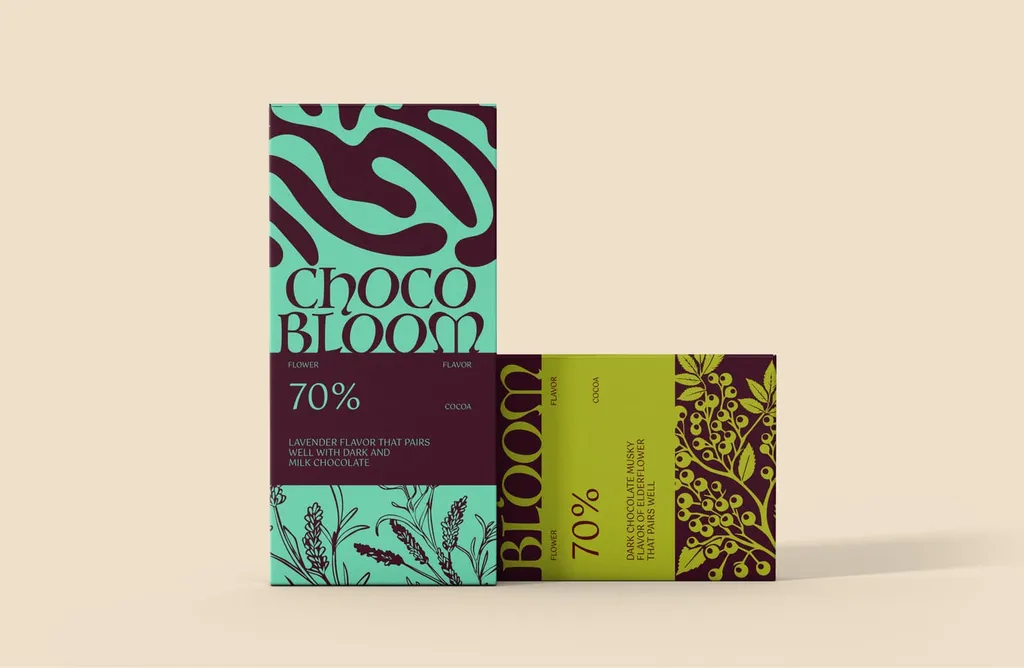
ChocoBloom, below, is a useful model here: two flavors, one wrapper system, and a color pair for each flavor.
Wholesale and café-supply labels
If you supply cafés, delis or grocers, your bread or pastry is packed at your bakery and sold somewhere else, often next to other brands. That changes the labeling question.
- In the UK, the FSA’s guidance for bakers says food packed at a different site from where it is sold is not PPDS, but it still needs a label with the name, the ingredients and the allergens. If a multipack is split to sell its packets one by one, each packet needs its own label.
- In the US, bread or pastry you package for another business to sell is packaged food, so plan the allergen declaration into its label.
- Your brand still has to show. A stand-up card or a “Baked by” sticker on the wrap keeps your name in front of the café’s customer.
- A wholesale label template. The product name, ingredients, allergens, your business name and contact, and space for a date.
Closest work: food and packaging brands
ChocoBloom: one wrapper system, a color pair per flavor
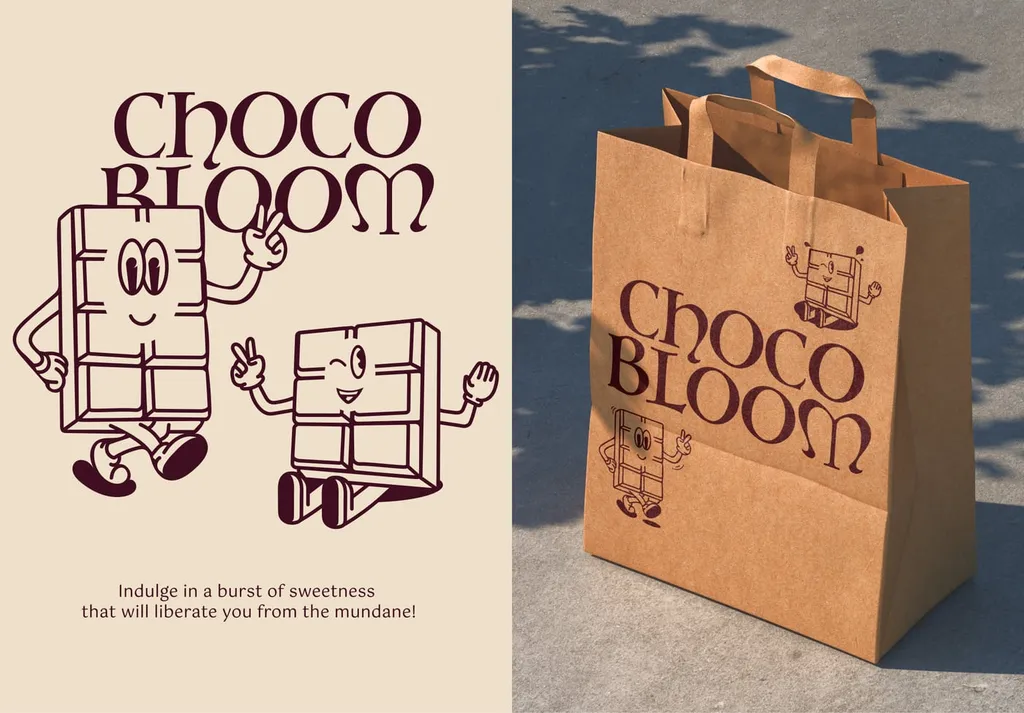
ChocoBloom, a chocolate shop in France, was launching a new bar in two flavors: elderflower and lavender. We created two cheerful chocolate bar characters and a vibrant yet muted palette of soft greens and pinks. The 70% bars are wrapped in bold swirls with a botanical drawing of each flavor, and each flavor has its own color pair: mint and plum for lavender, lime and plum for elderflower. The work went past the wrappers to a kraft paper bag, a tote, a thank-you card and campaign lines like “Go for it. You deserve it!”
For a bakery, the lesson is the range logic. A summer pastry box and a holiday one can differ like two flavors and still read as one brand, because only the color pair and the drawing change.
Tong: wrapping paper, bags and boxes in one color
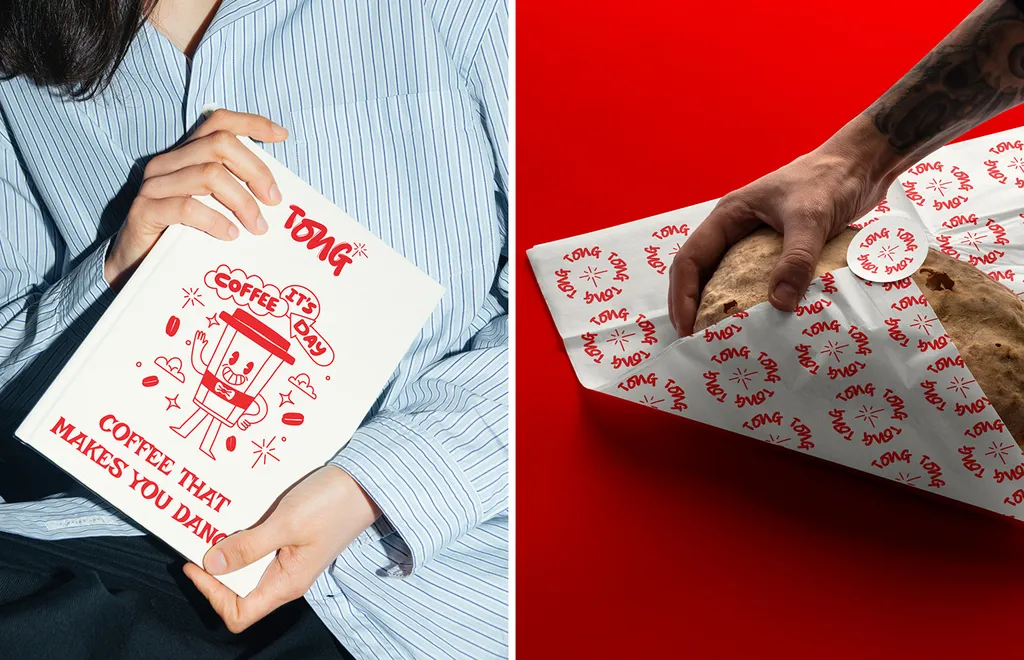
Tong is a coffee shop identity, so the cups and shopfront are covered in café branding. The part that matters for bakeries is the packaging around the food: red paper bags, pattern paper for wrapping sandwiches and boxes, and a red tote shown next to a croissant illustration, all designed to be easy to spot in a hand or on a street.
The lesson for a bakery is the pattern paper. A printed wrap turns a plain box or loaf into a branded one without paying for fully printed boxes.
Common mistakes in bakery branding
- A wheat sheaf, whisk or chef’s hat in brown script. It shows the category, not your bakery.
- A logo that only works in full color. Stickers, stamps and kraft bags need a one-color version.
- Designing on a generic box, not your supplier’s dieline, so the logo lands on a fold or under the tuck flap.
- No room for allergens. Ingredients squeezed into tiny type, or a sticker slapped over the design.
- A US label template used in the UK, or the reverse. The allergen lists and rules differ.
- Arabic added at the end. A typed Arabic panel next to a designed English one.
- Every season redesigned from scratch. Five years of holiday boxes that look like five bakeries.
- Wholesale products with no brand. Your croissants in someone else’s café, with nothing that says they are yours.
Checklist: a bakery brand ready to open or expand
- One distinctive asset chosen, checked against the bakeries nearest to you
- A logo, a compact mark or seal, and a one-color version for stamps and kraft
- A palette checked on your actual box board, kraft and sticker stock
- Pastry box, cake box, bread bag, carrier bag, seal and tape designed on your supplier’s dielines
- A display case and shelf label template with the name, a line, the price and an allergen spot
- A packaged-product label template with a fixed zone for ingredients and allergens
- Allergen rules checked for each market you sell in (the US, the UK, Saudi Arabia or elsewhere), with your advisor
- Seasonal and custom-cake versions planned: a changeable band, tape or color slot
- A wholesale label and a “Baked by” card for cafés and grocers
- Arabic and English panels designed together, if you sell in the Gulf
- Guidelines and source files for your printer, packaging supplier and team
How a bakery brand project works with me
A brand identity for a bakery, as for any food and beverage brand, is $3,499 and takes two to three weeks: strategy, logo, type, color, imagery, voice, brand guidelines and a Figma library, with unlimited revisions within the agreed scope. A logo on its own is $999 over one to two weeks, with three revision rounds. Boxes, bags, seals, labels and seasonal ranges are packaging design: two to four weeks, quoted by scope after a free call, with three revision rounds and print-ready files on your supplier’s dieline. If you sell in Saudi Arabia or the UAE, the Arabic and English name and logo are designed together at the same price. All the packages are on the pricing page. I work remotely, with weekly check-ins in your time zone, and you own all the final files.
If you are opening, expanding or rebranding a bakery, book a free 30-minute call and bring photos of your current boxes and bags (or the stock ones you plan to use), your supplier’s box sizes and a photo of your display case. We will start by finding the one thing your customers should recognize from across the room.
FAQ
What should a bakery branding package include?
A strategy, a logo with a compact mark or seal and a one-color version, color, type, imagery, voice and brand guidelines. Then the applications: pastry and cake boxes, bread bags, carrier bags, stickers and seals, tape and tissue, display case and shelf labels, packaged-product and wholesale labels, the shopfront, the menu board and social templates.
How much does bakery branding cost?
It depends on the scope. With me, a bakery brand identity is $3,499 and takes two to three weeks, and a logo alone is $999 over one to two weeks. Packaging (boxes, bags, labels) is quoted by scope after a free 30-minute call and takes two to four weeks.
What should be on a bakery label?
On a display case label: the product name, a short description, the price and an allergen note. On packaged products: whatever your market requires. In the US that includes declaring the nine major allergens; in the UK, food prepacked for direct sale needs the name and a full ingredients list with the 14 allergens emphasized. Check the rules for your products with your food safety advisor or regulator.
Do I need allergen labels on bakery boxes?
It depends on when the food is packed. In the US, the FDA’s allergen labeling rules don’t apply to food placed in a wrapper or container after the customer orders it, but they do apply to products you package in advance. In the UK, a box packed before the customer selects it is generally prepacked for direct sale and needs a full label; a slice of cake packed at the customer’s request does not. This is general information, not legal advice.
What colors work for a bakery brand?
Any color you can own locally and print well on your box board and kraft. Many bakeries use white, kraft and brown, so a committed color, such as a deep green, a pink or a blue, stands out. Choose it with the competition in front of you, and test it on the real packaging stock.
Can a home bakery get a full brand identity?
Yes. A home baker going commercial needs the same core identity, often with a simpler start: a logo, a seal sticker for stock boxes and bags, and a label template with room for ingredients and allergens. Packaging can grow as volumes justify custom printing. Check your local rules for selling food from home.
Sources
- FDA: The FASTER Act: Sesame Is the Ninth Major Food Allergen
- FDA: Food Allergies (allergen labeling requirements)
- Food Standards Agency (GOV.UK): Prepacked for direct sale (PPDS) allergen labelling changes for bakers
- Food Standards Agency (GOV.UK): Allergen guidance for food businesses
- SFDA: Is it allowed to write the food product label in English (only)?