Logo, identity or guidelines: what to ask for first
Not sure what to brief a designer for? Start with this simple order.

Summarize with AI
Key takeaways
- Ask for a logo to test an idea, a brand identity to launch or raise, and brand guidelines when an identity you already have is used by more people.
- Write a one-page brief first: what you sell, who it’s for, where the brand will appear, who decides, timing and budget.
- Before you approve a name or logo, search the trademark records in every market you sell in, and get the copyright assigned to you in writing.
Start with a short brief. Then ask for a logo if you’re testing an idea, a brand identity if you’re launching, raising or entering a new market, and brand guidelines if you already have an identity that more people are starting to use. Whichever you choose, check the name and the mark before you approve them, and put ownership in writing. Here’s how to tell which one you need, and what to ask for.
The short answer: a simple order
For most startups, this order avoids paying for the same work twice:
- A one-page brief. It forces the decisions a designer can’t make for you.
- A name and trademark check, before you fall in love with a logo.
- A logo, or a full brand identity, depending on where you are.
- Brand guidelines, once the identity is settled and other people start using it.
- Templates and design tokens, as the team and the product grow.
Logo, brand identity and guidelines in plain words
- A logo is the visual signature of your company. Atlassian’s design system puts it simply: it can be a word, an image, or a combination of both.
- A brand identity is the whole system around the logo: color, typography, imagery, icons and voice, built to work together. The American Marketing Association calls it the visual and symbolic elements that represent a brand. Our guide to what a brand identity includes lists every part.
- Brand guidelines are the rulebook for an identity that already exists: how to use the logo, the colors and the type, with examples, so everyone applies it the same way.
As a rough guide, a focused logo project takes 2–4 weeks, a full brand identity 4–10 weeks, and guidelines for an existing identity 2–4 weeks.
When a logo is enough
A logo on its own is a sensible start when:
- You’re testing an idea, running a pilot or building a side project.
- You have one or two places to show it, such as a landing page and social profiles.
- Your budget is small and you accept that you’ll extend it, or redo it, later.
Ask for more than a single file: the primary logo, the symbol on its own, one-color and reversed versions, two or three colors, one or two fonts, and files in SVG, PDF and PNG.
When you need a full brand identity
Go for the full identity when the brand has to work in many places at once:
- You’re launching a product, raising money or hiring.
- You need a website, an app, a pitch deck, packaging or signage.
- You’re entering a new market. In the UAE and Saudi Arabia, that often means an Arabic and English version of the brand.
A logo without a system tends to be stretched, recolored and paired with random fonts as soon as a second person uses it. An identity gives every touchpoint the same building blocks. For SpareCharge, an EV charging startup, the brand, the app UI and a design system with tokens were designed together in eight weeks, so the product and the marketing looked like one company from day one.

A full identity in use: the Wayfare logo, colors, icons, imagery and line working together.
When to ask for brand guidelines
Ask for guidelines on their own when your logo and identity work, but they’re used inconsistently. Typical signs: new hires or agencies keep asking for the logo, colors vary between the website and the deck, or a second product needs to fit the family.
Good guidelines usually cover:
- Brand core: what you do, for whom, and your positioning in a sentence or two.
- Logo: versions, clear space, minimum size and what not to do.
- Color and typography: exact values and a hierarchy.
- Imagery and icons: the style, with good and bad examples.
- Voice and tone: how you sound, with examples.
- Applications: templates for social, decks, documents and signage.
- Who to ask: one owner who approves new uses.
They don’t have to be a thick book, and a starter guide can be just a few pages. Three public examples are worth a look. NASA’s Graphics Standards Manual, designed by Danne & Blackburn in 1975 and issued in January 1976, set the rules for everything from stationery to spacecraft, and NASA still publishes brand guidelines today. Mailchimp’s content style guide shows how to write down a voice. Spotify’s design guidelines show how a brand explains logo use to its partners.
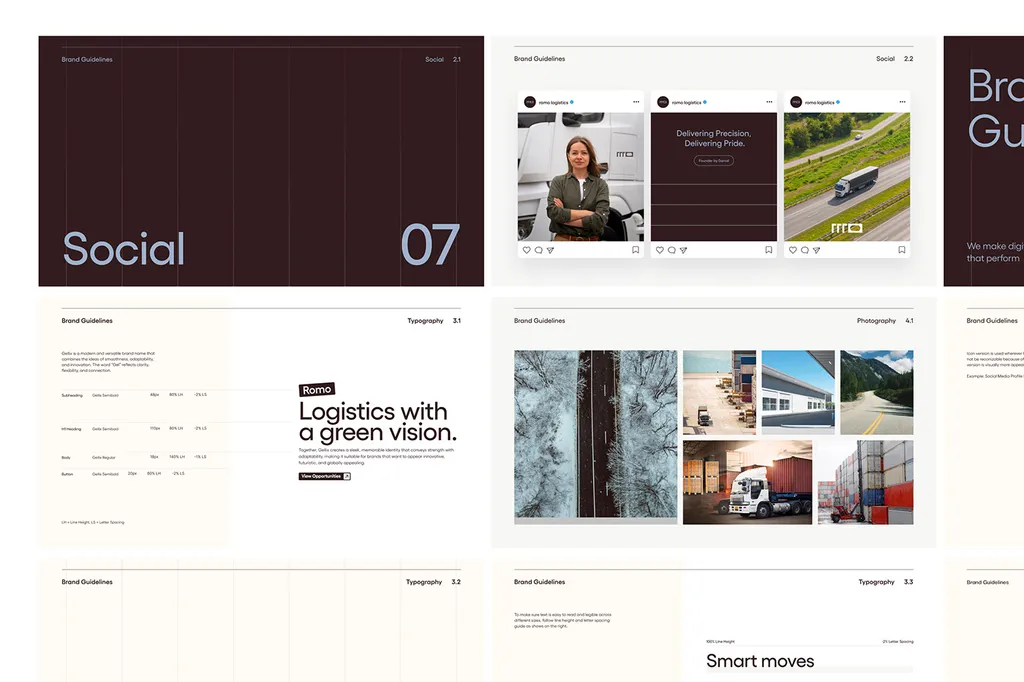
Guideline pages for social, typography and photography from the ROMO Logistics identity.
Write a one-page brief first
The UK Design Council puts it plainly: a designer can only be as good as the brief. In its Double Diamond process, the brief is what the first half produces: research turns into a clear definition of the challenge. Its advice for commissioning a designer is to cover your background, your aims, your audience and the practical details.
A useful brief answers eight questions:
- What do you sell, and to whom? Two lines are enough.
- Why now? A launch, a raise, a new market or a rebrand.
- Where will the brand appear: website, app, deck, packaging, signage, social?
- Which markets and languages?
- Who are your competitors, and which brands do you admire, and why?
- What must stay, if anything?
- Who gives feedback, and who makes the final decision?
- When do you need it, and what’s the budget?
Keep it short. A 2014 article on AIGA’s Eye on Design sums up bad briefs as restrictive, prescriptive and too long. Describe the problem, not the solution: “we need to look established to hospital buyers” is more useful than “make it blue”.
Check the name and the mark before you approve them
A logo you can’t register or defend is expensive to replace. Before you sign off, search:
- The US: the USPTO’s free Trademark Search, which replaced the old TESS system in November 2023. The USPTO notes that it’s your responsibility to also search state databases and the internet.
- Other countries: WIPO’s Global Brand Database, along with each country’s own office.
- The UAE: the trademark services of the Ministry of Economy and Tourism, including a paid search enquiry. The ministry notes that a search result doesn’t mean your application will be accepted.
- Saudi Arabia: the trademark search of the Saudi Authority for Intellectual Property (SAIP).
A clear search isn’t a guarantee, so for an important name, ask a trademark attorney before you file. This is general information, not legal advice.
Put scope and ownership in writing
Before work starts, agree in writing:
- The deliverables: the exact files, versions and templates.
- Rounds and timing: how many directions, how many revision rounds and the dates.
- What’s not included: for example printing, photography or trademark filing.
- Ownership: in the US, a transfer of copyright must be in writing and signed, so include a copyright assignment that takes effect on final payment.
AIGA, the professional association for design in the US, publishes a standard form of agreement for design services that is a useful reference when you review a contract.
Common mistakes
- Asking for “just a logo” when you’re about to launch everywhere, then redoing everything three months later.
- Writing guidelines before the identity is settled.
- Approving a name before anyone has searched the trademark records.
- Briefing with references only (“make it like Apple”) instead of the problem.
- Forgetting the Arabic version until the shop sign or the app store listing needs it.
If you’re unsure where you are, our logo design, brand identity and brand guidelines pages explain each scope, and the cost guide shows typical prices.
FAQ
Should I get a logo or a full brand identity first?
Get a logo if you’re testing an idea and only need a landing page and social profiles. Get a full brand identity if you’re launching, raising, hiring or need a website, app, deck or packaging, because each of those needs the same colors, type and imagery.
Do I need brand guidelines if I only have a logo?
A short guide is still worth it: the logo versions, colors, fonts and a few do’s and don’ts on one page. Full guidelines make sense once the identity is settled and more people or agencies use it.
What should a design brief include?
What you sell and to whom, why you need it now, where the brand will appear, your markets and languages, competitors and brands you admire, what must stay, who decides, and your timing and budget. One page is usually enough.
How long do a logo, a brand identity and brand guidelines take?
As a rough guide, a focused logo takes 2–4 weeks, a full brand identity 4–10 weeks, and guidelines for an existing identity 2–4 weeks. Feedback speed and the number of applications change the timeline most.
When should I do a trademark search?
Before you approve the name or the logo, and ideally before design starts. Search the USPTO in the US, WIPO’s Global Brand Database for other countries, the UAE Ministry of Economy and Tourism and SAIP in Saudi Arabia, and ask a trademark attorney for anything important.
Sources