Branding an EV startup: lessons from SpareCharge
How a charging idea became a brand, an app and a system in 8 weeks.

Summarize with AI
Key takeaways
- EV charging is a trust problem first. In the latest quarter of JD Power’s 2026 study, 12% of US public charging visits still ended without a charge, so an EV brand must promise certainty.
- SpareCharge needed one brand for two audiences, drivers and charger owners, so the mark, the app and the campaign all show the connection between them.
- Design the brand and the product together: SpareCharge’s identity, app, smartwatch and charger screens came from one system with design tokens, in eight weeks.
SpareCharge is a peer-to-peer EV charging platform. Drivers find idle private chargers at homes and businesses, send a request to the owner, then charge and pay in the app. In eight weeks we designed its brand strategy, logo, color and type, the app, a smartwatch companion, the charger screen, a design system and the launch campaign. Here are six lessons from that project for anyone branding an EV startup, and the 2026 numbers behind them.
Why EV charging is a trust problem
Electric cars are mainstream now. According to the International Energy Agency, more than 20 million were sold worldwide in 2025, a quarter of all new cars, and it expects about 23 million in 2026.
Charging is where confidence breaks:
- In JD Power’s 2026 US public charging study, 12% of charging visits in the latest quarter ended without a charge. That’s the lowest in the study’s history, but still more than one in ten.
- In JD Power’s 2026 consideration study, the availability of charging stations was the top reason shoppers gave for rejecting an EV (46%), ahead of charging time and price.
- Most charging happens in private. JD Power puts the share of typical charging done at home in the US at 86%, and the IEA counts more than 43 million private chargers worldwide, against about 7 million public ones.
SpareCharge’s brief started from that imbalance: drivers who can’t find a free public charger nearby, and private chargers that sit unused for much of the day. Other services share private chargers too, such as Co Charger and Joosup in the UK, where homeowners rent out their chargers, and EVmatch in the US, which lets apartment, business and vacation-rental hosts share theirs by reservation. So the brand had to make the idea feel simple and safe, fast.
Lesson 1: Promise certainty, not just sustainability
Every EV brand talks about clean energy. Drivers worry about something more basic: will I find a charger, and will it work? So SpareCharge’s launch line puts the driver’s benefit first: “Skip the queue. Charge around the corner.” Every ad, from highway billboards to print and digital, ends in one clear action: find a charger.
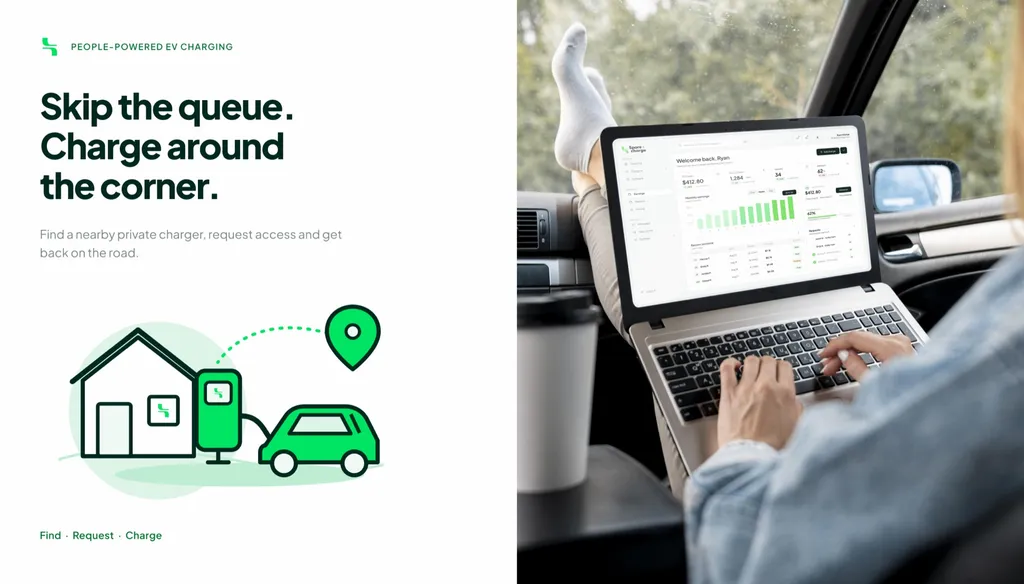
The launch line leads with what the driver gets.
Lesson 2: One brand for two audiences
A marketplace has two customers. Drivers want a charge. Owners want extra income and confidence that letting a stranger use their charger is safe. The brand had to speak to both.
The mark does it in one shape: two forms, a driver and a charger owner, meet around a central gap, which stands for the request that connects them. Flowing paths carry energy both ways: power for the driver, income for the owner. The campaign does the same in words, with lines for drivers and lines for owners, such as “Share your spare charge” and “Turn idle power into income”.
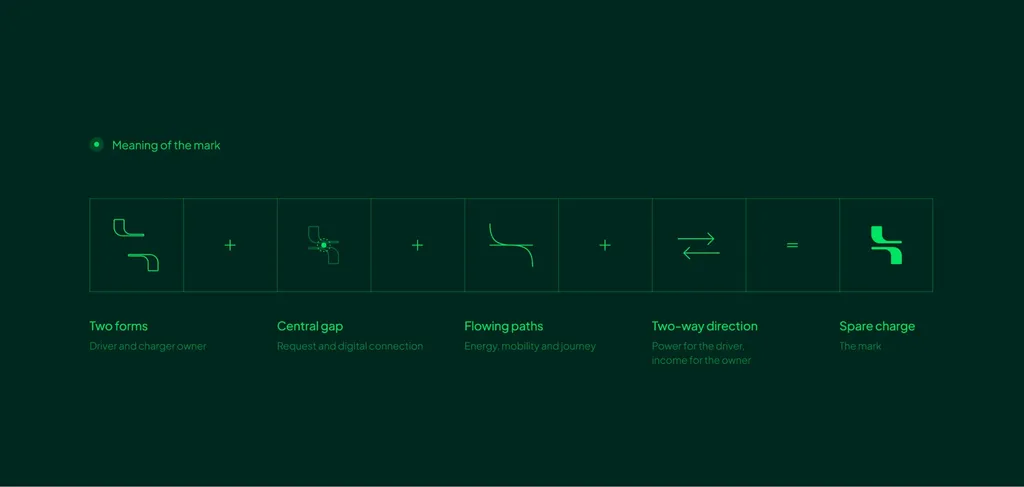
Two forms around a gap: the driver, the owner and the request between them.
Lesson 3: Let the product carry the brand
For a charging startup, the app is the brand most people meet. SpareCharge uses one app for both sides: drivers find a charger on a map, request it, charge and pay, while owners accept requests and track their earnings. We designed the whole session as one flow, from search to payment.
Two details matter in any charging product:
- Show the plug in plain words. North America is moving to SAE J3400, the standardized version of Tesla’s NACS plug, alongside CCS1. Europe uses Type 2 and CCS2. In the Gulf, DEWA’s network in Dubai offers Type 2 for AC charging and CCS and CHAdeMO for fast charging, and EVIQ’s Saudi sites list CCS2. A driver should see at a glance whether a charger fits their car.
- Make the status unmistakable. Available, requested, charging and done should look different, in color and in words, so nobody drives to a charger that’s already taken.
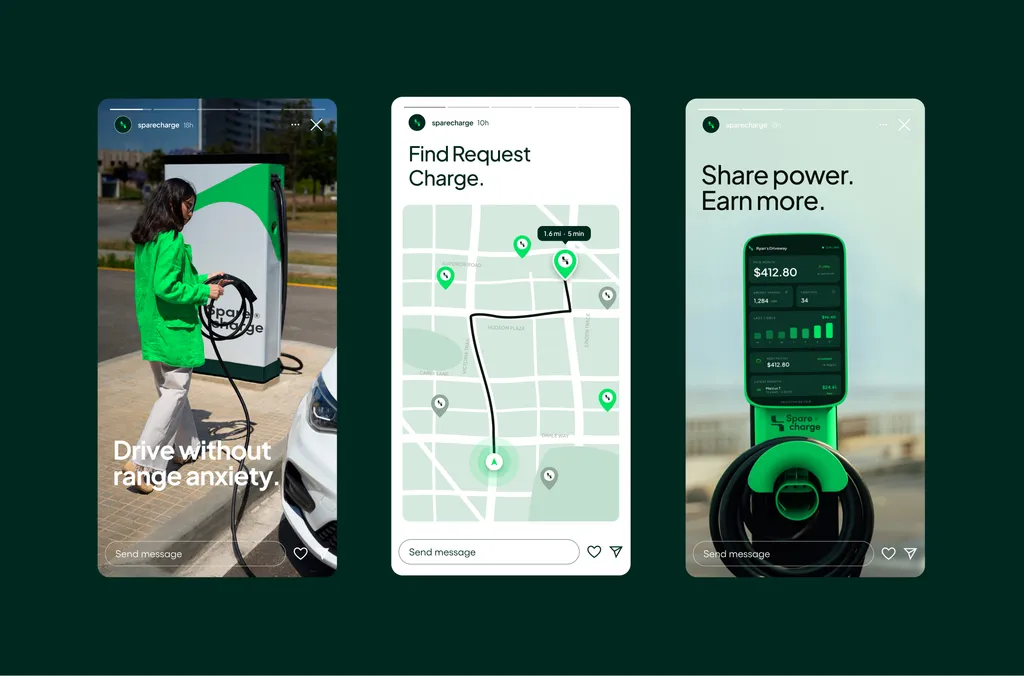
One app for both sides of the charger.
Lesson 4: Design for every screen the driver meets
Drivers don’t only use their phone. The SpareCharge system covers the app, a smartwatch companion that confirms requests and guides drivers to the charger, and the interface on the charger itself.
That shaped the identity from the start. It uses one type family, Plus Jakarta Sans, with hierarchy built from weight and size instead of a second typeface, which keeps data-heavy screens calm. The palette is two greens: Lime Green for highlights and actions, Dark Green for backgrounds and text. A short palette like this stays consistent on a watch face, a charger screen and a billboard.
Lesson 5: Build one system from day one
A startup moves fast, and a brand without rules breaks just as fast. SpareCharge’s team got brand guidelines and design tokens from day one: the design decisions, such as colors, type sizes and spacing, stored in a form developers can use directly. The same system produced billboards, charger signage, parking bay signs and social posts, so every touchpoint looks like one company. Our AI-ready brand system service builds on the same idea for teams that create with AI tools.
Lesson 6: Plan for the market you launch in
Charging differs a lot between markets, and the brand has to fit:
- Adoption: in 2025, electric cars made up 9.6% of new car sales in the US, 9.3% in the UAE and 2.6% in Saudi Arabia, according to Roland Berger’s EV Charging Index.
- The UAE aims for half of the vehicles on its roads to be electric by 2050, and DEWA’s EV Green Charger network in Dubai passed 1,860 charging points in January 2026.
- Saudi Arabia’s EVIQ, a joint venture of the Public Investment Fund and the Saudi Electricity Company, plans 5,000 chargers at 1,000 locations by 2030.
- Language: in the Gulf, an EV brand usually needs Arabic and English versions, with right-to-left layouts in the app. Our guide to designing a bilingual brand explains how.
What eight weeks delivered
The SpareCharge project covered:
- Brand strategy and positioning
- Logo, mark, color and typography
- An icon set of 16 icons
- The charging app UI
- A smartwatch companion and the charger screen UI
- A design system with tokens
- Brand guidelines
- Billboards, signage and social
Designing the brand and the product together kept it fast and consistent: every screen and every ad was built from the same parts. See the full SpareCharge case study, or read what a brand identity includes.
EV charging in 2026: numbers to know
- Over 20 million electric cars sold worldwide in 2025, a quarter of new cars (IEA).
- About 23 million expected in 2026, around 28% of sales (IEA).
- More than 7 million public charging points worldwide, and more than 43 million private ones (IEA).
- Over 260,000 public charging ports in the US (US Department of Energy, October 2026).
- Up to 240%: how much more public fast charging can cost than charging at home (IEA).
- 12% of US public charging visits ended without a charge in the latest quarter of JD Power’s 2026 study, the lowest it has recorded.
- 86% of typical US charging happens at home (JD Power).
Building an EV or mobility brand? Our brand identity service covers the brand, the product UI and the system together.
FAQ
How do you build a brand identity for an EV startup?
Start with the driver’s biggest worry, usually finding a charger that works, and make the brand promise certainty. Then design the identity and the product together, with one type family, a short palette and clear status colors, so the app, the charger and the ads all look like one company.
What makes a good EV charging app design?
A map that shows available chargers at a glance, the connector type in plain words, unmistakable status (available, requested, charging, done), a short path from search to payment, and clear prices. For marketplaces, the owner’s side needs requests and earnings that are just as clear.
How does peer-to-peer EV charging work?
Owners of private chargers at homes or businesses list them on a platform. Drivers find a charger on a map, request it, charge, and pay the owner through the app. SpareCharge, Co Charger and Joosup are examples of this model.
Which charging connectors should an EV app show?
In North America, SAE J3400 (the standardized NACS plug) and CCS1. In Europe, Type 2 for AC charging and CCS2 for DC fast charging. Gulf networks use Type 2 and CCS too, and some Dubai chargers also offer CHAdeMO. Show the connector as an icon and in words.
How long does it take to brand an EV startup?
SpareCharge’s brand, app UI and design system took eight weeks. A brand identity on its own usually takes 4–10 weeks, depending on scope.
Sources