How to Create a Perfume Brand Identity: Bottle, Box and Logo
Perfume brand identity and packaging design: how to make the name, mark, bottle, box and sample vial share one idea, from stock bottles to the label rules to plan for in 2027.

Summarize with AI
Key takeaways
- In fragrance, the pack carries the brand because the scent cannot travel through a screen. The bottle, cap and box are the brand’s main media.
- One idea, five places: name, mark, bottle, box and small formats.
- Many new houses start with a stock bottle. Make it yours with the cap, the collar, the decoration and the label, not with the logo alone.
- Set a fixed hierarchy for house name, scent name, concentration and size before the first label is drawn.
- Design for the sample vial and the mini, not just the full bottle.
- Labels are getting longer. Plan the box’s information panel for an expanded ingredient list, Arabic where required, and a US contact line.
A perfume brand identity works when the name, the logo, the bottle, the box and the smallest sample all express one idea, because a buyer meets the pack long before they smell the scent, and often never smells it before buying. That is why perfume branding and perfume packaging design are really one job. Choose one idea for the house, decide whether the bottle is a stock component you will make your own or a custom mold, set clear rules for how the house name, scent name, concentration and size sit together, and design for the 2 ml vial as carefully as the 100 ml flacon. Then leave room on the box for the label content each market requires, which is growing: since 31 July 2026, new perfumes placed on the EU market must name an expanded list of fragrance allergens, and a US rule on the same subject is still pending.
I’m Masuder Rahaman, a brand designer and the founder of Wolfpixel, where I lead the design team. I design brand identities and packaging for consumer brands in the US, Saudi Arabia and the UAE. I’ll be direct: none of the published work on my site is a perfume brand. My closest work is packaging for food and drink and a resort identity carried down to the soap bar. This guide is about the decisions a perfume identity has to make, and where they go wrong.
Why is perfume branding different?
Because the scent can’t be seen, the pack has to sell it. Most brands can explain themselves in words and pictures. A perfume cannot show you what it smells like. Online, the buyer sees a bottle, a box and a name; in a store, they see the shelf before the tester. So the visual identity does more work than in almost any other category: it has to suggest a scent, a mood and a price point at once. If you sell from your own online store, that idea has to carry through the theme, the checkout and the parcel too; Shopify store branding covers how.
Three other things set fragrance apart:
- The bottle is a component. Glass, pump, collar and cap often come from different suppliers. The identity has to work across materials you do not fully control.
- The range grows sideways. One house becomes ten scents, each needing its own name and often its own color, under one system.
- Sizes vary wildly. Circana reported that in US prestige fragrance in 2025, higher concentrations such as perfume and mini sizes remained influential. A mark that reads on a 100 ml bottle may vanish on a 2 ml vial.
What does a perfume brand identity include?
One idea for the house, carried through five places: the name, the mark, the bottle, the box and the small formats. Start by writing the one idea the house stands for, in a sentence. Not “luxury and elegance,” which every perfume claims, but something specific: a place, a material, a ritual, a memory, a way of wearing scent. Then test every decision against it in five places.
1. The name
The house name carries the idea before anything else. Decide whether it is a founder’s name, an invented word, a place, or a word in Arabic, French or English, and whether it must work in both Arabic and English. In Saudi Arabia, the Ministry of Commerce now reserves trade names in English as well as Arabic, but an English name needs an Arabic transliteration and is assessed for similarity by its Arabic equivalent, so settle both forms together. Giving an English brand an Arabic name walks through that choice. Scent names are a second naming system: decide early whether they are words, numbers, places or ingredients, so the range stays coherent at ten scents.
2. The mark
A perfume mark has to work in places a normal logo rarely goes: engraved or hot-stamped on a cap, printed small on a collar, debossed on a box lid, and sometimes as a single initial on a vial. Most perfume houses need a wordmark and a short mark (an initial, a monogram or a symbol) that still reads at a few millimeters.
3. The bottle
The bottle is the single most visible brand asset. See the next section for the stock vs custom decision.
4. The box
The box is where the idea gets the most surface: material, color, finish, opening, inner tray. It also carries the regulated information, so its back and side panels need as much design care as its front.
5. The small formats
Sample vials, minis, travel sprays and discovery sets are often the first thing a customer owns. They need their own layout rules, not a shrunk version of the full bottle.
Should a new perfume brand use a stock or custom bottle?
Usually a stock bottle, made your own through the cap, collar, decoration and label. Many new perfume houses start with one, a glass design a supplier already makes, because a custom mold adds tooling cost, higher minimum orders and months of development; Pochet, describing its standard range, puts a specific bottle at three to six months. There is nothing wrong with a stock bottle. The risk is looking like every other house on the same glass. The bottle becomes yours through:
- The cap. Material, weight, shape and finish. A heavy cap on a simple bottle reads very differently from a light plastic one.
- The collar. A metal or colored collar is a small, distinctive area for the short mark.
- The decoration. Screen printing, a colored or frosted coating, a lacquer, or a label. Each changes the bottle’s character.
- The label. Shape, material, position and typography. A label can be the brand’s signature on its own.
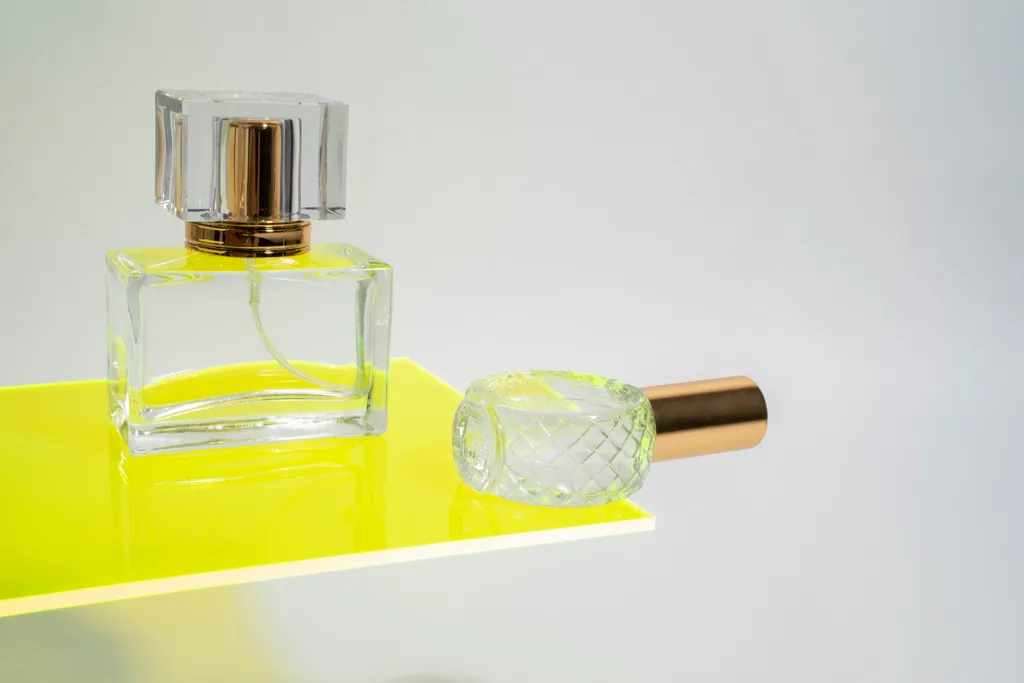
A well-known public example is Le Labo: the Paris agency Mazarine credits its identity and bottle to its Mazarine Pascalie Design studio, which paired a simple bottle, heavy in glass, and a matt metal cap with a laboratory-style label designed to be personalized. The bottle is quiet; the label carries the idea. At the other end, Guerlain’s Bee Bottle, first made for the Eau de Cologne Impériale in 1853, is reinterpreted every year in limited and numbered editions, which is what a custom bottle can become over a century and more.
Choose custom when the bottle shape itself is the idea and you have the budget and volume to support it. Otherwise, choose a stock bottle with the right weight and proportions, and spend the design effort on cap, collar, decoration and label.
How to set the label hierarchy for a perfume range
Decide once which name leads, and keep that rule for every scent. Every perfume label carries at least four pieces of information that compete for attention: the house name, the scent name, the concentration (eau de parfum, eau de toilette, parfum, extrait) and the size. Decide once, in the guidelines, which leads:
- House-led: the house name dominates; scent names are secondary. Suits a house building one strong name.
- Scent-led: each scent name dominates; the house is a small signature. Suits a house whose scents are collected individually.
- Equal, separated: the house name and scent name sit in different places, for example the house on the cap or collar and the scent on the label.
Then fix the typography and position for concentration and size, so they never fight the names. Add a rule for how each scent is distinguished across the range: a color, a number, a material or a pattern. A range of ten that uses ten unrelated colors with no rule looks like ten brands.
How to design for sample vials and minis
Start the identity work from the smallest thing you sell. If the short mark and the scent name read on a 2 ml vial and a 10 ml travel spray, they will read on the full bottle. The beauty and fragrance page on this site makes the same point: if minis and sample vials matter, the mark and the scent name have to read on a vial as well as on a full bottle and a gift box.
For discovery sets, plan the box as a system: one outer box in the house identity, an inner tray, and vials identified by scent name and the range’s color or number rule.
Perfume branding for Saudi Arabia and the UAE
The Gulf is one of the world’s most important fragrance markets, and it has its own expectations. A few figures: when Al Majed for Oud priced its IPO in 2024, it had 286 stores at the end of 2023, 237 of them in Saudi Arabia, and 650 products across 132 brands; perfume was the top category at Dubai Duty Free in 2025, with 18.45% of sales; and in 2024 UNESCO inscribed the cultural practices around Taif roses.
For a perfume or oud house selling in Saudi Arabia or the UAE:
- Design the Arabic and English names as one brand. Not a translation set in a default Arabic font, but a designed Arabic wordmark matched to the Latin one in weight, contrast and rhythm. Designing a bilingual brand in Arabic and English shows the method.
- Plan the label Arabic-first in Saudi Arabia. SFDA sets which label data must be in Arabic, and cosmetic ads there use Arabic, with any other language matching it.
- Plan the label evidence in the UAE. Cosmetics, perfumes included, follow UAE.S GSO 1943; labels name allergens in the ingredient list and must rest on lab evidence, and the MoIAT certificate needs the label artwork, so the label is designed before the application.
- Design for gifting. Gift boxes, sets and seasonal editions matter in the Gulf. Plan the box system so a seasonal edition is a variation, not a new brand.
- Plan for retail. In Dubai, a shopfront shows one trade name, horizontal, with Arabic above English; a perfume boutique’s sign needs a lockup for that.
What has to be on a perfume label in 2027?
It depends on the market, and the list is growing, so leave room for it. Labels are where the identity meets the rules, and the rules are getting longer. This is general information, not regulatory advice; your regulatory adviser or responsible person confirms what your product needs.
- European Union. Regulation (EU) 2023/1545 added 56 fragrance allergens that must be named individually on cosmetic labels when present above the thresholds (0.001% in leave-on products such as perfume, 0.01% in rinse-off). Since 31 July 2026, non-compliant products may no longer be placed on the EU market; products placed before that date can be sold until 31 July 2028. For a perfume, that can mean a noticeably longer ingredient list, and a new perfume launching in the EU in 2027 needs it from the first print run.
- United States. FDA requires the product’s identity and net quantity on the principal display panel and the ingredients in descending order of predominance. Since December 2024, under MoCRA, labels must also carry a US address, US phone number or electronic contact, such as a website, for adverse event reports. MoCRA also told FDA to propose which fragrance allergens must be named, by June 2024. As of early November 2026 I could find no published proposal, and FDA’s latest regulatory agenda targets November 2026, so there is no federal requirement yet to name individual fragrance allergens. Expect one, check its status on FDA’s labeling page before you finalize a US label for 2027, and if you already label for Europe, you are likely to be closer to ready.
- Saudi Arabia and the UAE. As above: Arabic label data set by SFDA; UAE.S GSO 1943 with allergens named and the label artwork submitted for MoIAT certification.
The design response is simple: give the box an information panel with generous space and a type size that stays legible when the ingredient list grows, and do not let the front-of-pack design spill into the panel the regulations need.
Perfume branding mistakes to avoid
- Luxury clichés instead of an idea. Black, gold foil and a serif, with nothing that is the house’s own.
- The logo stamped on a stock bottle and nothing else. The bottle still looks like everyone else’s.
- No hierarchy. House name, scent name and concentration all fighting on one small label.
- Designing only the 100 ml bottle. The vial and the mini become an afterthought.
- Arabic added at the end. A translation in a default font beside a designed Latin wordmark.
- No room for the ingredient list. Then the information panel is crammed into tiny type at the last minute.
- Approving color on screen. Glass, coatings, metal caps and board all shift color; ask for real samples.
Perfume brand identity and packaging checklist
- One-sentence idea for the house
- House name cleared, in Arabic and English where needed; scent naming system decided
- Wordmark and short mark tested at vial size
- Stock or custom bottle decided; cap, collar, decoration and label specified
- Hierarchy rules for house name, scent name, concentration and size
- Range rule for distinguishing scents
- Box system: outer box, inner tray, information panel, gift and seasonal variations
- Small formats: vial, mini, travel spray, discovery set
- Label content confirmed for each market by your adviser
- Physical samples of glass, cap and box checked before the order
How much does a perfume brand identity cost?
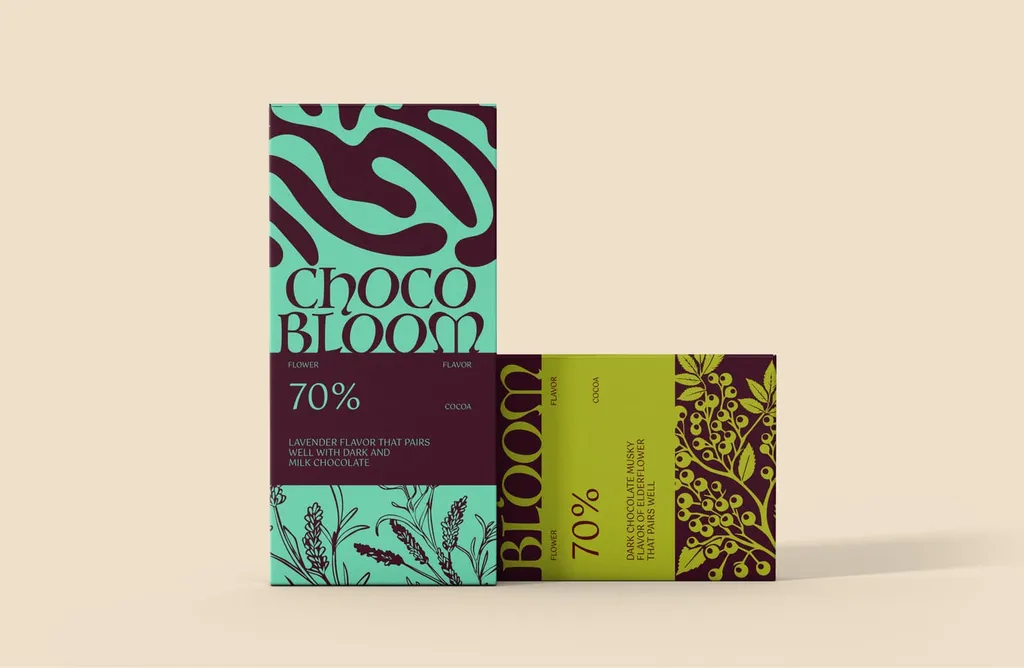
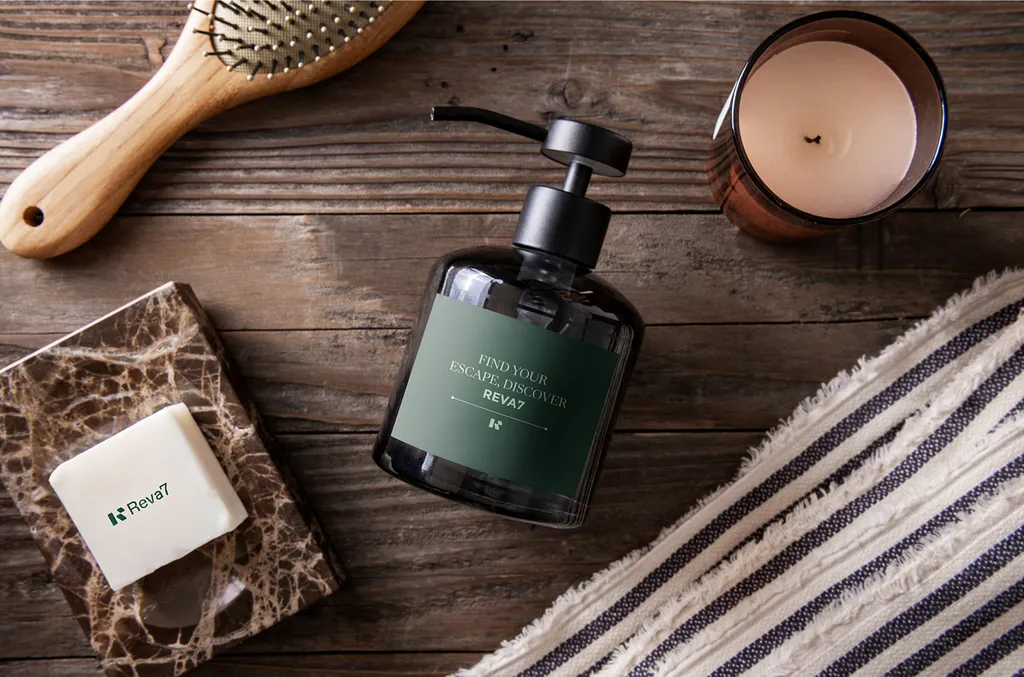
With me, a perfume brand identity is $3,499 over two to three weeks, and packaging design for the range is quoted by scope. I’ll repeat it: none of the published work on my site is a fragrance brand. The closest is packaging work such as ChocoBloom’s chocolate wrappers and Bright Fizz’s cans, where the pack carries the brand on a shelf and a range is told apart by color, and Reva7, a resort identity carried from the welcome folder to the soap bar. More of that packaging is under food and beverage work.
For a perfume or oud house, a brand identity ($3,499, two to three weeks) covers the logo and short mark, color, type and the hierarchy rules for name, scent, concentration and size, shown on a bottle, a box and a label, in Arabic and English where needed, with guidelines and a Figma library. Packaging design for the full range is separate (two to four weeks, quoted by scope): front and back panels, labels, a range system and print-ready files on your printer’s dieline. If you need a house name or scent names, brand and product naming takes one to two weeks. Every project starts with a free 30-minute call and a fixed written proposal; prices are in USD, with proposals available in AED or SAR. All packages are on the pricing page, and what a brand identity includes lists the deliverables.
If you are launching a fragrance house, book a free call and bring your bottle supplier’s spec sheet, or the stock bottle you are considering. We will start from the smallest thing you will sell.
FAQ
What does a perfume brand identity include?
A house name and scent naming system, a wordmark and short mark that read on a cap or vial, color and type, hierarchy rules for house name, scent name, concentration and size, and the identity shown on a bottle, box and label, in Arabic and English where needed, with brand guidelines. Packaging for the full range is usually a separate project.
Should a new perfume brand use a stock or custom bottle?
Usually a stock bottle, made distinctive through the cap, collar, decoration and label. A custom mold suits a house whose bottle shape is the idea and that has the budget and volume for it.
How long does perfume packaging design take?
With me, a brand identity takes two to three weeks and packaging design for the range two to four weeks. A custom glass bottle takes longer: one bottle maker puts a specific bottle at three to six months of development.
What has to be on a perfume label?
It depends on the market. In the US, identity and net quantity on the front panel, ingredients in descending order and a contact for adverse event reports. In the EU, an expanded list of fragrance allergens named individually above the thresholds. In Saudi Arabia, SFDA sets which data must be in Arabic; in the UAE, labels follow UAE.S GSO 1943. Confirm with your regulatory adviser.
Does a perfume brand in Saudi Arabia need an Arabic name?
It can have an English name; the Ministry of Commerce reserves trade names in English as well as Arabic. Under the 2025 regulations, an English name needs an Arabic transliteration and is assessed for similarity by its Arabic equivalent, so design both together.
How much does a perfume brand identity cost?
With me, a brand identity is $3,499 and takes two to three weeks. Packaging for the range is quoted by scope after a free call, depending on the number of products, sizes and languages.
Sources