Renewable Energy Branding: One Brand, Three Audiences
How to brand a solar, EV or cleantech company so investors, regulators and customers all trust it: the three tests, the new green-claims rules, and lessons from ZAYAN, SpareCharge and SUPA.

Summarize with AI
Key takeaways
- Renewable energy branding is a trust problem first. People can’t see electricity, a battery’s quality or a project pipeline, so they judge the brand instead.
- One brand has to pass three tests. Investors look for proof of scale, regulators look for accuracy, and customers look for savings and reliability.
- Green claims now carry legal risk. Since September 27, 2026, EU rules ban generic claims like “eco-friendly” without proof, and the UK regulator can fine up to 10% of global turnover.
- Skip the default sun, leaf and green gradient. A distinct symbol and palette are easier to remember and easier to protect.
- Design the brand and the product together. In energy, most people meet the brand through an app, a charger screen or a van.
Renewable energy branding is the work of making a solar, wind, storage, EV or cleantech company look and sound credible to the people it depends on: the investors who fund it, the regulators and partners who approve and connect it, and the customers who buy from it. The hard part is that each group judges you on something different. This guide shows how to build one brand that passes all three tests, using three energy and mobility brands I’ve worked on: ZAYAN (solar), SpareCharge (EV charging) and SUPA (electric cars).
| Audience | What they check | What the brand has to show |
|---|---|---|
| Investors | Can this company scale? | A clear category, a sharp story, a deck and website that look like one company |
| Regulators, utilities, grid and permitting partners | Is this company accurate and consistent? | Claims you can prove, the same facts everywhere, a calm and precise voice |
| Customers (homes, businesses, drivers) | Will it save me money and just work? | Savings in plain words, reliability, real people and vehicles in the street |
I’m Masuder Rahaman, a brand designer and the founder of Wolfpixel, where I lead the design team. This article is for energy founders who need to decide what to do with their name, logo, claims and website before a funding round or a grid application.
Why is renewable energy branding a trust problem?
One company’s solar panel, battery or kilowatt-hour of green power looks much like the next company’s. Customers can’t see the quality of the electricity. Investors can’t see the future of the pipeline. Regulators can’t check every sentence on your website. So all three fall back on signals: is this company clear, consistent and honest?
The industry has been slow to treat branding as part of the business. In a 2018 Recharge interview, energy-branding specialist Fridrik Larsen put it bluntly: “The barrier to branding is an energy industry run by engineers.” Researchers have looked at the question too: a 2012 study in Energy Policy examined how renewable electricity retailers in Australia compete on service and branding.
That gap is your opportunity. When most competitors look like a stock photo of a wind turbine, a clear brand stands out fast.
What does each audience need from your brand?
A common mistake is designing for one audience only. A brand made only for customers can feel too light in an investor meeting. A brand made only for investors can feel cold on a billboard. A brand that ignores regulators can make a claim that has to be withdrawn later.
Plan for all three from the start:
| Audience | What builds trust | What breaks trust |
|---|---|---|
| Investors: “Can this scale?” | A clear category, focus, a professional finish | A vague mission, “we do everything” |
| Regulators and partners: “Is this accurate?” | Consistency, evidence, plain facts | Claims you can’t back up, figures that change between documents |
| Customers: “Is it worth it for me?” | Savings, reliability, real people | Jargon, hidden costs, a brand that doesn’t match the service |
The core message stays the same in every column. Only the depth changes.
How do you win over investors?
Climate and energy investors see many companies with similar technology. Your brand should help them understand, in seconds, what you are and why you’ll win.
- Name your category in one line. “Peer-to-peer EV charging marketplace” tells an investor more than “the future of energy.” Put that line at the top of the deck and the homepage. A positioning statement is a good place to start.
- Look like one company. The same logo, type and color across the deck, website and product show that the team can execute. Investors notice when the deck and the website look like two different companies.
- Make the market visible. Energy markets are abstract. Show the customer, the place and the use case: the rooftop, the parking bay, the fleet.
- Don’t overpromise. Big climate language without numbers behind it can worry experienced investors, and the same words can create legal risk (see the next section).
If you’re raising soon, read branding before the seed round for what’s worth doing now and what can wait.
How do you win over regulators and partners?
Utilities, grid operators, permitting authorities and energy regulators aren’t your customers, but they decide how fast you can grow. A calm, precise, consistent brand is easier to say yes to.
In practice:
- Keep one set of facts. Capacity, installs, savings and emissions figures should match across the website, deck, applications and press. Keep them in your brand guidelines or a shared fact sheet.
- Use a precise voice. “Cuts a typical home’s grid electricity use” reads as competent. “100% clean, zero-impact energy” reads as marketing.
- Make only claims you can prove. Every environmental claim should link to evidence you’d be happy to show a regulator.
Which green claims rules do you need to know?
This is where branding and law now meet. Rules on environmental claims have tightened in the markets many energy companies sell into:
- European Union. Directive (EU) 2024/825 on empowering consumers for the green transition has applied since September 27, 2026. As Mayer Brown summarizes it, it bans generic environmental claims such as “environmentally friendly,” “green” or “eco” without recognized excellent environmental performance, product-level climate-neutrality claims based on offsets, and sustainability labels that aren’t based on a certification scheme or set by public authorities. Claims about future performance, such as reaching climate neutrality by a certain date, need a detailed, realistic implementation plan checked by an independent expert. Several EU countries hadn’t finished putting the rules into national law by the application date, so check each market you sell in before a 2027 launch.
- United Kingdom. The CMA’s Green Claims Code applies, and under the Digital Markets, Competition and Consumers Act 2024 the CMA can fine companies up to 10% of global turnover for breaching consumer law, as Linklaters explains.
- United States. The FTC’s Green Guides explain how marketers can avoid misleading environmental claims, including claims about “renewable” energy, certifications and seals, and carbon offsets. They were last revised in 2012.
What this means for your brand:
- Check the name and tagline. A name or tagline built on “green,” “eco” or “zero” may be read as a claim. Ask your lawyer before you commit to one.
- Swap vague words for specific ones. “Solar systems that cut your power bill” is specific. “Eco-friendly energy for a better planet” isn’t.
- Don’t design your own badge. A homemade “certified green” seal with no real certification scheme behind it is exactly what the EU rules target.
- Keep investor and customer messages aligned. The EU rules cover what you tell consumers. Sustainability-report language reused in an ad is judged as a consumer claim.
I’m a brand designer, not a lawyer. Have a lawyer in each market review your claims before launch. A good brand system makes that review easier, because every claim is written down in one place.
How do you win over customers?
Homes, businesses and drivers rarely buy “renewable energy.” They buy a lower bill, a reliable charge or a car they’re proud of. Lead with that.
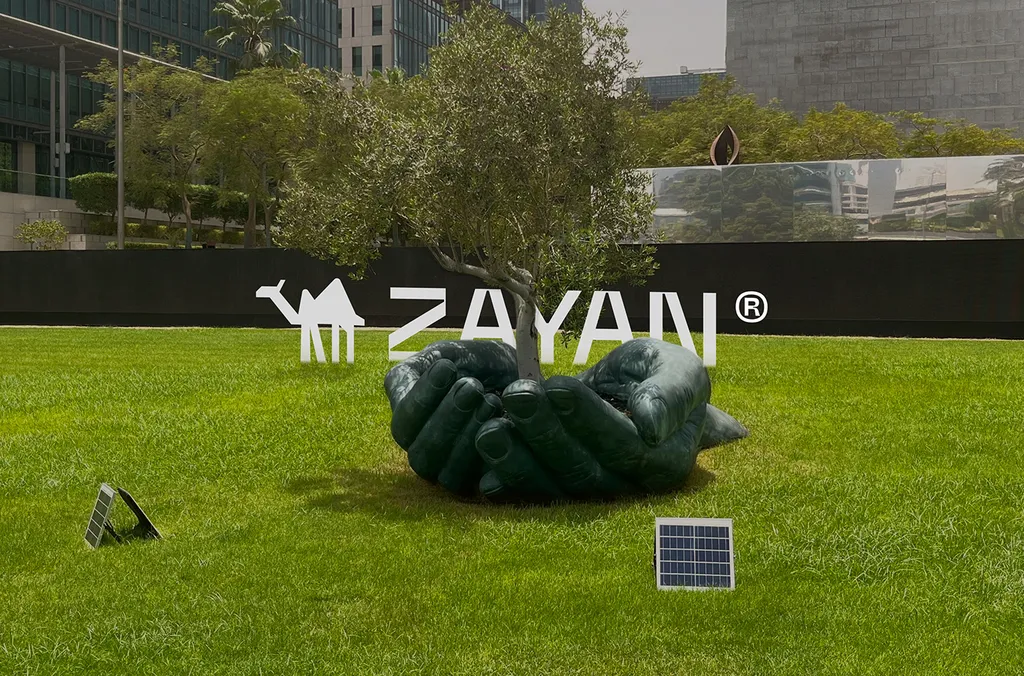
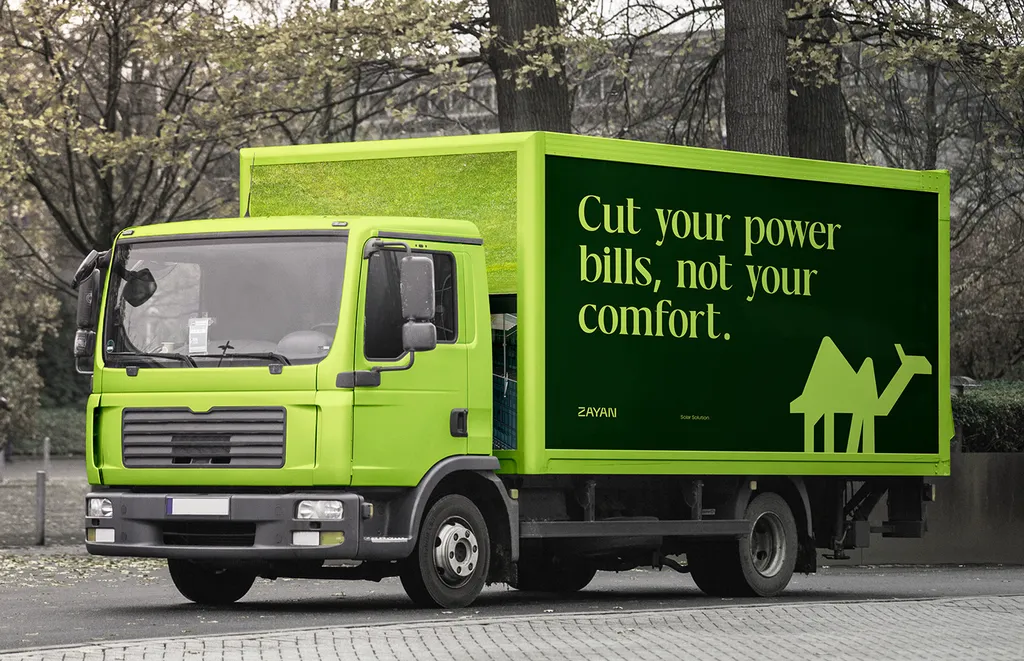
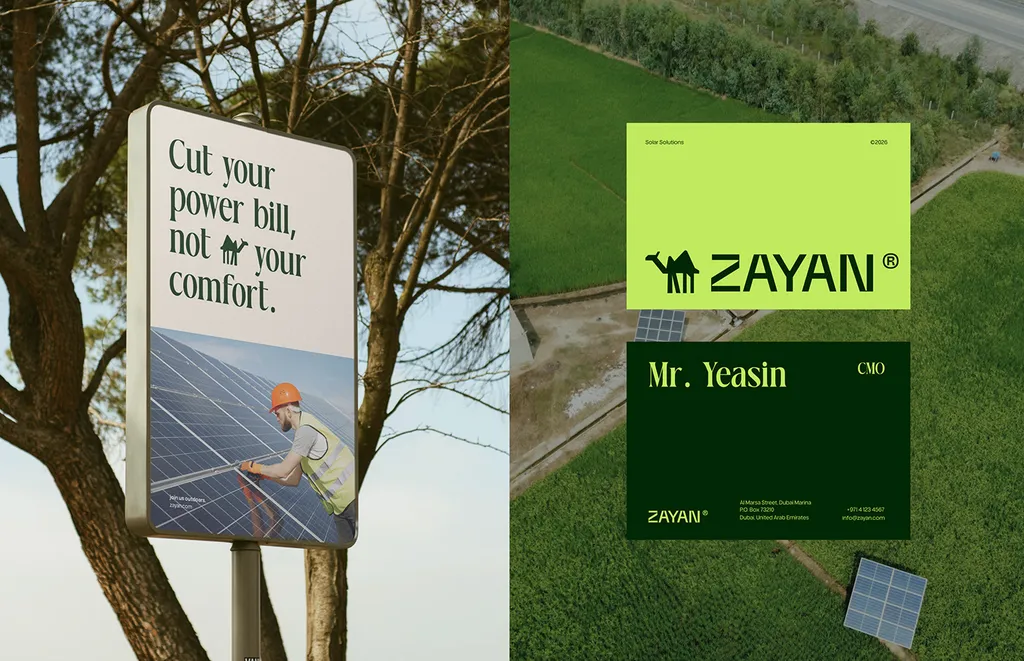
ZAYAN helps homes and businesses cut electricity costs with solar systems. Its campaign lines are about the customer, not the planet: “Cut your power bill, not your comfort.” The identity lives where customers meet the company: billboards, a lime-green fleet, technician workwear, ID badges, flyers and social posts. For a solar installer, the technician at the door is the brand.
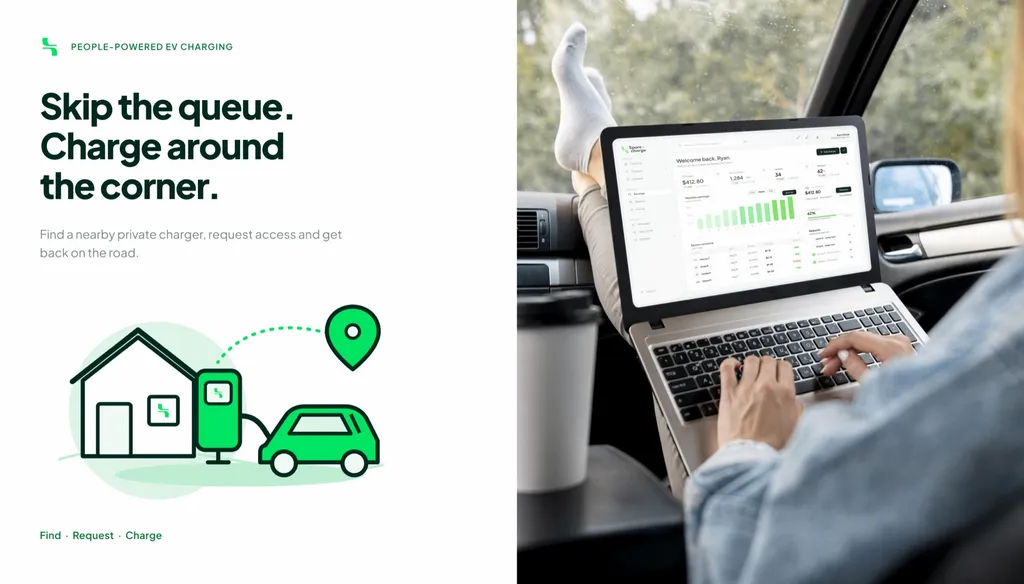
SpareCharge leads with the driver’s benefit: “Skip the queue. Charge around the corner.” Every ad has one clear action: find a charger.
SUPA speaks to drivers with short, confident lines: “Recharge your world” and “Less noise. More power.”
None of these lines promises to save the planet. Each promises something the customer can check.
Which design choices work in energy?
Many solar and clean-energy logos reach for the same ideas: a sun, a leaf, a lightning bolt, a blue-to-green gradient. They feel safe, but they make it hard to stand out and harder to protect as a trademark.
Better starting points:
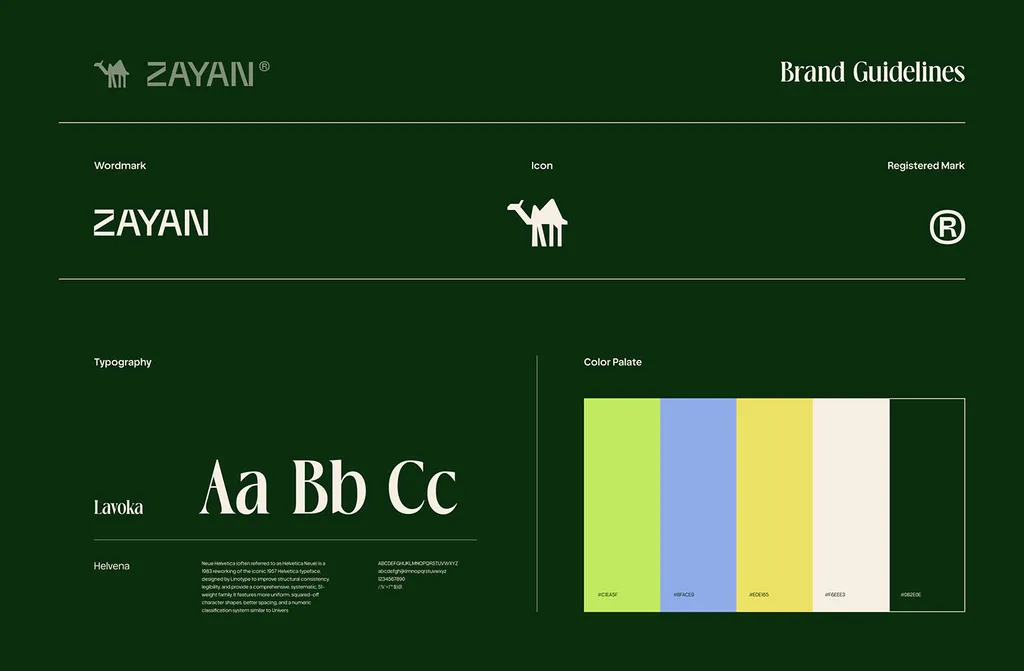
- A symbol with a story that fits the business. ZAYAN’s symbol is a camel, inspired by the camel’s ability to survive with minimal resources: like the camel, good solar does more with less. It’s memorable, it explains the promise without a word, and it doesn’t look like a solar cliché.
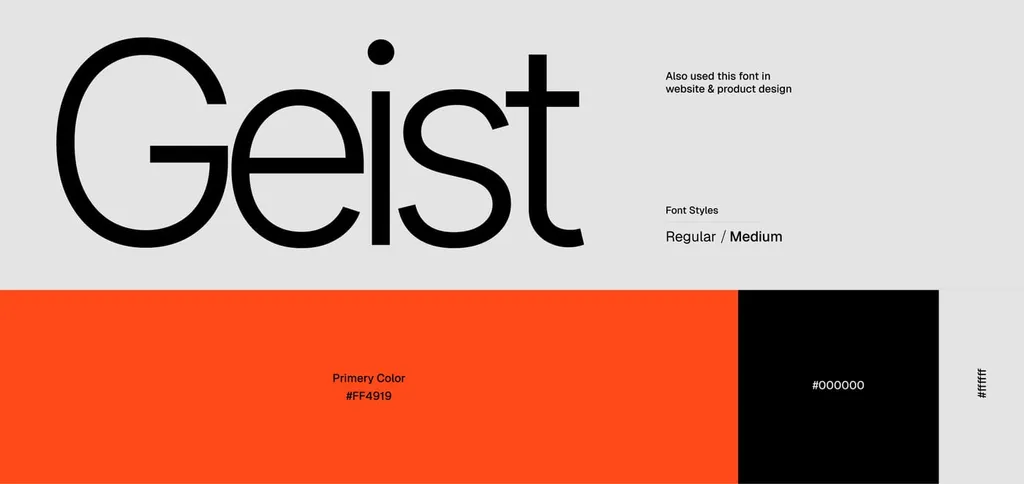
- A palette that isn’t the default green. ZAYAN uses spring lime, deep camouflage green, chalk blue, pearl and mustard. SUPA uses an electric orange (FF4919) with black and white. SpareCharge uses two greens: Lime Green for highlights and actions, and Dark Green for backgrounds and text. Green can work, but choose one you can own and pair it with something unexpected.
- Type that works on screens and on vans. SpareCharge uses a single family, Plus Jakarta Sans, so data-heavy app screens stay calm. SUPA uses Geist across the brand, the website and the product. ZAYAN pairs Lavoka for headlines with Helvetica for text.
- Applications from day one. Before you approve a logo, test it on a vehicle, a hard hat, a charger screen, an app icon and a one-page fact sheet.
How do you brand both sides of an energy marketplace?
Many new energy businesses are marketplaces or networks: drivers and charger owners, homeowners and installers, producers and buyers. The brand has to welcome both sides.
SpareCharge connects EV drivers with private chargers that sit idle at homes and businesses. Its mark shows two forms, a driver and a charger owner, meeting around a central gap that stands for the request that connects them. Energy flows to the driver, and income flows to the owner. One app serves both sides: drivers find, request and pay; owners accept requests and track their earnings.
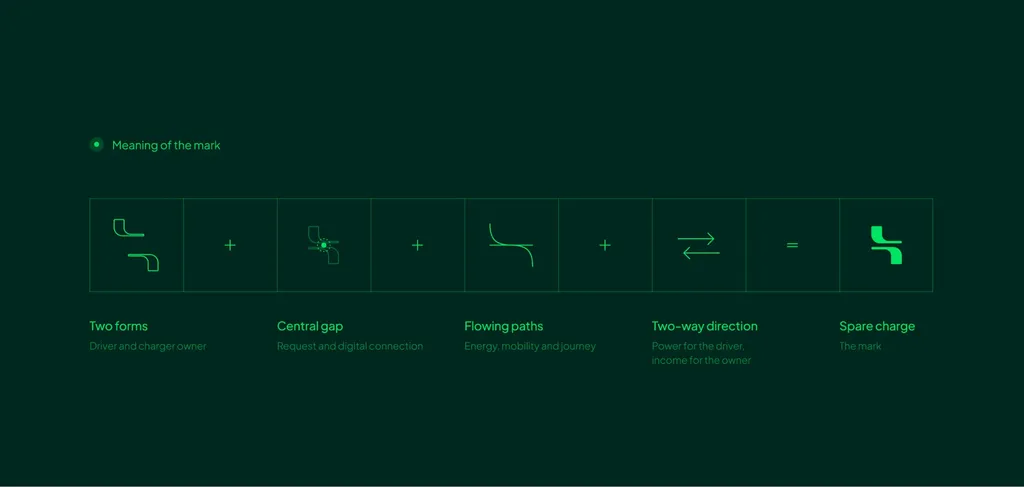
If your business has two sides, show the connection between them in the brand, not just one side. I wrote more about this in lessons from branding an EV startup.
Why build the brand and the product together?
In energy and mobility, most people meet the brand through a product: an app, a dashboard, a charger screen, an in-car display. If the product looks different from the marketing, trust drops.
For SpareCharge we designed the brand, the app, a smartwatch companion, the charger screen and a design system with guidelines and design tokens in eight weeks, so the team had one system to build on. For SUPA we designed the identity together with the app and the in-car interface: car controls, charging maps and an in-car display in one dark, calm interface.
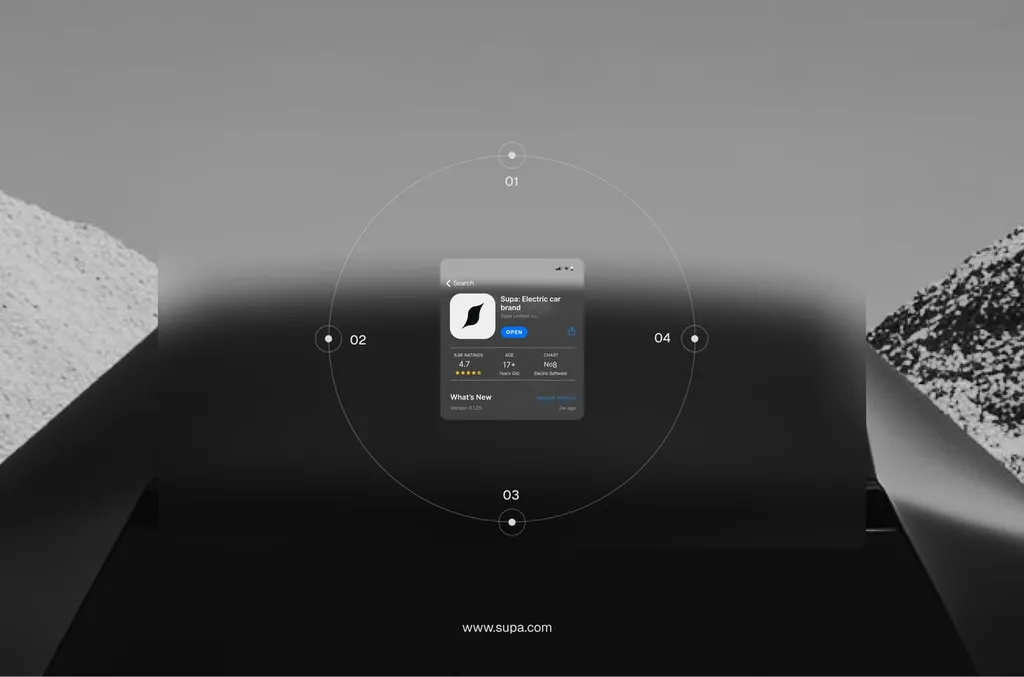
If you have a product, brief your brand designer on it from the start. That costs less than redesigning the app after launch.
Your renewable energy brand checklist
Use this before a funding round, a grid or permit application, or a launch:
- A one-line category description at the top of the deck and the homepage
- The name and tagline checked for vague green claims in every market you sell in
- Every environmental claim linked to evidence you can show
- The same capacity, savings and emissions figures in every document
- A distinct symbol, not a generic sun, leaf or bolt
- Palette and type tested on screens, vehicles, uniforms and print
- Customer lines that promise something the customer can check
- App, dashboard or charger screens built from the same system as the marketing
- Brand guidelines that include an approved claims list
- One person who owns the brand and its claims
How do you choose a renewable energy branding agency?
You don’t need an agency that only works in energy, but you do need one that understands its constraints. Ask:
- Have you designed for energy, cleantech or mobility? Ask to see the work in use: vehicles, apps and signage, not just logos.
- How do you handle environmental claims? A good answer mentions evidence and legal review, not just “we’ll make it feel green.”
- Can you design the product as well as the brand? If your business runs on an app or a device, this matters.
- Will the brand work for investors and regulators, not just customers? Ask how the system covers decks, fact sheets and formal documents.
- What do I own at the end? The final and source files, in writing; font licenses are usually bought by you.
For more on the choice itself, see brand designer vs branding agency and how to hire a brand designer.
Building a solar, EV or cleantech brand?
One brand has to convince investors, regulators and customers. I design identities that stay consistent across all three, from the pitch deck to the fleet and the app. Book a free 30-minute call in your time zone, or see brand identity design.
FAQ
What is renewable energy branding?
It’s the strategy, name, visual identity, voice and claims of a solar, wind, storage, EV or cleantech company, designed so that investors, regulators and customers understand it and trust it.
How much does branding cost for an energy company?
It depends on the scope. A logo alone costs less than a full identity with guidelines, vehicle graphics and product UI. My packages are $999 for a logo, $3,499 for a brand identity and $6,999 for the Premium package; anything larger, such as product UI, is quoted as a fixed proposal after a free call.
How long does energy branding take?
A brand identity with me takes 2 to 3 weeks. A project that adds an app and a design system takes longer: SpareCharge’s brand, app and design system took eight weeks.
Can I still use “green” or “eco” in my name or tagline?
Be careful. In the EU, generic environmental claims such as “green” or “eco” now need recognized excellent environmental performance behind them, and a name or tagline can read as a claim. Check with a lawyer in each market before you commit.
Do we need a branding agency that only works in energy?
No, but you need one that understands the constraints: environmental claims, investor and regulator audiences, and products such as apps, chargers and vehicles. Ask to see energy, cleantech or mobility work in real use.
Should the brand and the app be designed together?
Yes, if your business runs on a product. Most customers meet an energy brand through an app, a charger screen or a dashboard, so designing them from one system keeps the experience consistent and costs less than redesigning later.
Sources
- European Commission: Sustainable consumption (Directive (EU) 2024/825)
- Mayer Brown: The EU Directive on Empowering Consumers for the Green Transition two years on (October 2026)
- Linklaters: Green advertising claims in the UK, the CMA’s new fining powers
- FTC: Green Guides
- Paladino and Pandit: Competing on service and branding in the renewable electricity sector, Energy Policy (2012)