How to Write a Positioning Statement, With a Template
How to write a positioning statement: a copyable template, where the classic format comes from, a seven-step method, startup examples and a test before use.

Summarize with AI
Key takeaways
- Every version of the template does the same four jobs: it names the customer, the category, the difference and the proof.
- The “For … who … Unlike …” format is usually credited to Geoffrey Moore’s book Crossing the Chasm (1991).
- The statement is for your team. Your tagline and homepage headline are written from it, but they aren’t the statement itself.
- The hardest slot is “Unlike.” Name the alternative customers actually consider, including spreadsheets, an agency or doing nothing.
- If the statement would still be true with a competitor’s name in it, it isn’t finished.
A positioning statement is a short internal statement that says who you serve, what category you compete in, what you do for them that the alternatives don’t, and why they should believe it. The classic template is: For [target customer] who [need], [brand] is a [category] that [key benefit]. Unlike [main alternative], we [key difference], because [proof]. Write it for your team, not your homepage: it’s the brief that your website, deck, sales calls and design all work from.
I’m Masuder Rahaman, a brand designer and the founder of Wolfpixel, where I lead the design team. A positioning statement is one of the deliverables of my brand strategy projects, and it’s the first thing I check before designing an identity. This guide gives you a template to copy, explains where the format comes from and how to fill it in, and shows startup examples (clearly labeled as made up) plus one real example from my work.
Positioning statement template to copy
Copy this and fill in the brackets:
For [target customer]
who [need, problem or trigger],
[brand or product] is a [category]
that [key benefit, in the customer’s words].
Unlike [the main alternative customers consider],
we [the key difference],
because [proof: something you can show today].
What goes in each slot:
| Slot | Weak | Stronger |
|---|---|---|
| Target customer | “Small businesses” | “Independent restaurants with one to three locations” |
| Need | “Need to save time” | “Lose track of stock between deliveries” |
| Category | “A platform” | “Inventory app for kitchens” |
| Key benefit | “AI-powered” | “Know what to reorder before service starts” |
| Main alternative | “Legacy solutions” | “Paper count sheets and supplier spreadsheets” |
| Key difference | “Better” | “Counts stock from delivery invoices automatically” |
| Proof | “Revolutionary” | “Reads invoices from the five largest food distributors in the area” (if true) |
The proof slot matters more than it looks. In the US, the FTC’s long-standing policy is that advertisers need a reasonable basis for claims before they are disseminated. Build the statement on proof you already have, and the marketing claims written from it start on solid ground.
Where the classic positioning statement format comes from
The “For [target] who [need]” format is widely credited to Geoffrey Moore. Umbrex’s framework library says it was popularized by Moore in Crossing the Chasm (1991) and later works, with a second sentence that starts “Unlike [primary alternative].” That second sentence sets it apart from a plain value proposition, because it makes you name what customers would choose instead.
Later guides have adjusted the parts. The differences are small, but knowing them helps you pick one:
| Version | Parts | Source |
|---|---|---|
| Moore-style, two sentences | Target, need, category, benefit; then “Unlike” alternative and difference | Umbrex |
| One sentence with “because” | Target, need, brand, category, unique value, reason to believe | Product Marketing Alliance |
| Four elements | Target audience, market category, benefit, proof | Brandwatch |
| Four components | Target audience, frame of reference, brand promise, reason to believe | DealHub |
| Context-first | Brand, category, audience, challenge, benefit, solution | Open Strategy Partners |
The template at the top of this page combines them: Moore’s “Unlike” sentence plus the “because” clause that most later versions add. If yours runs long, cut words elsewhere and keep the “Unlike” sentence.
Product Marketing Alliance also summarizes April Dunford’s approach, which starts from the other end: competitive alternatives first, then your differentiated capabilities, the value they create, the customers who care most, and only then the market category. If you struggle with the “category” slot, work in that order.
Positioning statement vs value proposition, mission and tagline
These four are easy to mix up. The positioning statement is the internal one; the others are written from it. (A tagline is also different from a campaign slogan: see tagline vs slogan.)
| Compare | Who reads it | What it says |
|---|---|---|
| Positioning statement | Your team, agencies, designers | Who it’s for, category, difference, proof, in one to three sentences |
| Value proposition | Customers | The benefit customers get |
| Mission statement | Team, investors, sometimes customers | Why the company exists |
| Tagline | Customers | A memorable line of a few words |
Open Strategy Partners draws a similar line: the value proposition is external, while the positioning statement gives the strategic context and can be used both internally and externally (Open Strategy Partners).
How to write a positioning statement in seven steps
- List your real alternatives. Ask recent customers what they used before you, and what they nearly chose instead. Include doing nothing, a spreadsheet, a freelancer or an in-house hire. This fills the “Unlike” slot with something real.
- Find what you do that those alternatives don’t. Leave out what you merely do well; keep only what’s different and matters to the buyer.
- Write down the proof for each difference. A feature, a number, a named integration, a guarantee in your contract, a credential. If there’s no proof yet, it can’t go in the statement yet.
- Pick the customer who cares most about that difference. That’s your target customer, even if others buy too.
- Choose the category that makes the difference obvious. The category tells people what to compare you with. “Inventory app for kitchens” invites a different comparison than “restaurant software.”
- Fill in the template. Use your customers’ words for the need and the benefit. Sales call notes, support emails and lost-deal notes are the best source.
- Test it, then rewrite. Run the checks below, read it to two customers and one person who has never heard of you, and ask them to explain it back.
Positioning statement examples for startups
These four companies are fictional. I wrote them to show the template at work for early-stage businesses; they aren’t clients or real brands.
1. B2B SaaS (fictional “Quaylo”)
For finance leads at US startups with 20–100 employees who close the books in spreadsheets, Quaylo is a month-end close tool that cuts close from weeks to days. Unlike a spreadsheet checklist, it matches bank transactions to invoices automatically, because it connects directly to the banks and accounting tools those teams already use.
2. Direct-to-consumer (fictional “Brekkly”)
For parents of toddlers who want a quick breakfast without added sugar, Brekkly is a ready-to-heat oat cup that’s ready in two minutes. Unlike supermarket oat pouches, every flavor is sweetened only with fruit, because the recipe uses whole fruit purée and nothing else.
3. Gulf property app (fictional “Manzilo”)
For first-time buyers in Riyadh who find listing sites overwhelming, Manzilo is a home-search app that shortlists homes by commute and daily routine. Unlike listing portals, it asks how you live before it shows a single listing, because its matching starts from a short lifestyle profile instead of filters.
4. Professional service (fictional “Ostrand & Vale”)
For founders raising their first round, Ostrand & Vale is a startup law firm that prices funding paperwork as a fixed fee. Unlike hourly firms, you know the full cost before work starts, because every round is quoted from a published scope.
A before-and-after rewrite (fictional “Quaylo”)
| Version | Statement | Problem |
|---|---|---|
| Before | “Quaylo is an innovative, AI-powered financial platform that empowers businesses to take control of their finances.” | No customer, no alternative, no proof. Would fit hundreds of companies. |
| After | The statement in example 1 | Names the customer, the alternative, the difference and the proof |
A real example: Wayfare

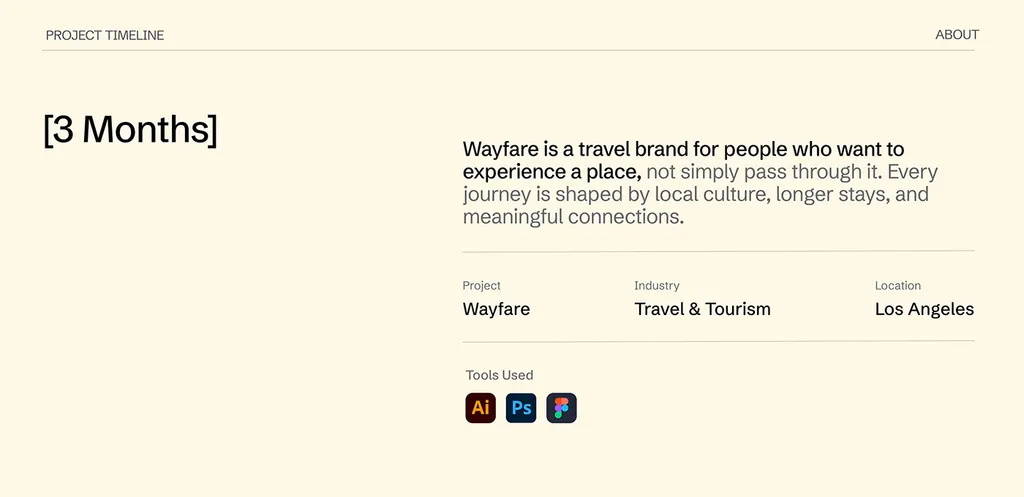
For the travel brand Wayfare, the strategy named the problem first: modern travel had become a race. The case study’s outcome note says Wayfare was positioned around depth, local knowledge and honesty, with fewer stops and more time in each. The template’s parts show up in what was published:
| Template slot | Where it shows up in Wayfare’s published brand |
|---|---|
| Target customer | “people who want to experience a place, not simply pass through it” (project overview) |
| Need | Trips that feel rushed and forgettable (problem page) |
| Key difference | Fewer destinations, longer stays, routes built by locals |
| Tagline written from it | “Go slow. See more.” |
How to test a positioning statement
Before you share it, run these checks:
| Check | Pass if |
|---|---|
| Swap test | It stops being true if you put a competitor’s name in it |
| Specific customer | You could make a list of real people who fit |
| Real alternative | The “Unlike” names something customers actually consider |
| Proof exists today | Every claim can be shown, not promised |
| Customer words | The need and benefit sound like your customers, not your pitch deck |
| One difference | It makes one main claim, not five |
| Explain-back | Someone outside the company can repeat it in their own words |
| Fits the next 12–24 months | It holds for the market you’re actually entering |
Common positioning statement mistakes
- Writing a tagline instead. “Banking, reimagined” is a slogan; the positioning statement is the thinking behind one.
- Positioning against a straw man. “Unlike outdated solutions” names nothing. Name the tool, habit or provider.
- Too many audiences. If every segment is in the statement, none of them will recognize itself.
- Claims without proof. “Fastest” and “most secure” need evidence before they’re used.
- Never updating it. Revisit it when you add a product line, move into a new market or a competitor changes the comparison.
Where to use your brand positioning statement
Once agreed, the positioning statement is the brief for your homepage headline, the opening slide of your pitch deck, your sales talk track, job ads and the design brief for your identity. It’s also the core of a full strategy document: the brand strategy template shows where it sits next to audience, messages and voice. If you’re unsure who should write it, what a brand strategist does covers the role. If you sell to companies, B2B brand strategy covers how a buying group reads the same position.
Get help writing your positioning statement
A positioning statement is part of every brand strategy project I run, and of the Strategy phase in my brand identity package. Book a free 30-minute call in your time zone, and bring your current homepage headline and a few sales call notes. We’ll look at whether your position is clear enough to design from.
FAQ
What is a positioning statement?
A positioning statement is a short internal statement that defines who your product is for, what category it belongs to, how it’s different from the alternatives and why customers should believe it. It guides marketing, sales and design.
What is the positioning statement template?
The classic format, usually credited to Geoffrey Moore’s book Crossing the Chasm, is: “For [target customer] who [need], [brand] is a [category] that [key benefit]. Unlike [main alternative], we [key difference].” Many guides add “because [proof].”
What’s the difference between a brand positioning statement and a product positioning statement?
The format is the same. A brand positioning statement covers the whole company and what it stands for; a product positioning statement covers one product and the alternatives it competes with. A startup with one product often uses one statement for both.
How long should a positioning statement be?
One to three sentences. If it needs a paragraph, it’s probably trying to serve too many customers or make too many claims.
Is a positioning statement the same as a value proposition?
No. A value proposition is customer-facing and focuses on the benefit. A positioning statement is mainly internal and adds the category, the alternative and the proof. The value proposition is usually written from it.
Should I publish my positioning statement?
Usually not word for word. It’s written for your team. Your tagline, homepage headline and sales messages are the public versions of it.
How often should you update a positioning statement?
When something it depends on changes: a new main customer, a new market, a new product or a competitor that changes the comparison. Otherwise, keep it stable so the team can rely on it.
Sources
- FTC: Policy Statement Regarding Advertising Substantiation (1984)
- Umbrex: Value Proposition Statement Framework (For [target] who [need]…)
- Product Marketing Alliance: What is positioning? (updated 13 August 2026)
- Brandwatch: Brand Positioning Statement: Template & Tips (20 November 2025)
- DealHub: What is a Positioning Statement? (updated 9 April 2026)
- Open Strategy Partners: Value Proposition vs. Positioning Statement (May 2025)