Brand Strategy Framework: A Template With a Worked Example
A brand strategy template you can copy: 11 sections, the question each one answers, the evidence to use, and a complete example for a fictional startup.

Summarize with AI
Key takeaways
- The template records decisions, not ideas: 11 sections that fit on a few pages.
- Fill it in order. Audience and alternatives come before positioning; positioning comes before messages and visuals.
- Every message needs proof you can show today.
- A filled-in example is more useful than a blank form, because it shows how specific each answer needs to be.
- A “digital brand strategy” is the same strategy applied to your website, search, social, product and email, not a separate document.
A brand strategy template is a one-document framework that records the decisions your brand is built on: the business goal, the audience, the alternatives you compete with, your positioning, personality, key messages with proof, voice, a brief for design, where the brand shows up, and how you’ll measure it. Below is the template as a table you can copy, the question each section answers and the evidence to fill it with, plus a complete example for a fictional startup so you can see what “finished” looks like.
I’m Masuder Rahaman, a brand designer and the founder of Wolfpixel, where I lead the design team. I write a strategy like this in every brand strategy project and in the Strategy phase of every identity project, before any design starts. NielsenIQ notes that “there isn’t a single universal framework” (NielsenIQ), so this one is built around the decisions a designer and a copywriter need from you.
The brand strategy framework in five layers
The template groups 11 sections into five layers, from the bottom up. Each layer depends on the one before it. It covers the brand, not channels or campaigns; brand strategy vs marketing strategy explains where one ends and the other begins.
| Layer | Sections | The question it answers |
|---|---|---|
| Context | 1. Business goal | What does the brand need to do for the business? |
| Market | 2. Audience; 3. Competitors and alternatives | Who are we for, and who are we compared with? |
| Position | 4. Positioning statement; 5. Purpose and values | What do we want to be known for, and why does it matter? |
| Expression | 6. Personality; 7. Key messages and proof; 8. Voice; 9. Visual direction | How do we say and show it? |
| Use | 10. Touchpoints; 11. Measurement and review | Where does it show up, and how do we know it’s working? |
The brand strategy template: 11 sections to fill in
Copy this table into a doc and replace the middle column with your answers. The last column tells you where to find them.
| Section | What to write | Evidence to use |
|---|---|---|
| 1. Business goal | The one result the brand must support in the next 12–24 months: a raise, a launch, a new market | Business plan, investor priorities |
| 2. Audience | Who you serve first, what triggers a purchase, what they fear, the words they use | Sales calls, support emails, interviews |
| 3. Competitors and alternatives | 3–5 options customers actually weigh, including doing nothing, and what each claims | Competitor sites, reviews, “what did you use before?” |
| 4. Positioning statement | For [customer] who [need], [brand] is a [category] that [benefit]. Unlike [alternative], we [difference], because [proof]. | The audience and competitor sections |
| 5. Purpose and values | Why the company exists, in one sentence, and three values written as behaviors | Founders, early team |
| 6. Personality | 3–5 traits, each with what it is and what it isn’t | A workshop with decision-makers |
| 7. Key messages and proof | 3–5 messages, each with its proof underneath | Product facts, data, certifications, results |
| 8. Voice | How the brand sounds, with do and don’t examples | The personality, your strongest copy |
| 9. Visual direction | What the identity must express and avoid, and its limits: markets, languages, main touchpoints | Positioning, personality, touchpoint list |
| 10. Touchpoints | Where customers meet the brand, ranked, and the job of each | Analytics, sales process, customer journey |
| 11. Measurement and review | 3–5 signals to track and a review date | Current baseline numbers |
The U.S. Small Business Administration’s guide to market research and competitive analysis is a good checklist for sections 2 and 3: it asks you to look at competitors’ strengths and weaknesses, indirect competitors and your window of opportunity. For section 4, my guide to writing a positioning statement explains each slot and how to test it.
A plain-text version to paste anywhere:
BRAND STRATEGY: [Company name]           Owner: [name]   Review date: [date]

1. Business goal (next 12–24 months):
2. Audience we serve first:
   - Who:
   - Trigger to buy:
   - What they fear:
   - Words they use:
3. Competitors and alternatives (and what each claims):
4. Positioning statement:
   For [customer] who [need], [brand] is a [category] that [benefit].
   Unlike [alternative], we [difference], because [proof].
5. Purpose (one sentence):
   Values (as behaviors):
6. Personality (is / isn’t):
7. Key messages + proof:
   1.            Proof:
   2.            Proof:
   3.            Proof:
8. Voice (do / don’t):
9. Visual direction (express / avoid / constraints):
10. Touchpoints, in order (and the job of each):
11. Measurement (baseline → target) and review date:
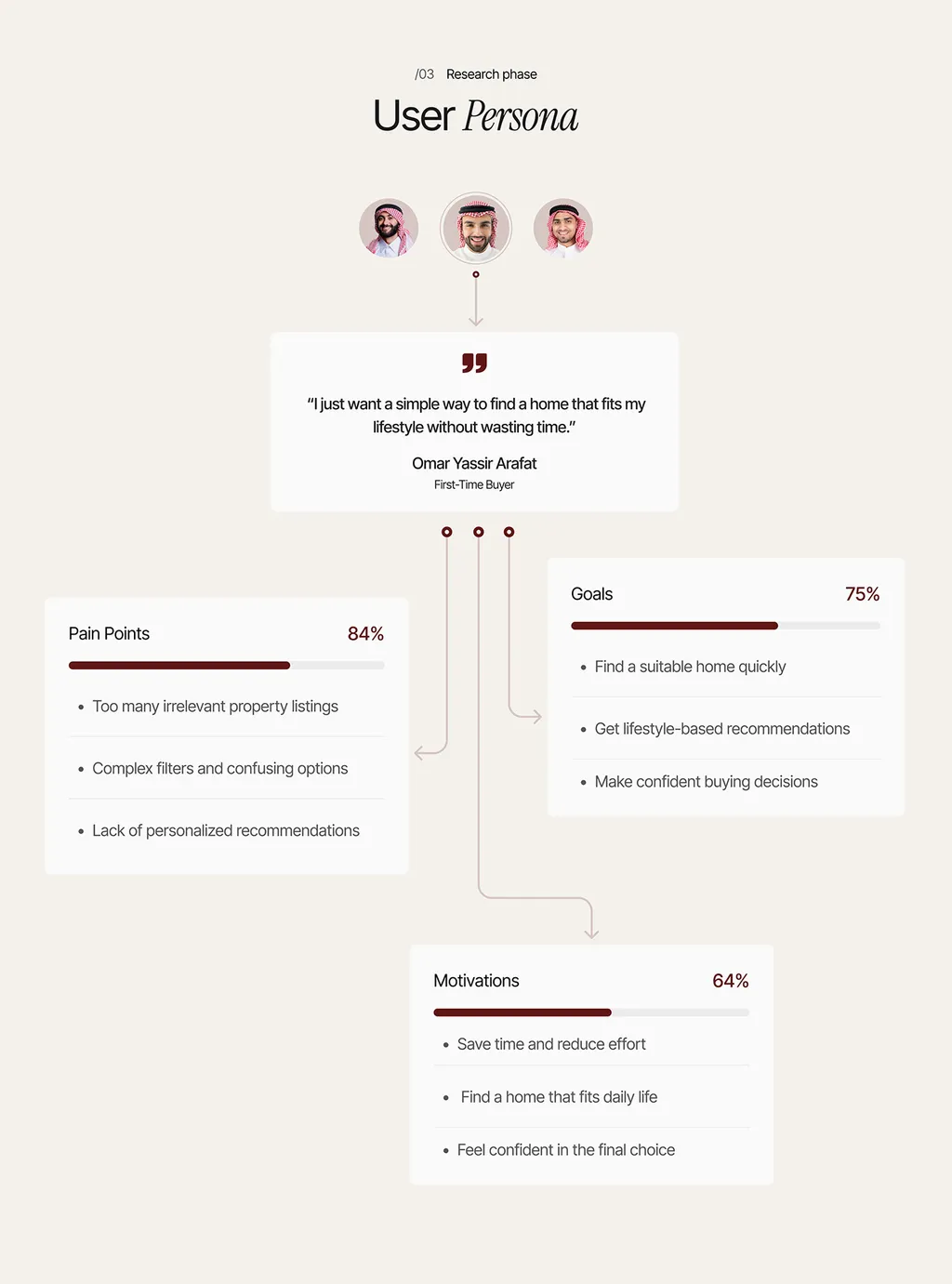
The board above is from the research phase of the Lyvio project. It shows section 2 filled in with one buyer’s pain points, goals and motivations, in place of demographics alone.
Brand strategy example: a filled-in template (fictional company)
Fernway is a fictional company I made up for this example. It is not a client and not a real brand. It’s an e-bike subscription for city commuters, chosen because its decisions are easy to follow.
| Section | Fernway (fictional) |
|---|---|
| 1. Business goal | 2,000 subscribers in one city before a seed round, and proof they stay past three months. |
| 2. Audience | Office workers aged 25–40 with a 2–6 mile commute and no car, or one they want to drop. Fear: theft, breakdowns, an expensive bike. |
| 3. Competitors and alternatives | Buying an e-bike (upfront cost, theft, upkeep), bike-share (not always there), transit (crowded), driving or ride-hailing. |
| 4. Positioning statement | For city commuters who want to stop depending on transit or a car, Fernway is an e-bike subscription with repairs and theft cover included. Unlike buying an e-bike, there’s nothing to pay upfront and nothing to fix yourself, because every plan includes servicing and theft replacement. |
| 5. Purpose and values | Purpose: a commute nobody has to think about. Values: fix it first, say the price once, be on time. |
| 6. Personality | Practical, not technical. Calm, not sporty. Friendly, not jokey. Confident, not loud. |
| 7. Key messages and proof | “Your own bike, no upfront cost” (pricing page). “Repairs and theft cover included” (service terms). “Cancel any month” (contract terms). |
| 8. Voice | Do: short sentences, plain prices, “you.” Don’t: speed talk, cycling jargon, exclamation marks. |
| 9. Visual direction | Everyday, reliable, city-friendly; no racing imagery or neon sports colors. The logo must work on a bike frame, an app icon and a van. |
| 10. Touchpoints | Website and pricing page, the app, the bike on the street, delivery and repair visits, then social and search ads. |
| 11. Measurement and review | Pricing-page sign-up rate, share still subscribed at three months, repair turnaround, mentions of “no upfront cost.” Review in six months. |
The example leaves out a long list of values, tagline ideas and brand archetypes; those can come later. It contains enough for a designer to start the identity and for a copywriter to write the website.
Digital brand strategy: applying the template online
A digital brand strategy is usually the same strategy applied to the places your brand lives online. NielsenIQ lists “digital” among its brand strategy framework types (NielsenIQ), but you don’t need a second document. Add a row per channel under section 10:
| Channel | Job | What the strategy decides |
|---|---|---|
| Website | Explain and convert | Homepage headline from the positioning statement; key messages as sections; proof on every claim |
| Search | Be found for the problem | The words your audience uses (section 2) become your page titles and topics |
| Social | Stay visible, show proof | Which messages to repeat; voice rules for replies |
| Product or app | Deliver the promise | Voice in buttons, errors and empty states; visual system in the interface |
| Keep customers | Tone for onboarding, billing and win-back emails | |
| Paid ads | Reach new people | One message per ad, always with its proof |
If you use AI tools to write or design content, give them the strategy too. Sections 7 and 8, the key messages with proof and the voice, are what keep AI output on-brand.
How to fill in a brand strategy template
- Start with evidence, not a workshop. Collect sales call notes, support emails, lost deals and reviews first. The audience’s own words beat anything written in a meeting room.
- Fill sections 1–3 before anything else. If you can’t name the alternatives, you can’t write the positioning.
- Write the positioning statement, then test it on two customers and someone who doesn’t know the company.
- Write messages only with proof. If a message has no proof yet, leave it out until you have some.
- Hand sections 4, 6 and 9 to your designer as the brief.
- Set a review date. Revisit when your audience, market or product changes.
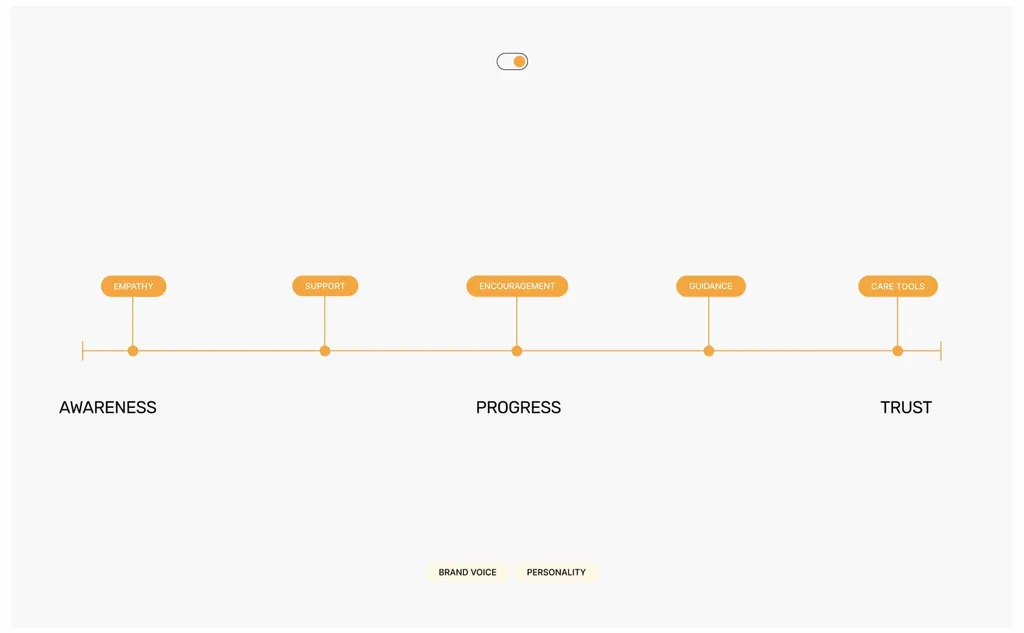
On the Sovia project, the board labeled brand voice and personality runs from awareness through progress to trust, with empathy and support early on and guidance and care tools later. It’s sections 6 and 8 applied to the customer’s journey.
Common mistakes with brand strategy templates
- Using a brand guidelines template instead. Guidelines say how to use the logo and colors. Strategy says what the brand stands for. You need the strategy first.
- Filling every box. Long templates tempt teams to write something everywhere. Leave optional sections blank until they’re needed.
- Writing for investors instead of customers. “Disrupting a huge market” belongs in a pitch deck, not on a homepage.
- No proof. A message without proof becomes a claim you can’t defend.
- No owner. A strategy without a named owner and a review date goes out of date quietly.
When to get help with your brand strategy
You can fill in this template yourself, and for an early company that’s often the right call. Bring in help when the team can’t agree on sections 2–4, when you’re about to spend on an identity or website, or when you’re entering a new market. What a brand strategist does explains the role, and brand development services explains how strategy fits with identity and guidelines. If you sell to companies, B2B brand strategy covers the buying-group map that B2B strategies add.
Book a brand strategy call
In a brand strategy project, I run the discovery workshop, review your audience and competitors, and write the positioning, personality, key messages and voice with you. It takes 2–3 weeks, with three revision rounds, at a fixed price agreed after a free call. Book a free 30-minute call in your time zone, and bring your website, deck and a few sales call notes.
FAQ
What should a brand strategy template include?
At minimum: the business goal, the audience, the alternatives you compete with, a positioning statement, personality, key messages with proof, voice, a brief for visual design, the main touchpoints, and how you’ll measure it. Purpose and values are useful if kept short.
What is a brand strategy framework?
A brand strategy framework is the structure that organizes those decisions so they build on each other. This one uses five layers: context, market, position, expression and use. NielsenIQ notes there’s no single universal framework, so pick one your team will actually fill in.
Do I need a separate template for a digital brand strategy?
No. A digital brand strategy is the same strategy applied to digital channels: website, search, social, product, email and ads. The positioning, messages and voice stay the same; each channel gets a clear job and rules for how the strategy shows up there.
How long should a brand strategy be?
A few pages. The filled-in example in this article fits in one table. A much longer document usually means decisions haven’t been made yet.
Can I write a brand strategy myself?
Yes, especially early on. Use real customer evidence, test the positioning statement on customers, and keep messages to what you can prove. Bring in a strategist when the team can’t agree or before a big design spend.
What’s the difference between a brand strategy and brand guidelines?
The strategy decides what the brand stands for, who it’s for and what it says. Guidelines show how to apply the identity: logo use, color, type and layouts. Strategy comes first; guidelines come with the identity.
How long does it take to create a brand strategy with a professional?
With me, a standalone brand strategy takes 2–3 weeks, with weekly check-ins in your time zone. It’s also part of the brand identity package, which takes 2–3 weeks including the identity and guidelines.
Sources