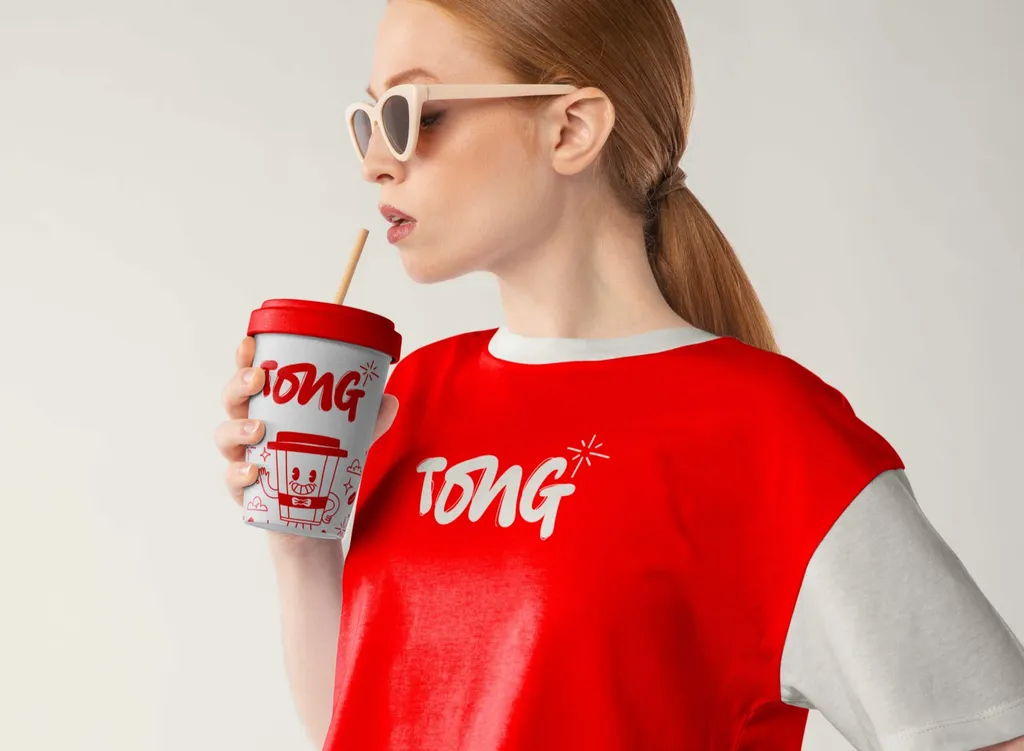
Brand Archetypes: The 12 Types and How to Choose Yours
The 12 brand archetypes with commonly cited examples, where they come from, a scoring method to choose yours, and how each one shapes color, type, logo and brand voice.

Summarize with AI
Key takeaways
- Brand archetypes are 12 character types, from Margaret Mark and Carol S. Pearson’s 2001 book The Hero and the Outlaw, built on Carl Jung’s idea of archetypes.
- They sit in four groups by motivation: independence and fulfillment, risk and mastery, belonging and enjoyment, stability and control.
- Choose from evidence, not taste: start from your positioning and your customers’ own words, then score a shortlist on fit, proof, difference, team fit and longevity.
- Use one lead archetype and at most one supporting archetype, then turn the choice into voice rules, color, type and imagery.
- Archetypes are a consistency tool, not a proven sales lever: there is little peer-reviewed evidence that choosing one raises sales.
Brand archetypes are 12 character types, adapted from Carl Jung’s psychology, that describe the role a brand plays in its customer’s life: the Innocent, Explorer, Sage, Hero, Outlaw, Magician, Regular Guy/Gal (often called the Everyman), Lover, Jester, Caregiver, Creator and Ruler. Each one stands for a basic human desire, such as freedom, mastery, belonging or control. You pick one to lead your brand and, usually, one to support it, then let that choice guide your messages, voice, color, type and imagery.
| Archetype | What it wants (and promises the customer) | Brands often cited as examples |
|---|---|---|
| Innocent | Simplicity, honesty, a good life | Dove, Coca-Cola |
| Explorer | Freedom and discovery | Patagonia, Jeep, The North Face |
| Sage | Truth and understanding | Google, TED, National Geographic |
| Hero | Mastery, proving yourself | Nike, FedEx |
| Outlaw | Breaking the rules that don’t work | Harley-Davidson, Diesel |
| Magician | Transformation, making things happen | Disney, Dyson |
| Regular Guy/Gal (Everyman) | Belonging, being one of us | IKEA, Levi’s |
| Lover | Intimacy, pleasure, beauty | Chanel, Godiva |
| Jester | Joy, living in the moment | Old Spice, M&M’s |
| Caregiver | Protecting and helping others | Volvo, Johnson & Johnson |
| Creator | Making something original and lasting | Lego, Adobe |
| Ruler | Control, order, leadership | Rolex, Mercedes-Benz |
The examples are how strategists commonly read these brands. Companies rarely publish their archetype, so treat each one as an interpretation, not a fact.
I’m Masuder Rahaman, a brand designer and the CEO and founder of Wolfpixel, where I lead a design team for founders in the US and the Middle East. Brand personality is part of my brand strategy work, decided before any design starts. This guide covers what most archetype lists leave out: a scoring method to choose yours, which pairs work together, and how each archetype turns into real color, type, logo and voice decisions.
What are brand archetypes?
Brand archetypes are a shortcut for giving a brand a consistent character. Instead of describing your brand with a long list of adjectives, you borrow a figure people already recognize from stories, myths and films (the rebel, the wise guide, the caring parent) and let it guide how the brand looks, sounds and behaves.
Where do brand archetypes come from?
The idea starts with the Swiss psychiatrist Carl Jung. In the essays collected as The Archetypes and the Collective Unconscious, Jung wrote about inherited patterns, such as the mother, the child and the trickster, that recur in myths and dreams. That is a psychological theory, not a branding tool, and Jung didn’t set out 12 types.
The 12-archetype system used in branding comes from Margaret Mark and Carol S. Pearson’s book The Hero and the Outlaw: Building Extraordinary Brands Through the Power of Archetypes (McGraw-Hill, 2001), which applies 12 archetypes to brands with case studies from advertising. When someone says “Jungian archetypes in branding,” this is almost always the system they mean.
Why do brands use archetypes?
Brands use archetypes to make decisions easier and more consistent. When five people write your website, design your packaging and run your social accounts, “we’re a Sage brand that teaches” is easier to follow than “we’re innovative, trustworthy and customer-focused.” An archetype also rules things out: a Sage brand doesn’t make jokes at the customer’s expense, and a Jester brand doesn’t write like a law firm.
It’s a tool for consistency, not a guarantee of results. There’s little published research on whether choosing an archetype makes a brand perform better; the limitations section below covers it.
What are the four groups of brand archetypes?
Mark and Pearson split the 12 archetypes into four parts of the book, and each part answers a different human need. The motivation labels below are how the model is commonly summarized, for example in a 2018 study of brand archetypes in the Revista de Gestão.
| Motivation | The book’s part title | Archetypes |
|---|---|---|
| Independence and fulfillment | The Yearning for Paradise | Innocent, Explorer, Sage |
| Risk and mastery | Leaving a Thumbprint on the World | Hero, Outlaw, Magician |
| Belonging and enjoyment | No Man (or Woman) Is an Island | Regular Guy/Gal, Lover, Jester |
| Stability and control | Providing Structure to the World | Caregiver, Creator, Ruler |
The groups help in two ways. They show you which need your product meets, which narrows 12 options to three. And they show you which pairs are natural: a secondary archetype from the same group, or a neighboring one, usually sits comfortably with the lead.
What are the 12 brand archetypes, with examples?
For each archetype: what it wants, what it fears, how it sounds and looks, where it shows up in B2B and SaaS, and the trap to avoid. The fears matter as much as the desires: a brand’s fear tells you what it must never do.
1. The Innocent
- Wants a simple, honest, good life. Fears doing something wrong and being punished for it.
- Sounds like short, warm, optimistic sentences. No jargon, no fear tactics.
- Looks like white space, soft or pastel colors, rounded shapes, natural light, clean product photos.
- In B2B and SaaS: tools that promise no surprises: simple pricing, plain-English contracts, software that just works.
- Trap: sounding naive. An Innocent brand still has to prove its claims.
2. The Explorer
- Wants freedom, discovery and an authentic life. Fears being trapped, conforming, an empty life.
- Sounds like active and open, with an invitation to go further: “go,” “find,” “beyond.”
- Looks like earthy and outdoor colors, rugged type, wide landscape photography, a compass, a horizon or a path.
- In B2B and SaaS: products that open new territory: remote-work tools, travel platforms, data tools that find what others miss.
- Trap: wanderlust with nothing behind it. Explorer brands need a real point of view on how to explore.
3. The Sage
- Wants truth and understanding. Fears being misled, ignorance.
- Sounds like calm, precise and evidence-based. It explains, cites and teaches.
- Looks like restrained palettes (deep blues, grays, one accent), serif or well-made sans-serif type, grids, charts and diagrams.
- In B2B and SaaS: analytics, research, consulting, education, compliance and expert services.
- Trap: lecturing. A Sage brand that only talks about itself, or hides behind jargon, isn’t wise, just dull.
- More: voice rules, colors, logos and the Ruler and Magician comparison are in the Sage archetype.
4. The Hero
- Wants to prove its worth through courageous action. Fears weakness, giving up.
- Sounds like direct, energetic and motivating: short verbs, a challenge, a finish line.
- Looks like strong contrast, bold condensed type, dynamic angles, people in motion.
- In B2B and SaaS: performance and delivery promises: logistics, security, sales tools.
- Trap: making the brand the hero. The customer should be the hero; the brand is the coach or the equipment.
5. The Outlaw
- Wants to overturn what isn’t working. Fears being powerless.
- Sounds like provocative, blunt and anti-establishment. It names the enemy.
- Looks like black, red and high contrast, rough or distressed type, raw photography, rule-breaking layouts.
- In B2B and SaaS: challenger brands that attack an old way of working: “no more spreadsheets,” “no more retainers.”
- Trap: rebellion as decoration. If the product doesn’t actually break a rule, Outlaw styling reads as fake.
6. The Magician
- Wants transformation, to make dreams come true. Fears unintended negative consequences.
- Sounds like visionary and a little mysterious: before and after, “imagine,” “transform.”
- Looks like deep purples, blues and gradients, light and glow effects, symbols of change.
- In B2B and SaaS: AI, automation and platforms whose value is a dramatic change in how work gets done.
- Trap: promising magic you can’t show. Demos and proof matter more here than anywhere.
7. The Regular Guy/Gal (Everyman)
- Wants to belong and to connect. Fears standing out, being left out.
- Sounds like friendly, plain and down-to-earth. Real people, real prices.
- Looks like familiar primary colors, simple sans-serif type, everyday photography of real customers.
- In B2B and SaaS: tools for small businesses and non-specialists: accounting, scheduling, website builders.
- Trap: blandness. Being relatable isn’t the same as being forgettable.
8. The Lover
- Wants intimacy, pleasure and beauty. Fears being unwanted.
- Sounds like sensual, warm and appreciative. It describes how things feel.
- Looks like rich reds, deep pinks, golds and blacks, elegant serifs and scripts, close-up photography, texture.
- In B2B and SaaS: rare, but it fits hospitality, premium food and drink, and design-led products where the experience is the point.
- Trap: style over substance. Luxury cues without the quality to match damage trust fast.
9. The Jester
- Wants to live in the moment and have fun. Fears boredom.
- Sounds like playful, witty and irreverent: jokes, puns, surprises.
- Looks like bright saturated colors, bouncy display type, illustration, characters and doodles.
- In B2B and SaaS: used more as a secondary archetype than a lead, to make a serious product approachable: friendly error messages, playful onboarding.
- Trap: jokes at the wrong moment. A Jester brand still has to be serious about billing, outages and complaints.
10. The Caregiver
- Wants to protect and care for others. Fears selfishness, ingratitude.
- Sounds like reassuring, patient and kind: “we’ll help,” “you’re covered.”
- Looks like soft blues, greens and warm neutrals, rounded type, photography of people helping people.
- In B2B and SaaS: healthcare, HR, insurance, customer support and any product that protects people or data.
- Trap: being so careful that the brand never says anything. Care still needs a clear point of view.
11. The Creator
- Wants to create something of lasting value. Fears a mediocre vision or result.
- Sounds like inspired and expressive, with an invitation to make something.
- Looks like bold, unusual color combinations, expressive or custom type, visible process (sketches, tools, building blocks).
- In B2B and SaaS: design tools, no-code platforms, developer tools and creative agencies.
- Trap: novelty for its own sake. An identity that changes every month isn’t creative, it’s inconsistent.
12. The Ruler
- Wants control, order and leadership. Fears chaos, being overthrown.
- Sounds like confident, formal and authoritative. Few words, no slang.
- Looks like black, navy, gold and deep green; classic serifs or strong, wide sans-serifs; symmetry, crests and monograms.
- In B2B and SaaS: enterprise software, finance, legal and any brand that sells stability to people who manage risk.
- Trap: coldness. Authority without warmth can feel arrogant, especially to smaller customers.
Brand archetype vs brand personality vs positioning: what’s the difference?
These three are often mixed up, and that confusion is why many archetype exercises go nowhere. They answer different questions, in a set order.
| Tool | The question it answers | What you end up with |
|---|---|---|
| Positioning | Who is this for, and why choose us over the alternatives? | One sentence about audience, category and difference |
| Brand archetype | What role do we play in the customer’s story? | One lead archetype, often one supporting archetype |
| Brand personality | How exactly do we behave and sound? | Three to five specific traits, plus voice rules |
Positioning comes first, because an archetype that contradicts your positioning is just a costume. How to write a positioning statement covers that step.
Brand personality is the more detailed, more measurable layer. The best-known research model is Jennifer Aaker’s brand personality framework (Journal of Marketing Research, 1997), which groups brand traits into five dimensions: sincerity, excitement, competence, sophistication and ruggedness. An archetype gives you the character; personality traits make it specific enough to write and design from. A Sage brand could be “precise, generous and calm” or “sharp, opinionated and fast,” and those two would look and sound very different.
How do you choose your brand archetype?
Choose your archetype from evidence, not from which description you like best. Founders often pick the archetype they admire (usually the Hero, Creator or Magician), not the one their customers actually experience. These six steps keep the choice honest:
- Start from your positioning. Write down who you serve, what problem you solve and why you, in one sentence. If you can’t yet, do that first: the brand strategy template walks through it.
- Name the customer’s core desire. Look at sales calls, reviews and support emails. Do customers want freedom (Explorer), certainty (Sage, Ruler), belonging (Regular Guy/Gal), protection (Caregiver), transformation (Magician)? Use their words, not yours.
- Pick the motivation group. That desire points to one of the four groups above, which leaves three archetypes.
- Audit your competitors. Put five competitors side by side and label their archetypes. If every competitor is a Sage, a second Sage is hard to remember. The gap may be your opportunity, as long as your product supports it.
- Shortlist two or three and score them (below).
- Test the winner on real headlines, a homepage and a social post before you commit (see the tests further down).
How do you score your shortlist?
Score each candidate from 1 (weak) to 5 (strong) on five questions, then total the scores. The highest total usually wins, but a low score on proof should rule an archetype out on its own.
| Criterion | The question to ask | What a 5 looks like |
|---|---|---|
| Customer fit | Does it match the desire your customers actually express? | Their own words in reviews or calls match the archetype |
| Proof | Can you prove it today with your product, service or team? | Concrete evidence: features, results, policies, people |
| Difference | Does it set you apart from your closest competitors? | None of your five closest competitors uses it |
| Team fit | Can your team sound like this every day without forcing it? | Your best salesperson already talks this way |
| Longevity | Will it still fit in five years, as you add products and markets? | It describes your mission, not one product |
Should you choose one archetype or two?
Choose one primary archetype to lead and, if you need it, one secondary archetype to add nuance. A second archetype helps when the lead alone would feel too narrow or too cold, for example a Sage with a touch of Jester to make expertise approachable. More than two and the character blurs. Some pairs work naturally; some fight each other.
| Pair (lead + support) | How it reads | Where it fits |
|---|---|---|
| Sage + Caregiver | An expert you can trust with something important | Healthcare, financial advice, education |
| Explorer + Creator | Adventurous and inventive | Outdoor gear, travel, design tools |
| Ruler + Sage | Authoritative and well informed | Enterprise software, legal, consulting |
| Regular Guy/Gal + Jester | Friendly and fun, never smug | Consumer apps, food, small-business tools |
| Hero + Outlaw | Determined to win against a broken system | Challenger brands, fitness, fintech |
| Innocent + Outlaw | Usually a clash: purity vs rebellion | Avoid unless the tension is the idea |
| Ruler + Jester | Usually a clash: control vs chaos | Works only as deliberate self-mockery |
How do brand archetypes shape your visual identity?
Each archetype points to a family of visual choices: color, type, shapes, imagery and logo style. These are tendencies, not rules. Color meanings change between cultures and categories, and a cliché is still a cliché. Use the table to make sure your visuals don’t contradict your archetype, then find your own way within it.
| Archetype | Color and type cues | Logo, shape and imagery cues |
|---|---|---|
| Innocent | Whites, pastels, soft blues; light rounded sans-serifs | Simple marks, curves, natural light, clean product shots |
| Explorer | Earth tones, forest greens, sky blues; sturdy, rugged type | Horizons, paths, compasses; wide outdoor photography |
| Sage | Deep blues, grays, one accent; serifs or precise sans-serifs | Geometric marks, grids, charts, diagrams |
| Hero | High contrast, red, black, bright accents; bold condensed type | Strong angles, forward motion, people in action |
| Outlaw | Black, red, raw contrast; distressed or hand-cut type | Broken rules in layout, raw photos, sharp edges |
| Magician | Purples, deep blues, gradients; refined, slightly unusual type | Light, glow and change; symbols of transformation |
| Regular Guy/Gal | Familiar primaries, warm neutrals; simple friendly sans-serifs | Plain marks, real customers, everyday settings |
| Lover | Rich reds, pinks, golds, black; elegant serifs and scripts | Close-ups, texture, soft focus, curves |
| Jester | Bright saturated colors; bouncy or hand-drawn display type | Characters, doodles, illustration, surprise |
| Caregiver | Soft blues, greens, warm neutrals; rounded humanist type | Hands, shelter shapes, people helping people |
| Creator | Unusual color pairs; expressive or custom type | Building blocks, sketches, visible process |
| Ruler | Black, navy, gold, deep green; classic serifs or wide caps | Crests, monograms, symmetry, premium materials |
The same layout changes character with the archetype behind it. A Ruler poster uses a dark band, a centered heading and strict rules. A Jester poster in the same format uses bright color, loose shapes and a line that bounces. A Sage poster stays white, with a fine grid and small, precise type.
For the type side in detail, see how to choose brand fonts. For the full process from strategy to finished identity, see how to build a brand identity from scratch.
How do brand archetypes shape your brand voice?
Your archetype decides how you say things, even when the message is the same. Here is one message, “our software saves you time on reporting,” written three ways:
| Archetype | The same message | Why it works for that archetype |
|---|---|---|
| Sage | “Teams using automated reports spend less time copying numbers and more time reading them.” | Calm, explains the mechanism, no hype |
| Jester | “Your spreadsheets called. They want a break.” | A joke that still makes the point |
| Ruler | “Every report, accurate and on time. Every month.” | Short, confident, about control |
Turn this into voice rules your whole team can use: three to five personality traits, a few lines of “we say / we don’t say,” and examples for the moments that matter most (the homepage, a sales email, an apology). The voice section of the brand strategy template has a format you can copy.
What do brand archetypes look like in real projects?
Here are two identities from my own portfolio, read through the archetype lens. The archetype labels are my reading of the finished work, not names written on the client briefs, but they show how a clear character turns into concrete design.
Tong: a Jester with an Outlaw streak
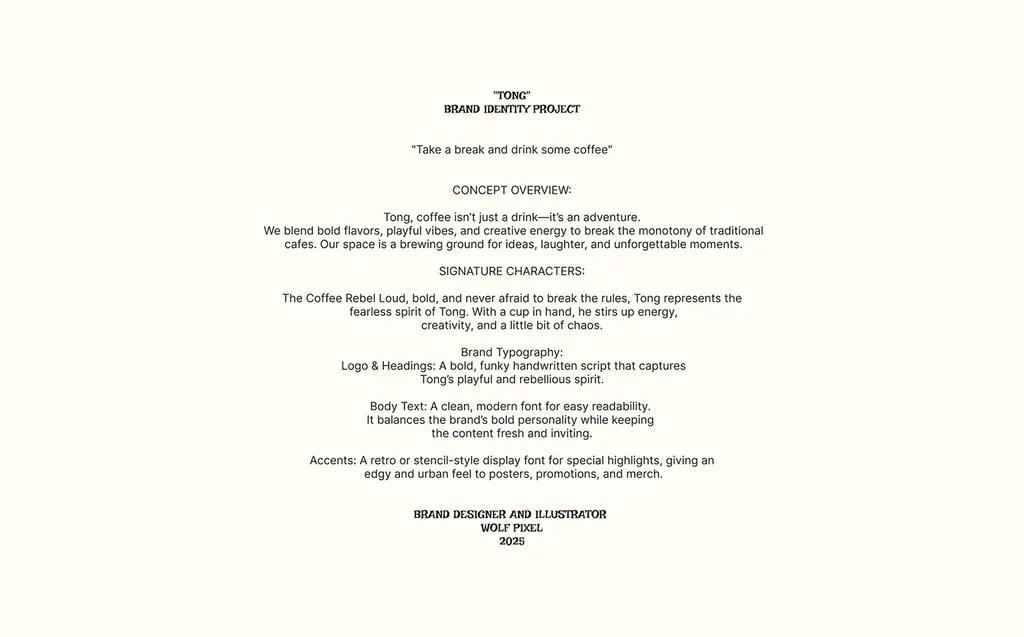
Tong is a coffee shop built around one line: “Coffee isn’t just a drink, it’s an adventure.” The identity reads as Jester: a bold, funky handwritten logo, a cast of doodles, red everywhere, and lines like “No bad days, just good coffee.” The secondary archetype is the Outlaw, carried by the lead character, the Coffee Rebel, described in the project as loud, bold and never afraid to break the rules. The brand sets out to break the monotony of traditional cafés without becoming hostile, which is what a Jester lead with Outlaw support does well.
Wayfare: a calm Explorer
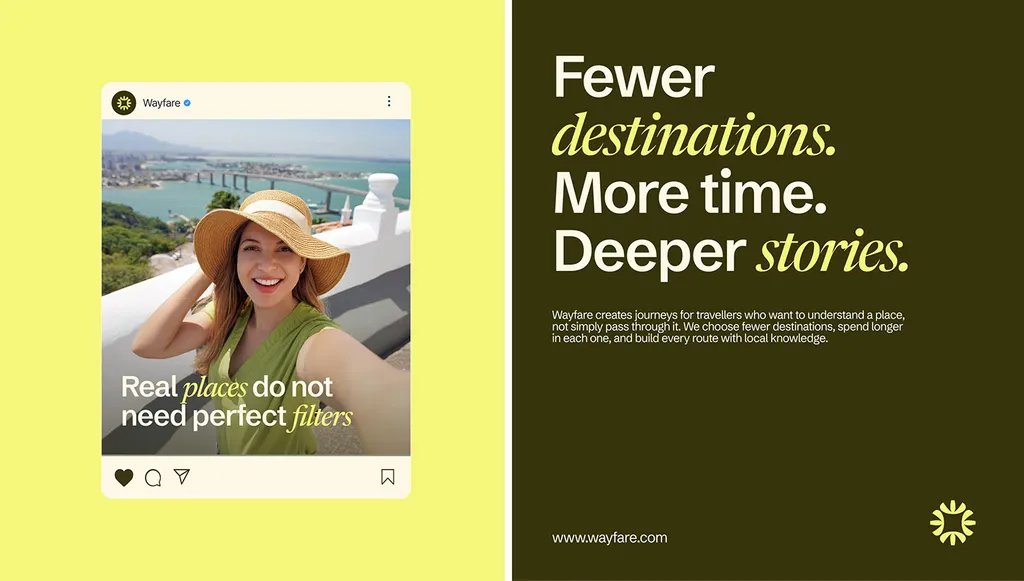
Wayfare is a travel agency with a slow-travel idea: “Go slow. See more.” That’s the Explorer’s desire for an authentic life, but without the usual Explorer adrenaline. Where travel branding often celebrates speed, Wayfare’s sun symbol is built from circles, open spaces and balanced forms so it feels calm, warm and unhurried, in lime, soft yellow, cream and deep olive. The calm reads as a secondary Sage note: fewer destinations, deeper understanding. It shows that two brands with the same lead archetype can look completely different.
How do you test a brand archetype?
Test your archetype on real work before you build a whole identity around it. Four quick tests:
- The headline test. Write your homepage headline, a sales email and an apology email in the archetype’s voice. If the apology sounds wrong, the archetype will break in the moments that matter.
- The swap test. Replace your brand name with a competitor’s. If your copy still works for them, the archetype isn’t doing anything.
- The customer test. Show three or four customers two versions of the same page (for example Sage and Regular Guy/Gal) and ask which sounds like a company they’d trust with their problem. Listen to the words they use.
- The team test. Ask three people on your team to write a social post in the archetype. If all three come back sounding similar, the archetype is clear enough to use.
What are the limitations of brand archetypes?
Brand archetypes are useful, but they have real limits:
- The evidence is thin. Jung’s archetypes are a psychological theory, not a tested scientific model, and I found no peer-reviewed study tying an archetype choice to sales. One of the few published studies, by Bechter and colleagues (2016), had 102 Executive MBA students watch two hotel TV commercials, then compared Jung’s archetypes with Aaker’s personality traits. It found common ground between the two frameworks; it didn’t measure sales.
- They can flatten a brand. Twelve boxes can’t capture everything a company is. Treat the archetype as a starting character, then add specific personality traits.
- They can lead to clichés. “We’re an Explorer, so let’s use mountains” is how ten brands end up with the same mountain. Use the archetype to choose a feeling, not a stock image.
- They come from Western storytelling. The figures are familiar in many cultures, but their colors, symbols and humor don’t translate one to one. For brands in the Gulf, for example, a Jester’s irreverence or a Lover’s sensuality needs care.
- They’re not a substitute for strategy. An archetype without positioning, audience research and proof is a costume.
What are the most common brand archetype mistakes?
- Picking the archetype you admire, not the one you are. Every founder wants to be the Hero. Score against evidence.
- Choosing before positioning. The archetype should express your positioning, not replace it.
- Using three or four archetypes. One lead, one support at most.
- Stopping at the label. “We’re a Sage” changes nothing until it becomes voice rules, color, type and imagery.
- Making the brand the hero. In most stories, the customer is the hero and the brand is the guide or the tool.
- Copying the category leader’s archetype. You’ll look established and forgettable.
- Never testing it. Run the four tests above before you commit.
A brand archetype worksheet you can copy
Fill this in with your team. It takes about an hour and gives a designer or copywriter what they need from the archetype.
| Prompt | Your answer | Evidence |
|---|---|---|
| Our positioning in one sentence | ||
| The customer’s core desire, in their words | Quote from a call, review or email | |
| Motivation group (independence, mastery, belonging or stability) | ||
| Lead archetype, and its score out of 25 | ||
| Supporting archetype (optional), and why | ||
| What we fear doing (from the archetype’s fear) | ||
| Three to five personality traits | ||
| We say / we don’t say (three lines each) | ||
| Color, type and imagery direction | ||
| The competitor archetype we’re avoiding |
Define your brand archetype with me
If you want help choosing your archetype and turning it into something your team and designers can use, my brand strategy project covers positioning, audience, key messages, brand personality and voice in 2–3 weeks, with a fixed written proposal after a free call. If you need the strategy and the full visual identity together, the brand identity package includes strategy, four concepts, guidelines and a Figma library for $3,499 in 2–3 weeks.
Bring your shortlist, or just your positioning, to a free 30-minute call in your time zone, and I’ll tell you which archetype your evidence supports.
FAQ
What are the 12 brand archetypes?
The Innocent, Explorer, Sage, Hero, Outlaw, Magician, Regular Guy/Gal (often called the Everyman), Lover, Jester, Caregiver, Creator and Ruler. They come from Margaret Mark and Carol S. Pearson’s 2001 book The Hero and the Outlaw, which adapted Carl Jung’s idea of archetypes for branding.
Are brand archetypes based on Jung?
Partly. Carl Jung introduced the idea of archetypes as shared patterns in myths and the human mind. The 12-type branding system came later, from Mark and Pearson. Jung didn’t define 12 brand archetypes himself.
Can a brand have more than one archetype?
Yes, but keep it to two: one primary archetype that leads and one secondary archetype that adds nuance. A Sage with a Caregiver secondary, for example, reads as an expert you can trust. More than two usually blurs the brand’s character.
Which brand archetype is best for B2B and SaaS companies?
There’s no single best one, but the Sage, Ruler, Caregiver, Creator and Hero are common in B2B because buyers want expertise, stability, protection or results. Choose the one your customers’ core desire and your proof support, and consider a Jester or Regular Guy/Gal secondary to make a technical product easier to approach.
Can you change your brand archetype later?
Yes, usually as part of a rebrand, when the company’s positioning or audience has changed. Changing it without a reason confuses customers, so treat it as a strategic decision, not a style update.
Do I need a brand archetype at all?
No. An archetype is a shortcut, not a requirement. If your positioning, personality traits and voice rules are already clear and your team uses them consistently, you can skip it. It’s most useful when several people create content for the brand and need a shared character to follow.
Sources
- Princeton University Press: The Collected Works of C. G. Jung, Volume 9 (Part 1): The Archetypes and the Collective Unconscious
- Library of Congress: Table of contents for The Hero and the Outlaw (Mark and Pearson, McGraw-Hill, 2001)
- Jennifer L. Aaker: Dimensions of Brand Personality, Journal of Marketing Research 34(3), 1997
- Bechter, Farinelli, Daniel and Frey: Advertising between Archetype and Brand Personality, Administrative Sciences 6(2), 2016
- Xara-Brasil et al.: The meaning of a brand? An archetypal approach, Revista de Gestão 25(2), 2018