Tagline vs Slogan: What’s the Difference, and Do You Need One?
Tagline vs slogan: a tagline stays with the brand for years, a slogan belongs to one campaign. A side-by-side table, famous examples, how to write a tagline and how to test it.

Summarize with AI
Key takeaways
- A tagline is a lasting line that sums up the brand. A slogan is written for one campaign, product or season and changes when the campaign does.
- Many people use the two words interchangeably, and in the UK a tagline is often called a strapline. What matters is how long the line is meant to last.
- A slogan can grow into a tagline: Nike’s “Just Do It” began as a 1988 campaign line and is still in use.
- Write the tagline from your positioning, not the other way round. If you can’t say what makes you different in a sentence, the tagline won’t fix it.
- A tagline can sometimes be registered as a trademark, but only if it works as a mark. Purely informational phrases are refused by the USPTO.
Tagline vs slogan comes down to how long the line is meant to last. A tagline is a short line that stays with a brand for years and sums up what it stands for. A slogan is written for one campaign, product or moment, and it changes when the campaign does. People often use the words interchangeably, so ask “how long will this line live?” rather than worrying about the label.
I’m Masuder Rahaman, a brand designer and the CEO and founder of Wolfpixel. In my brand strategy projects I write the positioning and key messages that a tagline is built on, and I place the tagline in the identity when there is one. This guide gives you a side-by-side comparison, famous examples (labeled as other companies’ work), one real example from my own projects, a method for writing a tagline and a test to run before you use it.
What is the difference between a tagline and a slogan?
The difference is lifespan and scope: a tagline belongs to the brand, a slogan belongs to a campaign.
| Tagline | Slogan | |
|---|---|---|
| What it’s for | Sums up what the brand stands for | Sells one campaign, product, offer or cause |
| How long it lasts | Years, often as long as the brand | Weeks to a few years, until the campaign ends |
| How many at once | One | Several can run at the same time |
| Where it appears | Next to the logo, homepage, signature, packaging, end of ads | Inside ads, posters, social posts, landing pages |
| Who writes it | Brand strategy and identity work | Campaign and advertising work |
| What it comes from | The positioning | The campaign brief |
| How often it changes | Rarely, usually with a rebrand | Whenever the campaign changes |
Lippincott, the brand consultancy, lists slogan, strapline, motto and credo as other names for a tagline, and describes a modern tagline as “an ownable shorthand for a brand’s intended meaning”. One of its rules sums up the relationship well: a tagline should be broad enough to link different campaigns. The tagline is the constant; the slogans are the campaigns that sit underneath it.
What is a tagline?
A tagline is the one line you want people to remember with your name. It answers “what is this brand about?” in a few words, and it appears wherever the brand does: next to the logo, on the homepage, in email signatures and at the end of ads.
A good tagline does one of three jobs:
- Says what you do, for a new company whose name doesn’t explain it yet.
- Says how you do it differently, taken from your positioning.
- Says what you believe, when the brand is already known and can afford to be less literal.
Taglines still carry weight in advertising. Lippincott cites Kantar research finding that 66% of TV ads end with a tagline, down from 74% ten years earlier. Fewer brands use one automatically, but the ones that do use it on purpose.
What is a slogan?
A slogan is a line written to make one campaign memorable. It can promote a product, a season, an offer or a cause, and when that campaign ends, the slogan usually ends with it. A brand can run several slogans in one year under the same tagline.
The test is simple: if the line would sound odd once this product or promotion is gone, it’s a slogan.
Tagline vs slogan vs motto vs strapline: what do the other terms mean?
The other terms describe either a different audience or a regional word for the same thing:
| Term | What it means in practice | Who it speaks to |
|---|---|---|
| Tagline | The lasting line that sits with the brand | Customers |
| Slogan | A line for one campaign, product or cause | Customers, voters, supporters |
| Strapline | The usual British word for a tagline | Customers |
| Motto | A short statement of a principle or belief that guides behavior | The team, members, a school, a city, a country |
| Mission statement | Why the company exists, in a sentence or two | Team and investors |
| Positioning statement | Who it’s for, the category, the difference and the proof | Your team and designers |
The slogan vs motto difference is direction. A slogan faces outward and tries to persuade. A motto faces inward and states what the group lives by; it isn’t selling anything. Your positioning statement is internal too, and it’s the source your tagline should be written from.
Famous tagline and slogan examples
These are other companies’ lines, not my work. Each date and attribution links to the source I checked. For 40 more, grouped by the technique behind each one, see slogan examples.
| Line | Brand | Started | Tagline or slogan? |
|---|---|---|---|
| “A Diamond Is Forever” | De Beers | Written in 1947 by Frances Gerety at the agency N. W. Ayer & Son | Tagline: one idea used for decades |
| “Just Do It” | Nike | 1988; the 30th anniversary campaign ran in 2018 | Began as a campaign line, became a tagline |
| “Where’s the beef?” | Wendy’s | First aired January 10, 1984 | Slogan: tied to one campaign |
| “Got Milk?” | California Milk Processor Board | Created in 1993 by Goodby Silverstein & Partners; informally retired in 2014 for “Milk Life” | Campaign slogan, replaced after about two decades |
Two lessons come out of these. First, the line between tagline and slogan isn’t fixed: “Just Do It” started as advertising and became the brand’s line because Nike kept it. Second, even very famous slogans end. “Got Milk?” was replaced nationally when the industry wanted a different message.
A real example from my work: Wayfare
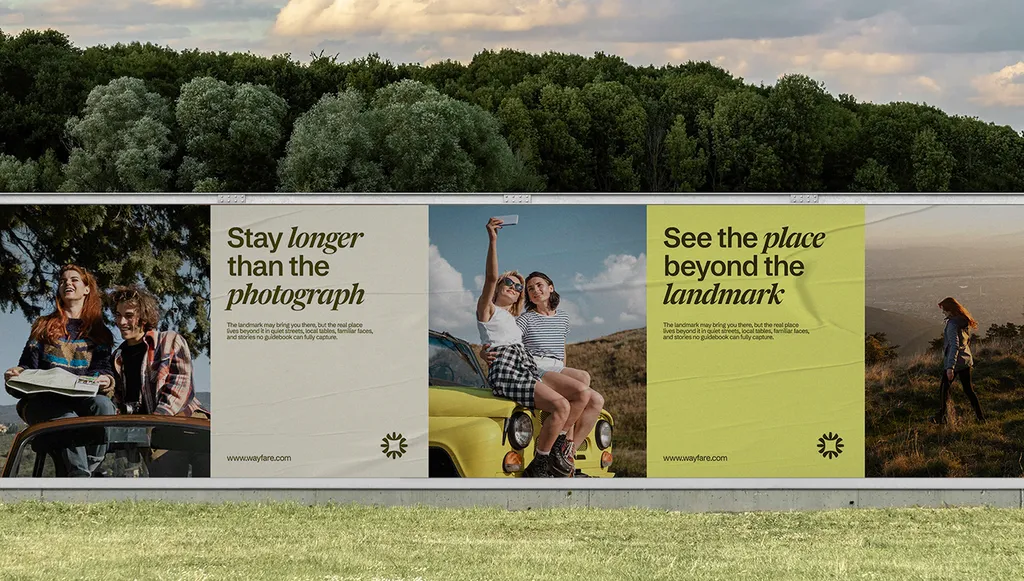
For the travel brand Wayfare, the brand line is “Go slow. See more.” It came straight out of the strategy: modern travel had become a race, and Wayfare would offer fewer stops and more time in each. Under that one line, the campaign work uses changing lines such as “Stay longer than the photograph,” “See the place beyond the landmark” and “Fewer destinations. More time. Deeper stories.” That’s the tagline and slogan relationship in one project: the tagline stays, the slogans rotate.
Does a small business need a tagline?
Not on day one, and not always. A tagline earns its place when your name doesn’t say what you do, when you compete in a crowded category, or when you need one consistent line across a website, packaging and ads.
You can skip it, at least for now, if:
- Your name already says what you do.
- You haven’t settled your positioning. A tagline written before the positioning usually has to be rewritten.
- Your homepage headline already does the job. A headline can change with every test; a tagline shouldn’t.
If you’re still choosing a name, decide the name first. A tagline can explain a distinctive name, but it can’t rescue a confusing one. If you’re changing your company name, the renaming guide covers the order of steps, and the tagline comes near the end.
How do you write a tagline?
Write it from your positioning, then cut until only the idea is left.
- Start with your positioning. Write down who you serve, what you do for them that the alternatives don’t, and the proof. The brand strategy template shows where that sits.
- Pick the job. Will the line say what you do, how you’re different, or what you believe? Choose one.
- Collect your customers’ words. Sales calls, reviews and support emails are full of phrases people already use about the problem you solve.
- Write 30 to 50 options. Quantity first. Try statements, imperatives (“Go slow. See more.”), questions and two-part lines.
- Cut to five. Remove anything a competitor could say, anything that needs explaining and anything that leans on a pun only one person laughs at.
- Put each one next to the logo. A tagline is read alongside the name. Some lines that work on paper repeat the name, fight it or make the lockup too wide.
- Run the test below, then choose one and leave it alone for a while.
Keep it short. There’s no official word limit, but most lasting taglines are a handful of words, because they have to fit under a logo and on a small screen.
How do you test a tagline?
Run these checks before you put the line on anything printed:
| Check | It passes if |
|---|---|
| Swap test | It stops being true with a competitor’s name next to it |
| Positioning match | It points to the difference in your positioning statement |
| Proof | You can back up every claim it makes today |
| Say it out loud | It’s easy to say on a call, without stumbling |
| Five-second test | Someone new can tell you what you do, or what you stand for, after reading it once |
| Lockup test | It fits under or beside the logo and stays readable at small sizes |
| Language check | It doesn’t mean something awkward in a language your customers speak |
| Search check | No one in your category already uses it or something very close |
| Lifespan | You’d still be happy using it in five years |
The proof check matters more than people expect. A tagline is advertising, so a claim like “fastest” or “safest” needs the same evidence as any other ad claim.
Can you trademark a tagline?
Sometimes. In the US a trademark can be “any word, phrase, symbol, design, or a combination” that identifies your goods or services, so a tagline can qualify. The USPTO also explains that you become an owner by using the mark, with rights limited to where you trade unless you register it federally.
Copyright is the wrong tool. The US Copyright Office says copyright does not protect names, titles, slogans or short phrases, and that they may be protected as trademarks instead.
Not every line can be registered. The USPTO’s examination manual says “merely informational matter fails to function as a mark”, giving WHY PAY MORE! as an example of a common advertising slogan. The USPTO has also published Exam Guide 2-17 on merely informational matter to add detail to that section. In practice, a distinctive tagline used consistently with your brand has a better chance than a generic phrase anyone in your industry might say.
Trademark advice should come from a trademark attorney. Ask them to search and file before you print the tagline on packaging, vehicles or signs.
Where should you use a tagline?
Use it where the brand is introduced, and keep it consistent everywhere else:
- Next to or under the logo in a tagline lockup, with a version without it for small sizes.
- On the homepage, the email signature, the pitch deck cover and business cards.
- At the end of ads and videos, after the campaign slogan has done its work.
- In your brand guidelines and brand kit, written exactly once, so nobody retypes it with different punctuation.
How I can help
Tagline writing isn’t a set deliverable in my packages, but the work it depends on is. My brand strategy service writes your positioning, key messages and brand voice in 2–3 weeks; a tagline written from those has something real to say. If you still need a name, my brand naming service gives you name ideas with reasons, a shortlist, domain and handle checks and a preliminary trademark search in 1–2 weeks. If you want a tagline written as well, tell me on a free 30-minute call in your time zone; any scope outside the packages gets a fixed written proposal first.
FAQ
Is a tagline the same as a slogan?
Not quite, although many people use the words interchangeably. A tagline is meant to last and stays with the brand; a slogan is written for one campaign, product or moment. The same line can start as a slogan and become a tagline if the brand keeps it.
What is a strapline?
Strapline is the word commonly used in the UK for a tagline: the short line that sits with a brand name or logo and sums up what the brand stands for.
What is the difference between a slogan and a motto?
A slogan faces outward and tries to persuade customers or supporters, usually for one campaign. A motto faces inward and states a principle a group lives by, like a school, a city or a team. A motto isn’t selling anything.
How long should a tagline be?
There’s no fixed limit, but most lasting taglines are a handful of words. It has to fit under or beside the logo, stay readable on a phone and be easy to say out loud.
Should the tagline be part of the logo?
Make a tagline lockup, but keep a version of the logo without it. At small sizes such as a favicon, an app icon or a social avatar, the tagline becomes unreadable, and a tagline you may change later shouldn’t be the only version of your logo.
Can a business have more than one tagline?
It should have one at a time. Sub-brands or product lines can have their own lines, and campaigns can have as many slogans as they need, but two competing brand taglines make it harder for people to remember either.
Sources
- Lippincott: The art of the tagline (August 2, 2024)
- USPTO: What is a trademark?
- U.S. Copyright Office: What does copyright protect? (FAQ)
- TMEP §1202.04: Informational Matter (BitLaw copy of the USPTO manual)
- USPTO bulletin: Exam Guide 2-17, “Merely Informational Matter”
- Sotheby’s: How De Beers changed the diamond market with one simple tagline
- Adweek: Colin Kaepernick fronts Nike’s 30th anniversary of “Just Do It” (2018)
- The Takeout: How Wendy’s “Where’s the Beef” campaign got its start
- Mental Floss: A brief history of the “Got Milk?” campaign