Slogan Examples: 40 Lines and the Technique Behind Each One
40 slogan and tagline examples grouped by the technique that makes each one work, what to copy and what to avoid, the swap test and a seven-step way to write your own.

Summarize with AI
Key takeaways
- The slogans people remember do one job each: state a benefit, turn a weakness into a promise, give an instruction, play with sound, sell a feeling, ask a question or claim a moment.
- Most lasting lines are short, specific to one brand and true. If a competitor could use your line unchanged, it isn’t working yet.
- Sound helps more than it seems: in one study, rhyming sayings were judged more accurate than the same idea without the rhyme.
- A line that promises something you can’t prove is a risk, not just a weak line.
- Copy the technique, never the words. Start from your positioning, pick one technique and write 30 or more options before you choose.
The best slogan examples have three things in common: they’re short, they could only belong to one brand, and they say one thing a customer cares about. “Melts in your mouth, not in your hand” works because it’s a concrete benefit no other candy owned. “Just Do It” works because it gives an instruction people want to follow. Below are 40 slogans and taglines, grouped by the technique that makes each one work, so you can see what to copy and what to leave alone.
| What the best ones share | What it looks like | Why it matters |
|---|---|---|
| One idea | A single benefit, belief or instruction | Two ideas in one line means neither is remembered |
| Specific to the brand | It fails if you swap in a competitor’s name | A line anyone could say builds nobody’s brand |
| Short and easy to say | Most famous ones are two to eight words | It has to fit under a logo and be repeated out loud |
| True | The product backs it up | An unprovable claim can be challenged |
| Built for repetition | Rhythm, rhyme, repetition or a strong verb | Lines get remembered by being heard many times |
I’m Masuder Rahaman, a brand designer and the CEO and founder of Wolfpixel, where I lead a design team for founders in the US and the Middle East. In my naming and strategy work, the name and the positioning come first, and the line that sits next to the name is written from them. Every famous line here is another company’s work, not mine; the one example from my own projects is labeled.
Slogan or tagline? People use the two words interchangeably. Strictly, a tagline stays with the brand for years and a slogan belongs to one campaign; tagline vs slogan covers the difference. This list includes both, because the techniques are the same.
1. Which slogans state a plain benefit?
The simplest technique: say what the customer gets, in words they would use themselves.
| Slogan | Brand | Why it works |
|---|---|---|
| “Melts in your mouth, not in your hand” | M&M’s | Names a real product advantage (the candy shell) in a way you can picture; it launched with the brand’s first TV ads in 1954 |
| “When it absolutely, positively has to be there overnight” | FedEx (former) | Speaks to the moment of panic the service solves; the two adverbs are the promise. Written by the agency Ally & Gargano in the late 1970s |
| “The Ultimate Driving Machine” | BMW | Claims the driving experience, not the badge; coined in 1974 and still in BMW’s advertising |
| “Save money. Live better.” | Walmart | Joins the rational reason (price) to the emotional one (what the savings buy); introduced in 2007 |
| “It keeps going and going and going” | Energizer | Turns a battery’s one job, lasting, into a line that itself keeps going |
What to copy: find the benefit you can prove and say it as a customer would. If your benefit needs a footnote, it isn’t ready for a slogan.
2. Which slogans turn a weakness into a promise?
These brands said the awkward thing out loud and made it the reason to buy.
| Slogan | Brand | Why it works |
|---|---|---|
| “We Try Harder” | Avis | Being number two in car rental became proof of effort; written by DDB in 1962 and still on Avis’s site |
| “Think Small” | Volkswagen | Made a small car look like the smart choice when big cars were the norm; a 1959 DDB ad headline |
| “Love it or hate it” | Marmite | Admits half the market dislikes the taste, which makes fans feel part of a club; from 1996 |
| “Good things come to those who wait” | Guinness | Reframes the slow pour of a pint as a reward instead of a delay; AMV BBDO, late 1990s |
| “With a name like Smucker’s, it has to be good” | Smucker’s | Jokes about an odd-sounding name and turns it into a quality claim; used since 1962 |
What to copy: list what customers complain about (price, wait, size, an unusual name) and ask whether it’s the side effect of something good. If it is, that’s a line.
3. Which slogans give an instruction?
An imperative verb makes the reader the subject of the sentence. It works best when the instruction is something the customer already wants to do.
| Slogan | Brand | Why it works |
|---|---|---|
| “Just Do It” | Nike | Speaks to anyone who has put off a run, not only athletes; began as a 1988 campaign line and stayed |
| “Think Different” | Apple (former) | Two words that position the customer, not the computer; launched in 1997 by TBWA\Chiat\Day |
| “Taste the Rainbow” | Skittles | Turns the product’s many colors into an invitation |
| “Obey Your Thirst” | Sprite | Tells you to trust your own taste instead of the image of other drinks |
| “Eat Fresh” | Subway | Two words that carry the brand’s difference from other fast food: food made in front of you |
What to copy: pick a verb your customer would be proud to do. “Discover,” “Experience” and “Unleash” are on so many websites that they no longer register.
4. Which slogans use rhyme, rhythm and repetition?
Sound is the oldest memory trick there is, and research backs it. In a study by McGlone and Tofighbakhsh, people judged rhyming sayings as more accurate than versions with the same meaning but no rhyme. A line that sounds right feels right.
| Slogan | Brand | Why it works |
|---|---|---|
| “Maybe she’s born with it. Maybe it’s Maybelline.” | Maybelline | The brand name finishes the sentence, so you can’t say the line without it. Used from 1991 and updated in November 2026 to “Maybe. We’re born with it. Maybe. It’s Maybelline.” |
| “Have a break, have a Kit Kat” | Kit Kat | Repeats “have a” and links the snap of the bar to a break in the day; dates from the late 1950s |
| “Beanz Meanz Heinz” | Heinz (UK) | Three rhyming words, with a misspelling that makes it look like a logo; from 1967 |
| “Snap! Crackle! Pop!” | Rice Krispies | Describes the sound of the cereal, so every bowl repeats the slogan |
| “Kids and grown-ups love it so, the happy world of Haribo” | Haribo | A jingle that works sung or spoken, and widens the audience to adults |
What to copy: read your options out loud. If the brand name can land on the beat, or the last word rhymes with it, you have a line that repeats itself.
5. Which slogans sell a feeling?
These don’t describe the product at all. They describe how it feels to buy it or own it.
| Slogan | Brand | Why it works |
|---|---|---|
| “A Diamond Is Forever” | De Beers | Ties a stone to permanence and a promise; written in 1947 by Frances Gerety at N. W. Ayer & Son |
| “Because I’m worth it” | L’Oréal | Gives the buyer a reason that’s about her, not the formula; written by Ilon Specht at McCann in 1971, and today “Because You’re Worth It” |
| “There are some things money can’t buy. For everything else, there’s Mastercard.” | Mastercard | Admits what a card can’t do, which makes the claim about everything else believable; the “Priceless” campaign began in 1997 |
| “When you care enough to send the very best” | Hallmark | Turns buying a card into proof of how much you care |
| “Open Happiness” | Coca-Cola (former) | Links the physical act of opening a bottle to the feeling the brand wants |
What to copy: this technique needs a brand people already know. For a new company, a feeling with no product attached usually reads as vague. Pair the feeling with what you do until the name carries the meaning.
6. Which slogans ask a question?
A question makes people answer it in their head, which is half of remembering it.
| Slogan | Brand | Why it works |
|---|---|---|
| “Got Milk?” | California Milk Processor Board (former) | Two words that make you check the fridge; from 1993 |
| “Where’s the beef?” | Wendy’s (former) | Asked of competitors’ burgers; a 1984 campaign line that entered everyday speech |
| “What’s in your wallet?” | Capital One | Makes you think about the card you carry now, which is the competitor |
| “Where do you want to go today?” | Microsoft (former) | Put the user, not the software, at the center; launched in 1994 |
| “Does she or doesn’t she?” | Clairol (former) | Its suggestive question, written by Shirley Polykoff in 1956, sold the idea that the hair color looked natural |
What to copy: the best questions have only one answer, and it points to you. Avoid questions people can answer with “no.”
7. Which slogans claim a moment or a need?
Instead of a benefit, these lines claim a time of day or a situation, so the situation reminds people of the brand.
| Slogan | Brand | Why it works |
|---|---|---|
| “You’re not you when you’re hungry” | Snickers | Claims the moment of hunger and frames the bar as the fix; from 2010 |
| “America Runs on Dunkin’” | Dunkin’ | Claims the morning routine of working people, not coffee quality; from 2006 |
| “Red Bull gives you wings” | Red Bull | Claims the moment you need energy, in a figure of speech |
| “Betcha can’t eat just one” | Lay’s | Turns the snacking habit into a dare |
| “Breakfast of Champions” | Wheaties | Claims a meal and a type of person at the same time |
What to copy: finish the sentence “People think of us when…” The answer is often a better slogan than any description of the product.
8. Which short lines from newer brands work?
Newer brands tend to write shorter, plainer lines, often with a twist of humor. They’re useful models for a startup or small business, because they had to work without decades of advertising behind them.
| Slogan | Brand | Why it works |
|---|---|---|
| “Belong Anywhere” | Airbnb | Sells the feeling of being local, which is the difference from a hotel; from its 2014 rebrand |
| “Where work happens” | Slack (longtime tagline) | Claims the place, not the features, and is short enough to sit under the logo |
| “Murder your thirst” | Liquid Death | A deliberately dramatic line for canned water, matching a heavy-metal brand |
| “Wow no cow” | Oatly | Rhyme, humor and the product difference in three words |
| “Shave Time. Shave Money.” | Dollar Shave Club (early tagline) | A pun on “save” that states both benefits: convenience and price |
What to copy: match the line to the brand voice. Liquid Death’s line works because the whole brand is that loud; on a quiet brand the same joke falls flat.
A real example from my work: Wayfare
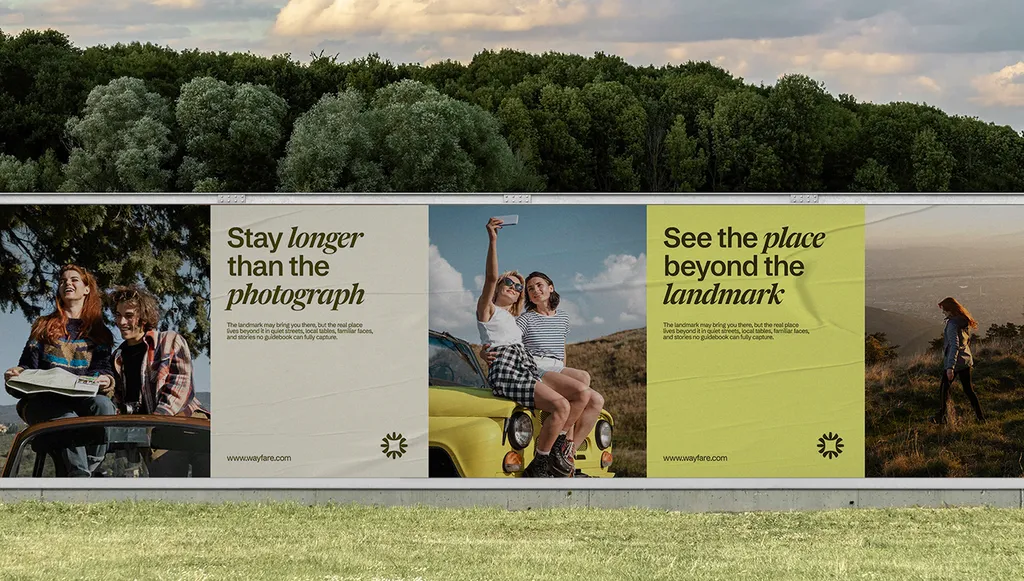
For the travel brand Wayfare, the brand line is “Go slow. See more.” It uses two of the techniques above: an instruction, and a repeated two-word rhythm. It came from the strategy, not a brainstorm: modern travel had become a race, and Wayfare offers fewer destinations and longer stays. Under it, the campaign lines change (“Stay longer than the photograph,” “See the place beyond the landmark”) while the brand line stays the same.
What do the best slogans have in common?
Looking across all 40, a few patterns repeat:
- One technique per line. None of them tries to rhyme, ask a question and state a benefit at once.
- Concrete words. Mouth, hand, overnight, wallet, hungry, fridge. Abstract words like “solutions,” “excellence” or “innovation” almost never appear.
- The brand name, or its idea, is built in. Several lines finish with the name; the rest make a point no competitor could make.
- Room to run for years. “The Ultimate Driving Machine” and “Just Do It” survived many campaigns because they’re broad enough to hold them.
- Repetition did the rest. These lines are famous partly because they were heard thousands of times. A good line on a small budget won’t become “Just Do It,” but it should still make your brand clearer the first time someone reads it.
What are the most common slogan mistakes?
| Mistake | What it looks like | What to do instead |
|---|---|---|
| A line anyone could use | “Quality you can trust,” “Your partner in success” | Run the swap test: put a competitor’s name next to it. If it still works, start again |
| A claim you can’t prove | “The best,” “The fastest,” “Clinically proven” with no study | Keep only what you can back up today. Red Bull agreed a $13 million class-action settlement in 2014 over its advertising claims, while denying wrongdoing |
| Too many ideas | “Fast, affordable and sustainable design for growing teams” | Pick the one idea that matters most and cut the rest |
| A pun only you enjoy | Wordplay on an industry term customers don’t know | Test it on five people outside the company. If anyone needs it explained, drop it |
| Trend words | “Reimagined,” “Unleashed,” “Next-gen” | Use the plain word a customer would say about what you do |
| Ignoring the name | A line that repeats the name, or fights it | Write the line next to the logo, never on a blank page |
| Only checked in one language | A word that means something awkward to some customers | Ask native speakers in each market before you print it |
What slogan formulas can you adapt?
Every example above follows a pattern. These fill-in formulas are a starting point for your own options, not finished lines. Write ten versions of each that fit your business, then cut.
| Formula | Pattern | Modeled on |
|---|---|---|
| Benefit, without the pain | [What you get], not [what you usually suffer] | “Melts in your mouth, not in your hand” |
| Weakness as promise | Because we’re [weakness], we [benefit] | “We Try Harder” |
| Instruction | [Verb] [what the customer wants] | “Just Do It,” “Eat Fresh” |
| Two-part rhythm | [Verb] [noun]. [Verb] [noun]. | “Save money. Live better.” |
| Question with one answer | [Need]? or Where’s the [missing thing]? | “Got Milk?” |
| Name the moment | [Group] runs on [brand], or You’re not you when [situation] | “America Runs on Dunkin’” |
| Name at the end | [Statement], [brand] | “Maybe it’s Maybelline” |
How do you write a slogan for your business?
Write it from your positioning, then use one technique from this list.
- Write your positioning in one sentence: who you serve, what you do for them that the alternatives don’t, and the proof. If you can’t, start with the positioning statement guide; the slogan comes after.
- Pick one technique from the eight groups above: a benefit, a turned-around weakness, an instruction, sound, a feeling, a question, a moment or a short twist.
- Collect customer words. Reviews, sales calls and support emails already contain the phrases people use about you.
- Write 30 to 50 options. Use the formulas above to get started. Quantity first, judgment later.
- Cut to five, removing anything a competitor could say, anything that needs explaining and anything you can’t prove.
- Test the five: say them out loud, put each under your logo, show them to people outside the company and check that no one in your category already uses something close.
- Pick one and give it time. A slogan gets remembered through repetition, so changing it every few months throws that away.
Tagline vs slogan has a fuller test table and covers trademark questions. Short version: the U.S. Copyright Office says copyright doesn’t protect slogans or short phrases, a distinctive line can sometimes be registered as a trademark, and a generic phrase usually can’t. Ask a trademark attorney before you print it on anything permanent.
Should you choose the name or the slogan first?
The name, almost always. A slogan is read next to the name, and a good one can explain a distinctive name, but it can’t fix a confusing one. If your name already says what you do, the slogan is free to carry a benefit or a feeling instead. If you’re changing your company name, how to rename a company sets out the order of steps, and the new line is written near the end, once the name is settled.
How I can help
Slogan and tagline writing isn’t a set deliverable in my packages, but the work a good line depends on is. My brand naming service gives you name ideas, a shortlist, domain and handle checks and a preliminary trademark search in 1–2 weeks. My brand strategy service writes the positioning, key messages and voice a slogan is written from, in 2–3 weeks. If you want the line written as well, tell me on a free 30-minute call in your time zone; any scope outside the packages gets a fixed written proposal first.
FAQ
What are the top 10 slogans of all time?
There’s no official ranking, but these ten appear on most lists and are still widely recognized: Nike’s “Just Do It,” De Beers’ “A Diamond Is Forever,” “Got Milk?,” Avis’s “We Try Harder,” M&M’s “Melts in your mouth, not in your hand,” Apple’s “Think Different,” Mastercard’s “There are some things money can’t buy,” L’Oréal’s “Because I’m worth it,” BMW’s “The Ultimate Driving Machine” and Wendy’s “Where’s the beef?”
What is a famous slogan?
Nike’s “Just Do It” is probably the most famous. It began as a 1988 campaign line, became the brand’s lasting tagline because Nike kept it, and works because it gives an instruction almost anyone can relate to.
What makes a good slogan today?
The lines that work now are short, plain and specific: a few words that say one thing about one brand, readable under a logo on a phone screen. Newer brands often add a twist of humor, as in Oatly’s “Wow no cow.” Avoid trend words like “reimagined” or “next-gen,” which date quickly and say nothing about you.
How do you create a slogan?
Start from your positioning: who you serve and what makes you different. Pick one technique (a benefit, an instruction, a question, a rhyme), write 30 to 50 options, cut anything a competitor could say or that you can’t prove, then test the last five out loud and next to your logo before choosing one.
Should I choose my business name or my slogan first?
The name, almost always. A slogan is read next to the name and can explain a distinctive one, but it can’t fix a confusing one. Settle the name, then write the line that sits beside it.
Can I use a slogan another company uses?
Don’t. Even if the line isn’t registered, using another brand’s slogan confuses customers, weakens your own brand and may infringe a trademark. Copy the technique behind a line you admire, never the words, and check your category before you launch.
Sources
- McGlone and Tofighbakhsh: Birds of a feather flock conjointly (?): Rhyme as reason in aphorisms, Psychological Science 11(5), 2000
- U.S. Copyright Office: What does copyright protect? (FAQ)
- BMW Group Newsroom: The ultimate ad slogan
- Marketing Dive: Maybelline updates “Maybe” tagline (November 2026)
- NBC Philadelphia: Red Bull energy drink settlement (2014)