Marketing Collateral: The Pieces a New Brand Actually Needs
Marketing collateral for a new brand: what to make first, examples by buyer stage, brand vs sales collateral, print specs, templates and a launch checklist.

Summarize with AI
Key takeaways
- Marketing collateral is the set of branded materials, printed and digital, that help people understand and buy from you: cards, one-pagers, decks, brochures, case studies, templates.
- A new brand needs five to seven pieces at launch, a few more once sales start, and the rest only when there’s a clear reason.
- Build collateral after the identity is settled, and as templates, not one-offs, so your team can make new pieces that still look like the brand.
- Buyers do more of the work alone: in a Gartner survey of 646 B2B buyers published in March 2026, 67% said they prefer a rep-free experience, so each piece has to make sense on its own.
- Print files need bleed (0.125 in, about 3 mm), a safe margin inside the trim, 300 PPI images at final size and CMYK color.
Marketing collateral is the set of branded materials, printed and digital, that help people understand and buy from your business: business cards, one-page overviews, sales decks, brochures, case studies, social templates, email templates and more. A new brand doesn’t need all of it. Most need five to seven pieces at launch, a few more once sales start, and the rest only when there’s a clear reason. The order matters more than the volume.
| Stage | Make now | Can wait |
|---|---|---|
| Before launch | Business card and email signature, a one-page overview, a short pitch or sales deck, a social profile kit and post templates, a document template for proposals and invoices | Brochures, catalogs, video, white papers |
| First sales (about the first 90 days) | One or two case studies, a product or service sheet, email templates, an FAQ or objection sheet | Trade show kit, printed catalog, merch |
| Growth | Brochure or catalog, white papers or guides, video, event and trade show materials, packaging inserts, merch | Anything nobody has asked for yet |
I’m Masuder Rahaman, a brand designer and the CEO and founder of Wolfpixel, where I lead a design team for founders in the US and the Middle East. Collateral is where a brand identity either holds together or falls apart, because it’s the first thing made by people other than the designer. This guide covers what to make first, how each piece connects to your identity, the print and digital specs that save reprints, and how to keep it all consistent as your team grows.
What is marketing collateral?
Marketing collateral is any branded material used to support the sale of a product or service. Wikipedia describes it the same way and notes that the term historically meant brochures and sell sheets. Today it covers digital formats too: PDFs, decks, email templates, social graphics and landing pages.
Collateral is different from your brand assets. Your assets are the building blocks: logo, colors, typefaces, imagery style, icons and voice. Collateral is what you build from them. If you don’t have the building blocks yet, collateral will be inconsistent no matter how good each piece looks. What a brand identity includes lists those building blocks.
Why does collateral matter more now?
Because buyers do more of the work without you. In a Gartner survey of 646 B2B buyers, run in August and September 2025 and published in March 2026, 67% said they prefer a rep-free experience, and 45% had used AI during a recent purchase. Gartner’s analyst put it plainly: sellers “can’t rely on static collateral to carry influence in those moments.” Your one-pager, deck and case studies often do the selling before anyone talks to you, so each piece has to make sense on its own.
Consistency matters too. In an earlier Gartner survey of 632 B2B buyers (August and September 2024), 69% reported inconsistencies between the information on a supplier’s website and what its sellers told them. Collateral that tells a different story from your website is one of the easiest ways to create that gap.
Brand collateral vs marketing collateral vs sales collateral: what’s the difference?
The three terms overlap, and many people use them interchangeably. Separating them helps you decide who makes what, and what to make first.
| Type | What it does | Examples |
|---|---|---|
| Brand collateral | Makes every contact look and sound like the same company | Business cards, letterhead, email signature, document and slide templates, social profile kit, packaging, merch |
| Marketing collateral | Attracts and educates people who don’t know you yet | Social posts, brochures, guides and white papers, blog graphics, ads, newsletters, event materials |
| Sales collateral | Helps a specific buyer decide | Sales deck, one-pager or sell sheet, case studies, product or service sheets, comparison sheets, proposals, pricing sheets |
A practical rule: brand collateral comes first, because everything else is built on its templates. Sales collateral comes next, because it’s closest to revenue. Marketing collateral grows with your marketing budget.
What are marketing collateral examples by buyer stage?
Another way to plan is by the question the buyer is asking at each stage. Make one strong piece for each question before you make a second piece for any of them.
| Buyer stage | The buyer’s question | Collateral that answers it |
|---|---|---|
| Awareness | “Who are these people, and do they get my problem?” | Social posts, short guides, blog graphics, ads, event banners |
| Consideration | “What exactly do they do, and how is it different?” | One-pager, service or product sheet, brochure, explainer video, webinar slides |
| Decision | “Can they deliver, and is it worth the price?” | Case studies, testimonials, sales deck, comparison sheet, proposal, pricing sheet |
| After purchase | “How do I get the most out of this?” | Welcome email, onboarding guide, packaging insert, user guide, referral card |
What collateral does a new brand actually need first?
A new brand needs the pieces every customer will see, plus the pieces that help close the first sales. Everything else can wait until there’s evidence it’s needed.
Before launch: the core set
- Business card and email signature. The card goes out at meetings and events; the signature goes out with every email. Design both.
- A one-page overview (sell sheet). What you do, who it’s for, how it works, proof, and how to get in touch. A PDF people can forward is often more useful than a long brochure.
- A short pitch or sales deck. Ten to fifteen slides, built as a template so your team can adapt it without breaking the design.
- A social profile kit. Profile picture, cover images for each platform you use, and three to five post templates (announcement, quote, tip, case result).
- Document templates. Proposal, quote, invoice and letter templates in Word, Google Docs or your proposal tool. These carry your brand into every deal.
- Your website’s key pages. Strictly speaking a website isn’t collateral, but collateral points people to it, so make sure the site tells the same story.
First sales: the proof set
Once you’ve had real customers, add pieces that prove you can deliver:
- One or two case studies. Problem, approach, result, in the customer’s words where possible. Even a short one beats none.
- Product or service sheets. One page per main offer, with what’s included, the timeline and the next step.
- Email templates. Follow-ups, onboarding, newsletters.
- An FAQ or objection sheet. The questions you hear on every sales call, with clear answers. It helps your team as much as buyers.
Growth: the scale set
Make these when you have a specific use and someone to own them: a brochure or catalog, white papers and guides, video, trade show and event materials (banner, booth, flyers), packaging inserts and merch.
Does it change by business type?
Yes. The first pieces depend on where your customers meet you.
| Business type | First five pieces | Can usually wait |
|---|---|---|
| B2B service or SaaS | Sales deck, one-pager, case study, email signature, proposal template | Brochure, printed catalog, merch |
| Shop, café or local service | Signage, menu or price list, social templates, packaging or bags, loyalty or business card | White papers, long decks |
| E-commerce brand | Packaging and inserts, a product photography style, social and ad templates, email templates, size or care cards | Business cards, brochures |
How does collateral connect to your brand identity?
Every piece of collateral should be built from the same few parts: the logo system, color palette, typefaces, imagery style, graphic elements and voice. When those are defined in brand guidelines and turned into templates, anyone on your team can make a new piece that still looks like your brand.
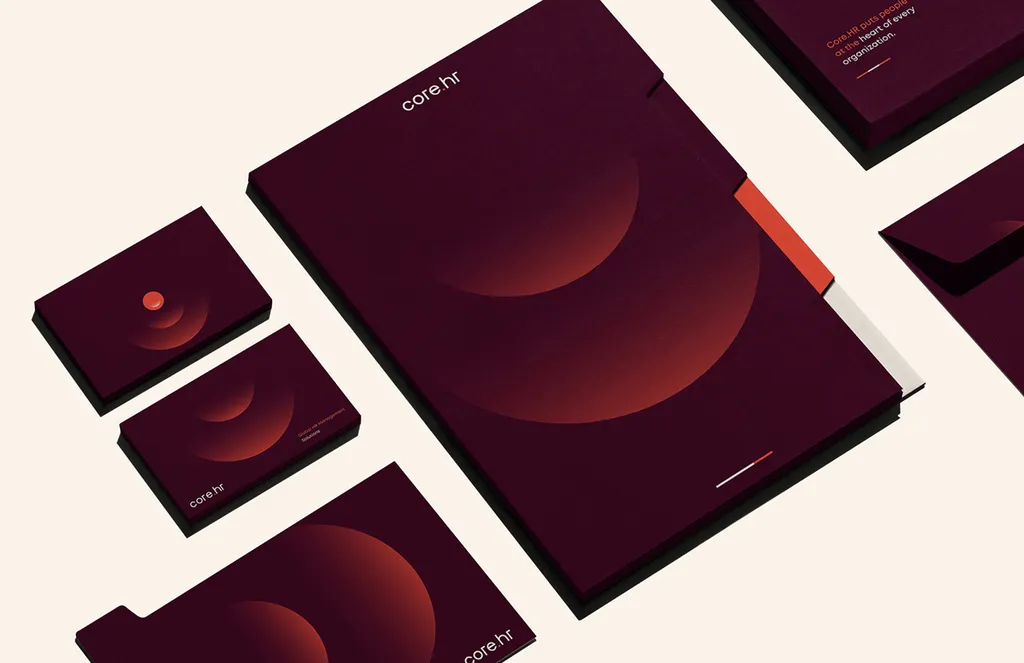
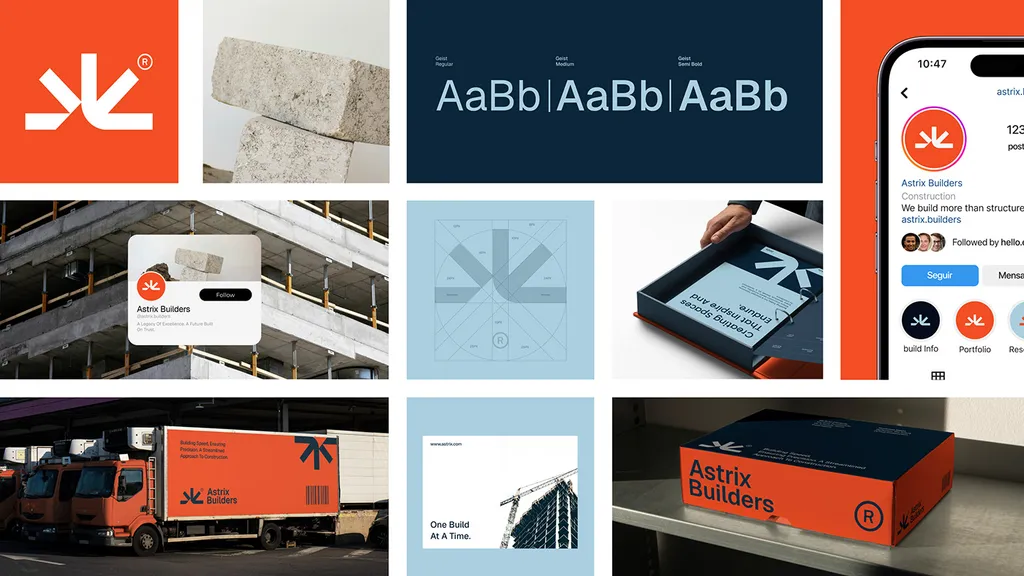
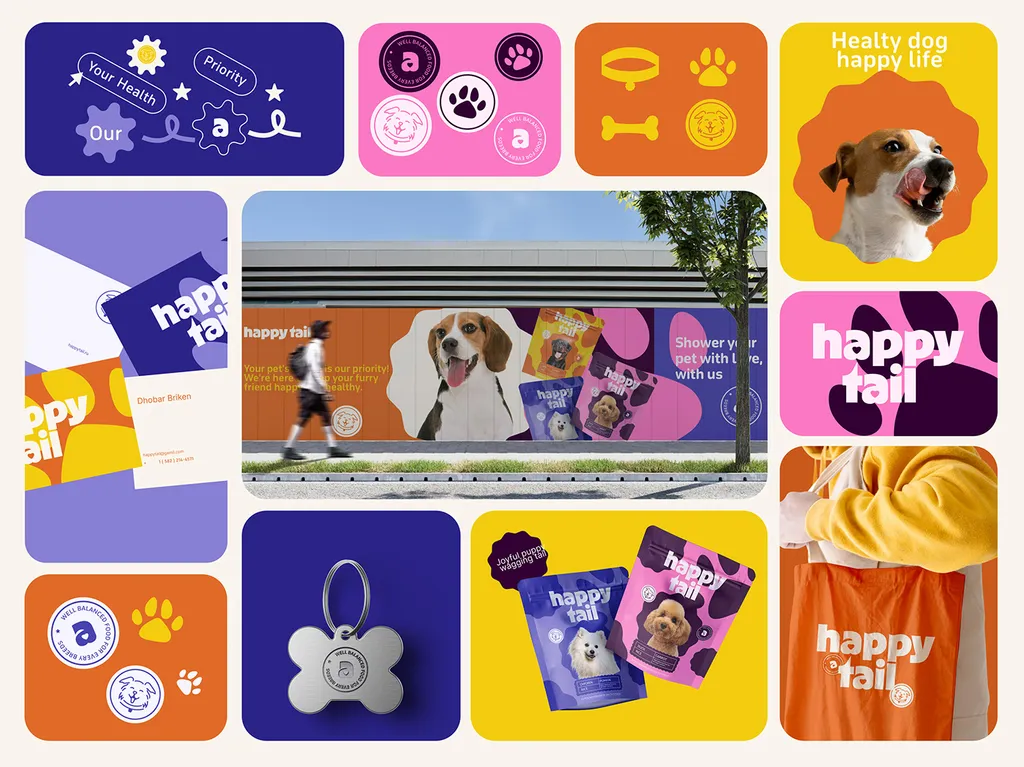
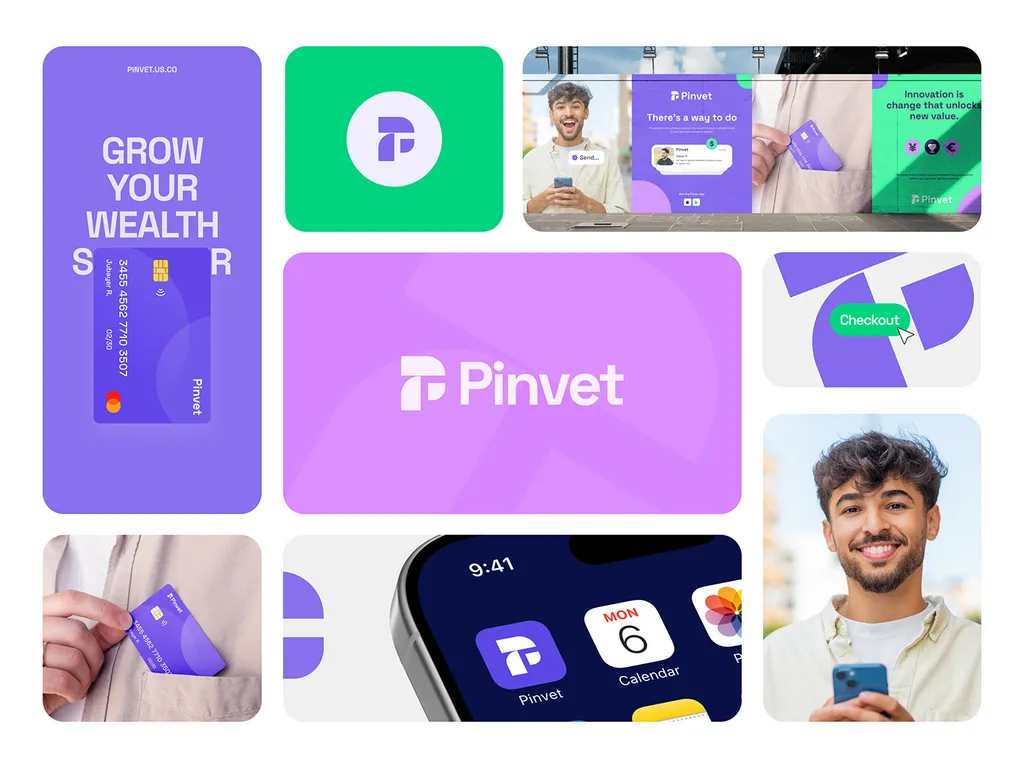
Four identities from my portfolio show the system doing that work:
- core.hr, an HR software company: business cards, letterhead and a folder in burgundy, all carrying the red circle from the identity. The stationery needs no new design ideas, because the system already provides them.
- Astrix Builders, a construction firm: the same orange, navy and asterisk mark on hoardings, trucks, business cards, posters, boxes and social profiles.
- Happy Tail, a dog food brand: stickers, a bone-shaped tag, business cards, pouches, a tote and a street banner, all built from the same colors, badges and seals.
- Pinvet, a fintech brand: a payment card, app screens and street posters sharing the same rounded shapes and purple and green palette.
How do you create marketing collateral that works?
- Start with the buyer’s question. Decide which question the piece answers (see the buyer-stage table above) and who will receive it. A one-pager for a CFO and a one-pager for a designer shouldn’t be the same document.
- Write before you design. Draft the words first, then design around them. Collateral designed around placeholder text usually ends up with copy cut to fit the layout rather than written to persuade.
- Lead with one message and proof. Each piece should make one main point, backed by something specific: a result, a customer quote, a process, a guarantee you actually offer. Check that the message matches your website, so buyers don’t find the gaps Gartner describes.
- Build templates, not one-offs. Design each piece as a template with locked brand elements (logo, colors, type styles, grid) and editable content areas, in the tools your team actually uses: PowerPoint or Google Slides for decks, Word or Google Docs for proposals, Canva or Figma for social and simple print.
- Prepare files correctly for print and screen. Print and digital files have different requirements; the specs are below.
- Track whether it’s used. Add a unique link or QR code to printed pieces, use UTM tags on links in PDFs and emails, and ask your sales team which pieces they actually send. Retire what nobody uses.
- Review it every quarter. Prices, team members, services and results change. Put an owner and a review date on every piece, and remove out-of-date versions from shared drives.
What are the print and digital specs for collateral?
These are common defaults. Always confirm with your printer, because requirements vary by product and press.
| Spec | Common default | Why it matters |
|---|---|---|
| Bleed | 0.125 in (about 3 mm) beyond the trim on every side | Prevents white slivers when the sheet is cut |
| Safe margin | Keep text and logos 0.125–0.25 in inside the trim | Stops important content being trimmed off |
| Resolution | 300 PPI at final printed size | Avoids blurry or pixelated images |
| Color | CMYK for most printed materials, RGB for screens | Screen colors shift when printed |
| Print file | PDF exported as High Quality Print, Press Quality or PDF/X | Keeps fonts, colors and layout as designed |
| Business card size | 3.5 × 2 in (about 89 × 51 mm) in the US; 85 × 55 mm in much of Europe | A US layout doesn’t scale straight to the European size |
The bleed, safe margin, resolution, color and PDF guidance follow Utah Valley University’s print file setup guide; the card sizes come from 4OVER4’s business card size guide. If a brand color has to match exactly on packaging or signs, ask your printer about a spot color.
For digital collateral:
- Keep PDFs light so they open quickly on phones and get through email filters. Compress images for screen.
- Use real text, not images of text, so PDFs are searchable, selectable and work with screen readers.
- Export in RGB for screens, and check colors on a phone as well as a monitor.
- Name files clearly, with the brand, the piece and the date or version (for example, brand-one-pager-2027-01.pdf).
- Keep the logo files separate, in the formats each use needs. Logo file formats explains which is which.
How do you keep collateral consistent as your team grows?
Consistency comes from rules and templates, not from a designer checking everything.
- Write short brand guidelines. Logo use, colors, type, imagery and voice, with examples. A few practical pages beat an 80-page PDF nobody opens; see brand guidelines for a small team.
- Lock what shouldn’t change. In templates, lock the logo, colors and type styles, and leave only the content editable.
- Keep one source of truth. One shared folder or brand portal with current versions only. Archive old ones.
- Name an owner. Someone who approves new pieces and retires old ones.
- Check it before it goes out. A two-minute check: right logo, right colors, current details, working links, spelling.
What about Arabic and bilingual collateral?
If you sell in the Gulf, plan bilingual collateral from the start rather than translating at the end. Arabic reads right to left, so layouts usually need to be mirrored, not just translated: the logo position, image placement and reading order all change. Choose Arabic and Latin typefaces that work together, give Arabic text enough size and line spacing, and agree on one spelling of your name in each language. Decide early whether each piece is two separate versions or one bilingual layout. Designing a bilingual brand in Arabic and English covers the identity side.
What are the most common marketing collateral mistakes?
- Making everything at once. Ten pieces nobody asked for cost more than three pieces your sales team uses every day.
- Designing before the identity is settled. Collateral built on a temporary logo or random colors has to be redone.
- One-off designs instead of templates. Every new piece then needs a designer, or drifts off-brand.
- A different story from the website. Buyers notice, and it costs trust.
- Too much text, no proof. Long lists of services with no result, quote or example.
- Ignoring print specs. No bleed, RGB files and low-resolution images are common causes of reprints.
- Out-of-date versions in circulation. Old prices and old team members in a PDF that keeps getting forwarded.
- No way to measure use. If you can’t tell what’s used, you can’t tell what to improve.
A launch collateral checklist you can copy
| Item | Ready? | Owner |
|---|---|---|
| Logo files, colors and fonts in one shared folder | ||
| Short brand guidelines (logo, color, type, imagery, voice) | ||
| Business card (print-ready PDF with bleed, CMYK) | ||
| Email signature (tested in Gmail and Outlook, on mobile) | ||
| One-page overview (PDF, real text, a few MB at most) | ||
| Sales or pitch deck template (10–15 slides) | ||
| Proposal, quote and invoice templates | ||
| Social profile kit and three to five post templates | ||
| Website key pages telling the same story | ||
| Tracking: UTM links, unique URLs or QR codes on print | ||
| Owner and review date for every piece | ||
| Arabic or other language versions, if needed |
For everything a full identity project should hand over, not just collateral, see the brand identity deliverables checklist.
How much does marketing collateral cost?
It depends on how many pieces you need and whether you have a brand identity to build from. Templates are cheaper to produce, and much cheaper to maintain, once the identity is defined. For typical market prices of branding packages that include some collateral, see branding package price.
With me, the brand identity package gives you the system every piece of collateral is built on: strategy, four concepts, the logo system, color and type, brand guidelines as PDF, PowerPoint and Illustrator files, and a Figma library, for $3,499 in 2–3 weeks, with unlimited revisions within the agreed scope. Arabic and English versions come at the same price. Any scope beyond the package, such as a deck, a one-pager or extra templates, gets a fixed written proposal after a free call. All packages are on the pricing page.
Bring a list of the pieces you think you need to a free 30-minute call in your time zone, and I’ll help you cut it down to the ones that matter for your launch.
FAQ
What is marketing collateral?
Marketing collateral is any branded material, printed or digital, used to support the sale of a product or service. Common examples are business cards, one-page overviews, sales decks, brochures, case studies, product sheets, email templates and social media templates.
What are examples of marketing collateral?
Business cards, letterhead, email signatures, one-pagers or sell sheets, sales decks, brochures, catalogs, case studies, white papers, product or service sheets, social media templates, email newsletters, event banners, packaging inserts and merch.
What is the difference between marketing collateral and sales collateral?
Marketing collateral attracts and educates people who don’t know you yet, such as social posts, guides and brochures. Sales collateral helps a specific buyer decide, such as a sales deck, case study, comparison sheet or proposal. Many pieces do both, but separating them helps you decide what to make first and who owns it.
What is brand collateral?
Brand collateral is the set of everyday branded items that make every contact look like the same company: business cards, letterhead, email signatures, document and slide templates, social profiles, packaging and merch. It’s usually the first collateral a new brand should make, because other pieces are built on its templates.
What marketing collateral does a startup need first?
Usually a business card and email signature, a one-page overview, a short pitch or sales deck, a social profile kit with post templates, and document templates for proposals and invoices. Add case studies and product sheets once you have customers, and brochures, video and event materials later.
Should I design collateral before or after my brand identity?
After. Collateral is built from your logo, colors, type, imagery and voice. Designing it before those are settled usually means redoing it, and it makes consistency much harder as more people create pieces.
Sources
- Gartner: Sales survey finds 67% of B2B buyers prefer a rep-free experience (March 9, 2026)
- Gartner: Sales survey finds 61% of B2B buyers prefer a rep-free buying experience (June 25, 2025)
- Wikipedia: Marketing collateral
- Utah Valley University Printing Services: How to set up print files correctly
- 4OVER4: Business card sizes around the world and why they differ (February 5, 2026)