How to Brand a Boutique Hotel: From Booking Thumbnail to Key Card
Boutique hotel branding as one system: the story of the place, a name and a compact mark, the booking listing, signs, key cards, amenities, F&B outlets and soft brands.

Summarize with AI
Key takeaways
- A boutique hotel has no chain name to lean on. The name, the mark and the voice carry the whole promise, so build them on one idea the building can prove.
- Design for the guest journey in order: the booking listing, the website, arrival, signs, the key card, the room, the bathroom, the bar, checkout and the post afterward.
- The logo needs a compact version (a monogram or symbol) for key cards, soap, robes and social avatars, where the full name won’t fit.
- Decide early whether your restaurant and bar share the hotel’s name, carry it as an endorsement, or stand alone. It changes the signs, menus and social accounts.
- If you might join a soft brand such as Autograph Collection or Curio Collection, ask for its brand standards before you pay for signs.
- A full package is the core identity plus a rollout set: signage, in-room collateral, amenities, uniforms, F&B sub-brands and booking assets.
Boutique hotel branding is the name, logo, color, type and voice of an independent hotel, carried through every point where a guest meets it: the booking listing, the website, the sign out front, the key card, the room, the toiletries, the bar and the post after checkout. Because there is no chain name beside yours, the brand has to say on its own what kind of stay this is. The work starts with the story of the place (its street, its building, its rooms), turns that into a name and a mark that work as small as a key card, and ends with a rollout set your sign maker, printer and amenities supplier can produce.
I’m Masuder Rahaman, a brand designer and the founder of Wolfpixel, where I lead the design team. I design brand identities for hotels, resorts and travel brands, working remotely with calls in your time zone. The worked example below is Reva7, a resort identity we carried from the R monogram to the key card, the soap bar and the booking flow.
Start with the story of the place
Most boutique hotels are sold on what makes the place itself different. Saudi Arabia’s Ministry of Tourism, for example, defines boutique hotels as a specialized category with “a compact structure with unique and elegant rooms,” decor and creative details. Whatever the definition in your market, the brand has to name that difference in one idea.
A good idea is one the building can prove. It comes from:
- The building. A former bank, a print works, a family house. The history gives you a name, a type style and a story for the welcome letter.
- The street or neighborhood. The market next door, the harbor, the old quarter. Guests choose a boutique hotel to be somewhere.
- The rooms. A few rooms, each different, or one signature detail.
- The host. A family that has run the place for decades, or an owner with a clear point of view.
- The feeling. Calm, playful, literary, sociable. This sets the voice on every sign and card.
Write the idea as one sentence, then test it against your competitors’ listings. If three hotels within a mile could say the same sentence, keep going. The strategy also sets out who the guest is, what they compare you with and your price position. For Reva7, the sentence became “the perfect blend of nature and nurture,” and every later choice (the deep greens, the editorial serif, the calm voice) came from it.
The name and the logo
The name. For a new hotel, the name is the first brand decision and the hardest to change. It has to read on a facade, sound right on the phone, and stand out in a booking search. Check domains, social handles and existing trademarks before anyone orders a sign. Brand naming is a separate service with a preliminary trademark search; your lawyer does the final clearance.
The logo system. A boutique hotel logo needs more versions than most:
- A primary logo with the full name, for the facade, the website and print.
- A compact mark (a monogram, a symbol or a single letter) for the key card, the soap bar, robe embroidery, the social avatar and the favicon.
- A one-color version for embossing, foil, engraving, etched glass and stitching. Many hotel touchpoints are made, not printed.
- A horizontal and a stacked lockup, because a corridor sign and a door hanger have very different shapes.
Keep stars out of the logo. A hotel’s class is granted by an authority and can change; the logo shouldn’t have to.
The guest journey: every touchpoint in order
Plan the brand in the order a guest meets it. Each stop has a different job and a different constraint.
Before arrival: listing, website, confirmation
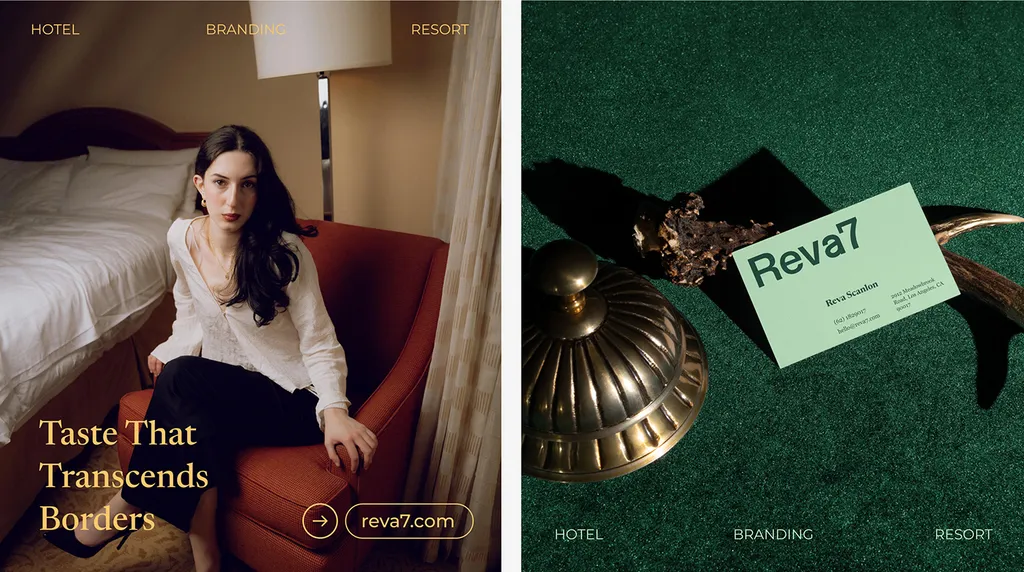
The booking listing. On booking sites and map listings, guests usually meet your photos, your name and your reviews before they see a logo. So the brand has to live inside the photographs: the facade sign in the shot, the bedding, the wall colors, the art direction. Brief your photographer with the brand, not before it exists.
The website. Your own site is where an independent hotel can show the full brand and take direct bookings. It should sell the feeling first and then make booking easy. If you show prices to US guests, the FTC’s fees rule, in effect since May 12, 2025, requires businesses that offer, display or advertise short-term lodging (hotels, motels, inns and vacation rentals, with booking platforms and travel agents too) to show the total price up front, mandatory resort fees included, and to display it more prominently than other pricing information. Design rate cards, ads and booking screens with that in mind.
The booking engine and confirmation email. Most hotels use a third-party booking engine. Ask what you can control: usually the logo, the colors and a header image. Set those to match the site, so the guest doesn’t feel they’ve left the hotel.
Arrival: sign, reception, wayfinding
The facade sign. It has to be readable from a car at night, so test the logo in one color, lit and unlit, at the actual size.
Reception. The welcome folder, the registration card and the first sentence the receptionist says. This is where the voice shows up in person.
Signage and wayfinding. Treat wayfinding as part of the brand, not a facilities job. Floor directories, corridor signs, room numbers, the lift, the pool and the gym all use the same type and color. In the US, signs that identify permanent rooms and spaces, such as room numbers, need raised characters repeated in Grade 2 braille, mounted within a 48 to 60 inch height range, with a non-glare finish and light-on-dark or dark-on-light contrast, according to the US Access Board’s guide to the ADA standards. Pick a sign typeface and color pair that can meet those rules before the sign maker quotes. Your architect or sign contractor confirms the details for your building.
In the room: key card to toiletries
The key card. A small, plastic, much-handled surface. The compact mark, one strong color and the room number field (if your system prints it) are usually enough. Ask your lock supplier for the card template and print area before designing.
In-room collateral. The door hanger, the room directory or QR card, the minibar menu, the notepad and pen, the Wi-Fi card. This is the place for the voice: Reva7’s door hanger reads “Beyond this door: comfort.”
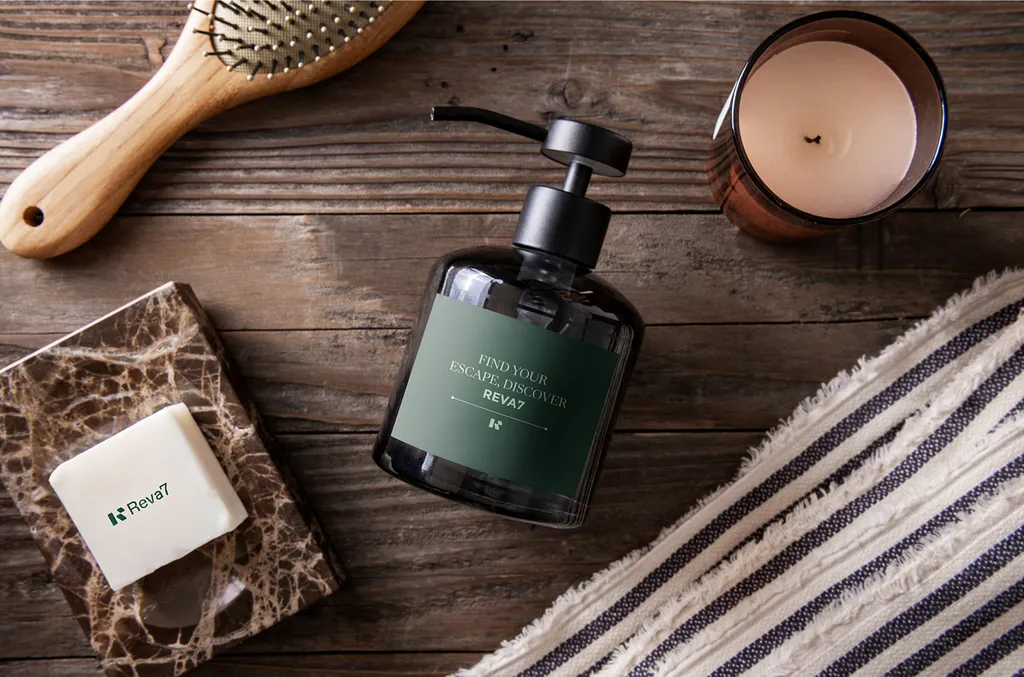
Amenities and toiletries. Soap, bottles or dispensers, slippers, the robe, the laundry bag. Many suppliers offer stock bottles with your label, which is a good start for a small hotel; custom bottles and boxes come later. Design the labels on the supplier’s templates and check the ingredients panel with them. Packaging design covers custom labels and boxes.
Food and drink: outlets as sub-brands
A boutique hotel’s restaurant, bar or rooftop is often what locals know it for. Decide how it relates to the hotel before anything is named:
| Model | How it looks | Good when |
|---|---|---|
| Same name | “[Hotel name] Restaurant”: the hotel logo and colors | The outlet mainly serves hotel guests |
| Endorsed | Its own name, with “at [Hotel name]” in small type | You want locals in, but the hotel name helps |
| Standalone | Its own name, logo and social accounts | The outlet should draw locals on its own and could outlive the concept |
Whichever model you choose, keep a shared base (a typeface, a paper stock, a color), so the outlet still feels part of the building. The cups, menus and signs of a café inside a hotel follow the same rules as a standalone café; I cover those in café branding.
Staff and after the stay
Uniforms. Embroidered marks, name badges, aprons for the bar. The one-color and compact versions of the logo matter here.
Social and email. The profile avatar (the compact mark), post templates, a photo style and the post-stay email. The checkout and the email afterward are the last things guests remember.
Independent, or under a soft brand?
Many boutique hotels consider a “soft brand”: a collection run by a big hotel group, where the hotel keeps its own name and character but joins the group’s booking and loyalty systems. Two examples:
- Autograph Collection Hotels (Marriott) describes itself as “a global collection of distinctive independent hotels.”
- Curio Collection by Hilton lets guests “experience independent hotels” while earning Hilton Honors points; Hilton’s fact sheet listed 216 hotels open in October 2026.
What this means for the brand:
- Your own identity still does the work. These collections sell the individuality of their hotels, so a weak story of your own is a harder fit, not an easier one.
- There will be a second logo. Expect the collection’s name or lockup next to yours somewhere: the website, the booking engine, possibly the facade. Leave room for it.
- Read the standards first. How your logo and theirs appear together is set by the group’s brand standards and your agreement, not by the designer. Ask for them before the sign, the website header and the key cards are produced.
- Plan for leaving. If you join for a term and later go independent, a strong standalone identity means a sign change, not a rebrand.
What a full boutique hotel brand package includes
| Part | What it includes | Why a boutique hotel needs it |
|---|---|---|
| Strategy | The guest, competitors, price position, the one idea, voice | Decides everything after it, including the name |
| Name (if new) | Name ideas, a shortlist, domain and handle checks, a preliminary trademark search | The hardest thing to change after the sign goes up |
| Logo system | Primary logo, compact mark, one-color version, horizontal and stacked lockups | Facades, key cards, embroidery, embossing and avatars all need a different version |
| Color and type | A palette with print and screen values, display and text typefaces, a sign typeface | Signs, print, fabric and screens all reproduce color differently |
| Photography direction | A brief for rooms, spaces, food and people | The booking listing is mostly photos |
| Voice | How you write welcome letters, door hangers, menus, signs and posts | The small text guests read in the room |
| Booking assets | Website design, booking engine settings, rate card layouts, email headers | Where independents earn direct bookings |
| Signage and wayfinding | Facade sign, directories, corridor and room signs, amenity signs | Arrival, and the accessibility rules where they apply |
| In-room collateral | Key card, door hanger, directory or QR card, minibar menu, stationery | The most-handled pieces of the brand |
| Amenities | Soap, bottle or dispenser labels, slippers, robe, laundry bag | What guests photograph and take home |
| F&B sub-brands | Names and logos, or endorsed lockups, menus, cups, signs | Often what locals know the hotel for |
| Uniforms and social | Embroidery, badges, the avatar, post templates | Staff and the online voice |
| Guidelines and files | Brand guidelines and source files for sign makers, printers and suppliers | So the next sign or bottle matches the first |
With me, the strategy, logo system, color, type, imagery, voice and guidelines are the brand identity package. The rest is the rollout set, which we size together for your property. For the full list of identity files, see what a brand identity includes. If the property sits at the top of the market, luxury brand identity covers what changes in the logo, type, color, photography and packaging when you charge more.
Worked example: Reva7
Reva7 is a resort, not a boutique hotel, but its brand had to solve the same problem: carry one feeling from the first screen to the soap bar. We designed the resort identity, the print and the booking website in 2025.
- The idea. “The perfect blend of nature and nurture.” The brand had to feel calm, warm and premium.
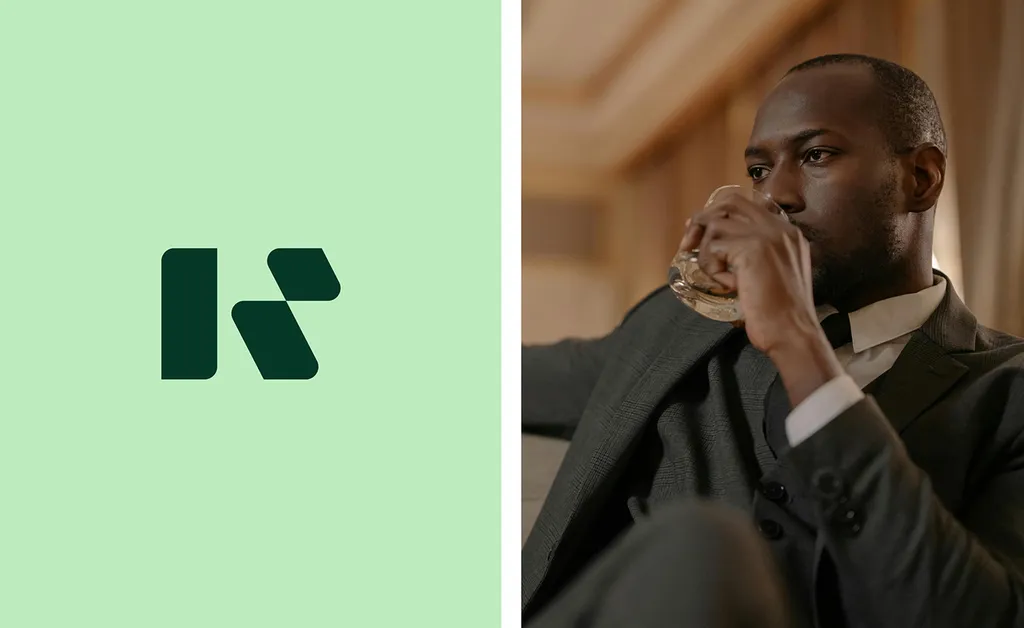
- The mark. A bold R monogram built from two simple shapes, used alone or with the Reva7 wordmark. The monogram is what made the small touchpoints possible: it fits on a key card, a soap bar and a pair of slippers where “Reva7” in full would be too small.
- Color and type. Deep resort green with mint, sky blue and a warm orange, set in an editorial serif with a clean sans.
- The guest experience. We carried the system through the welcome folder (“Serving you the Reva7 way”), the menu, the key card, the door hanger, the slippers, the soap and dispenser, a brush, a candle, a box and a coffee cup, then into signage, posters and billboards.
- The website. A booking site that sells the feeling first, then makes the stay easy to book, with a booking flow from a package and contact details to a reservation summary, payment and a confirmation. The website was designed as separate scope; the build isn’t part of an identity project.
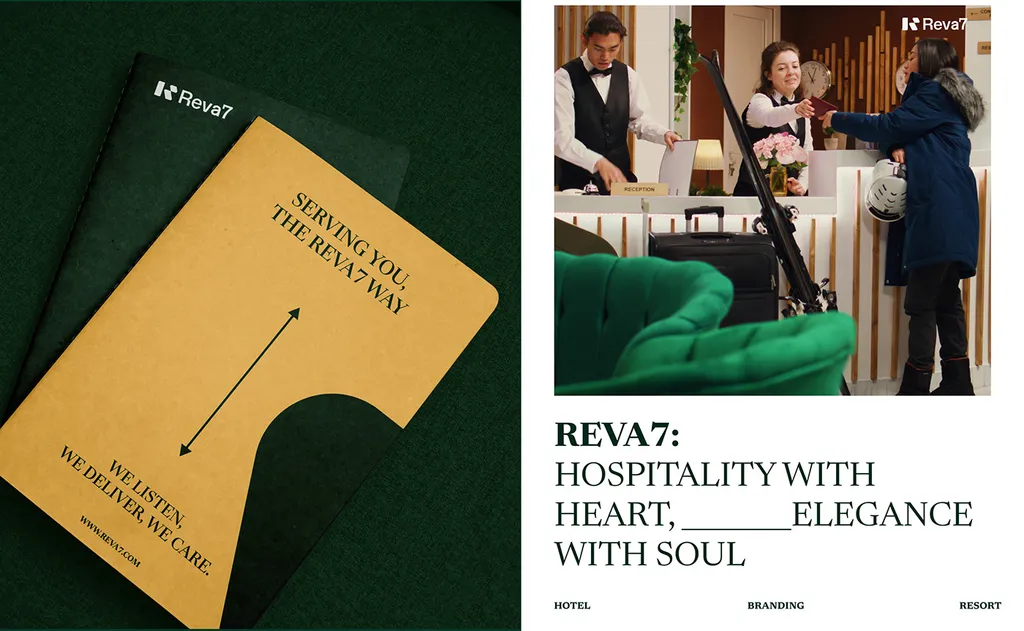
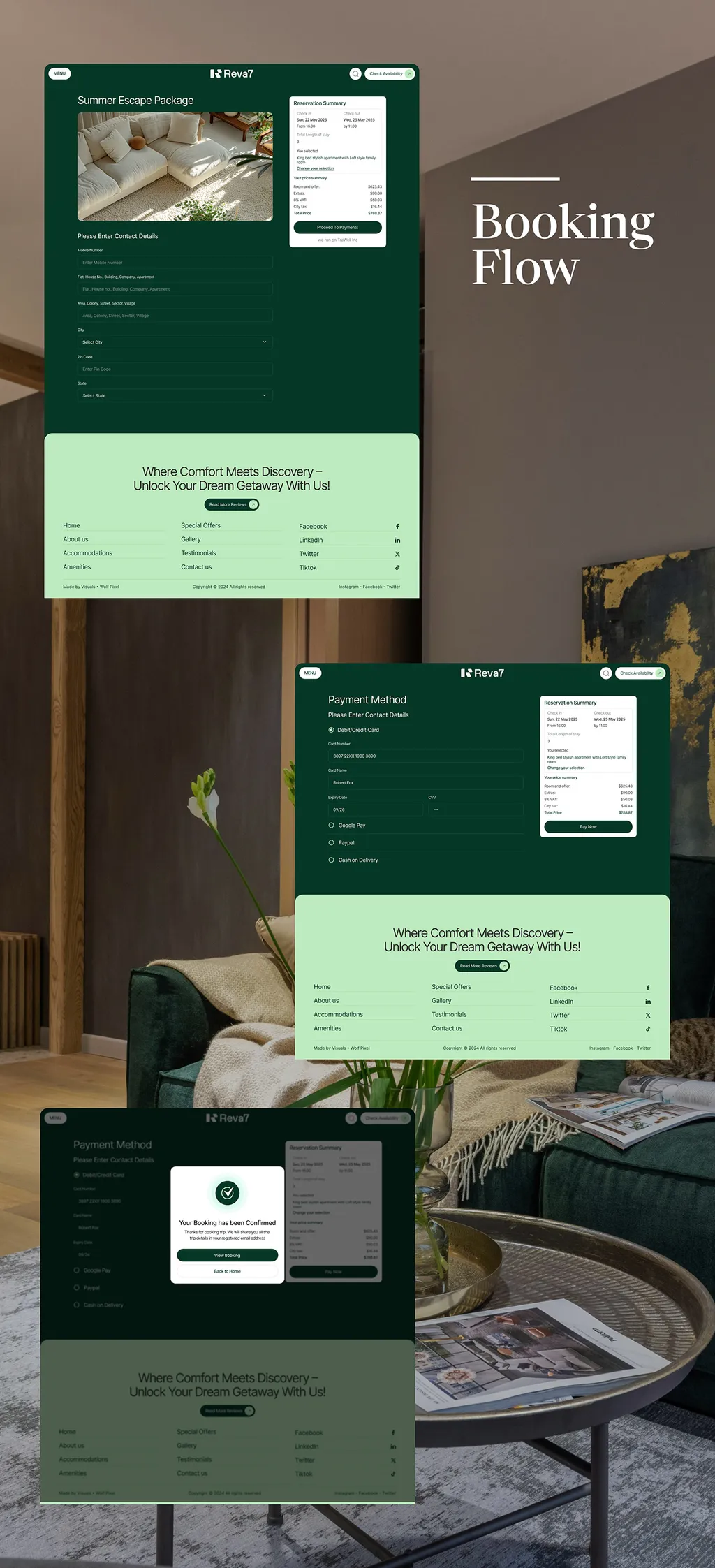
The lesson for a boutique hotel: decide the compact mark early. Most of the touchpoints that make a stay feel branded are too small for a full name.
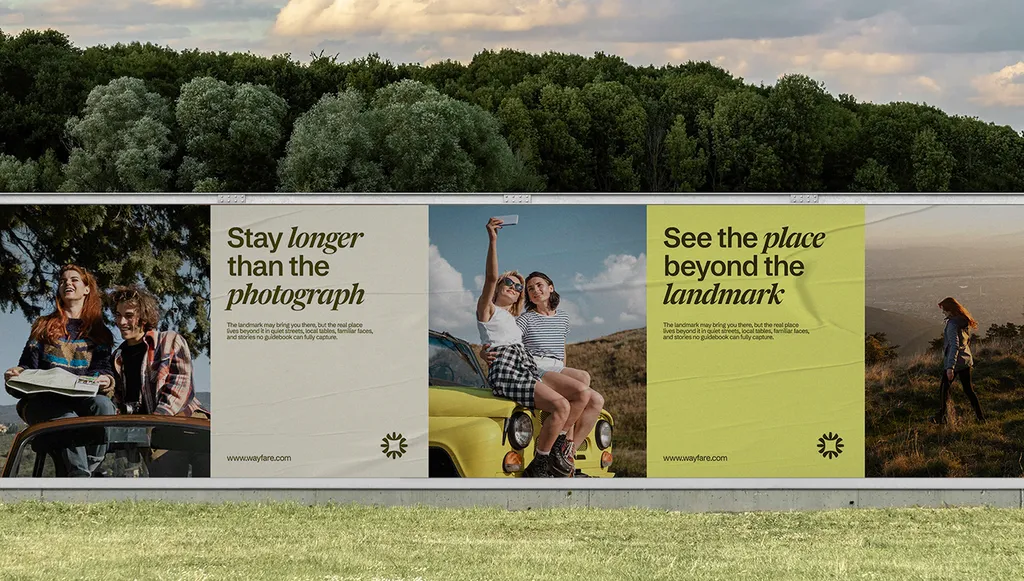
A second, smaller lesson from travel. Wayfare, a travel agency brand for a Los Angeles client, shows how one line can run a whole voice. Its idea, “Go slow. See more.”, became campaign lines like “Stay longer than the photograph.” A boutique hotel can do the same on door hangers, welcome letters and signs: one idea, many short lines.
Arabic and English for Gulf hotels
For hotels in Saudi Arabia and the UAE, I design the Arabic and English versions of the name, logo and type together, including right-to-left layouts, so the facade, the key card and the booking listing read as one brand in both scripts. In Saudi Arabia, the Ministry of Tourism’s 2022 guide asks licensed facilities to use the trade name in their license when promoting through signs, publications or online reservation systems, and amended rules take effect on July 1, 2027, so settle the name and its Arabic form before the license and the sign. The hotel and travel branding page covers the Saudi and UAE rules, old and new, and bilingual logo design explains how the two scripts are matched.
Common mistakes in boutique hotel branding
- A story the building can’t prove. “Luxury, comfort and elegance” describes every hotel. Name the street, the history or the rooms.
- No compact mark. The full name is squeezed onto the key card and soap until it’s unreadable.
- Stars or “boutique” in the logo. Classes change, and “boutique” says nothing a guest doesn’t already assume.
- Wayfinding left to the contractor. Corridor signs in a different typeface, and room signs that miss accessibility rules.
- Photos shot before the brand exists. The listing most guests see first shows none of it.
- The bar named as an afterthought. A strong concept stuck with “[Hotel name] Restaurant.”
- Signing a soft-brand deal after the signs are made. Then reworking the facade and website to fit.
- A catalog bottle with a sticker on top. Fine to start, but design the label on the supplier’s template.
Checklist: a boutique hotel brand ready to open
- One idea in one sentence, tested against nearby competitors’ listings
- The name checked for domains, handles and trademarks (with your lawyer)
- A primary logo, a compact mark, a one-color version and lockups
- A sign typeface that works at a distance and in raised characters
- A photography brief written before the shoot
- The website and booking engine matched; the total price shown first for US guests
- The facade sign tested lit and unlit; room signs checked against accessibility rules
- Key card, door hanger, directory, minibar menu and amenity labels
- An F&B model chosen: same name, endorsed or standalone
- Soft-brand standards read first, if you are considering a collection
- Arabic and English designed together, for Gulf hotels
- Guidelines and source files for your sign maker, printer and suppliers
How I work with boutique hotels
A brand identity for a boutique hotel, as for any hotel or travel brand, is $3,499 and takes two to three weeks: strategy, logo system, color, type, imagery, voice, brand guidelines and a Figma library, with unlimited revisions within the agreed scope. A logo on its own is $999 over one to two weeks, with three revision rounds. The Premium package adds website design (in Figma; the build isn’t included) and an AI-ready brand system for $6,999 over four to six weeks. A new hotel name is brand naming, one to two weeks. A hotel changing its position or leaving a chain is a rebrand, three to four weeks. Custom amenity labels and boxes are packaging design, two to four weeks. Naming, rebrands, packaging and the rollout set are quoted after a free 30-minute call, as a fixed written proposal. For Saudi Arabia and the UAE, the Arabic and English name and logo are designed together at the same price. All the packages are on the pricing page. I work remotely, with weekly check-ins in your time zone, and you own all the final files. I don’t file trademarks; your lawyer does, with the clean files I hand over.
If you are opening, repositioning or rebranding a boutique hotel, book a free 30-minute call and bring your hotel’s address and a few photos of the building, links to the three hotels guests compare you with, your opening date, and whether you are staying independent or talking to a collection. We will start by finding the one idea your building can prove.
FAQ
What does boutique hotel branding include?
A strategy, a name if you need one, a logo system with a compact mark, color, type, photography direction, voice and brand guidelines. Then the rollout set: the website and booking assets, the facade sign and wayfinding, the key card and in-room collateral, amenity labels, F&B outlet branding, uniforms and social templates.
How much does it cost to brand a boutique hotel?
It depends on the scope. With me, a brand identity is $3,499 over two to three weeks, a logo alone is $999 over one to two weeks, and the Premium package with website design is $6,999 over four to six weeks. Naming, rebrands, amenities packaging and the full rollout set are quoted after a free 30-minute call, as a fixed written proposal.
How is boutique hotel branding different from chain hotel branding?
A chain hotel inherits a name, logo and standards from the group. An independent boutique hotel has to create all of it, and its brand carries the whole promise without a famous name beside it. That’s why the story of the place matters more: guests choose a boutique hotel for what makes it different.
Should a boutique hotel join a soft brand like Autograph Collection or Curio?
That’s a business decision for you and your advisors, not a design one. For the brand, the main points are that you keep your own name and identity, a collection name or lockup will appear next to yours, and the group’s brand standards set how. Read them before producing signs, the website and key cards.
Should the hotel restaurant have its own brand?
If you want locals to come for the restaurant or bar on its own, a separate or endorsed name usually works better than “[Hotel name] Restaurant.” If it mainly serves guests, sharing the hotel’s name is simpler. Keep a shared base, such as a typeface or color, either way.
What should go on a hotel key card?
Usually the compact mark, one strong color and little else. Ask your lock or key card supplier for the template, the print area and whether a room number or magnetic stripe takes space before you design.
Sources
- Ministry of Tourism (Saudi Arabia): Services Guide, Tourism Accommodation Facility Regulations (V.1 2022)
- Federal Trade Commission: Rule on Unfair or Deceptive Fees, Frequently Asked Questions
- US Access Board: Guide to the ADA Accessibility Standards, Chapter 7: Signs
- Marriott: Autograph Collection Hotels
- Hilton: About Curio Collection by Hilton (fact sheet, updated October 2026)