Brand Book: What Goes In It, Page by Page
A brand book explains the why behind a brand as well as the rules. Here is what goes in one, part by part, how it differs from guidelines, and when you need it.

Summarize with AI
Key takeaways
- A brand book is the document that explains a brand: its story and strategy (the why) together with its identity and rules (the how).
- Brand guidelines are usually the rules on their own. The guidelines say where the ZAYAN camel icon may go; the brand book also says why there’s a camel.
- Sources don’t agree on the terms: some use brand book and brand guidelines for the same document. Agree the contents with your designer rather than the label.
- Make one when people outside the founding team need to understand the brand, not just use the logo: new hires, agencies, investors or franchisees.
- Design it to be read front to back: short pages, one idea per spread, and the brand itself applied on every page.
A brand book is a document that explains what a brand stands for and how to express it: the story, purpose, values, audience and personality at the front, then the logo, color, type, imagery and voice with the rules for using them. The simplest way to separate it from brand guidelines: the brand book gives the “why,” and the guidelines give the “how.” The outline below has eight parts, from the opening pages to contacts, and this article goes through each one.
| Part | Pages it holds | What it tells the reader |
|---|---|---|
| 1. Opening | Cover, contents, a letter or manifesto | What this book is for and how to use it |
| 2. Story | Who we are, where we came from | The founding problem and what the company does about it |
| 3. Strategy | Purpose, mission, vision, values, audience, positioning | Why the brand exists and who it’s for |
| 4. Personality and voice | Traits, voice, messaging | How the brand sounds and what it always says |
| 5. Identity, explained | Logo idea, color meaning, type, imagery | Why the brand looks the way it does |
| 6. Rules | Logo, color, type, imagery and voice rules | How to apply it (the brand guidelines) |
| 7. Applications | Deck, social, stationery, signage, product | What it looks like in real use |
| 8. Close | Files, contacts, ownership | Where things are and who to ask |
I’m Masuder Rahaman, a brand designer and the founder of Wolfpixel, where I lead the design team. I design brand guidelines and the brand strategy that sits in front of them. This article sets out where a brand book ends and guidelines begin, gives a page-by-page outline you can brief a designer with, and shows pages from two brand books we designed, for ZAYAN and ROMO Logistics.
What is a brand book?
A brand book (also written brandbook, and sometimes called a brand bible or brand manual) is the reference document for a brand. It tells people what the brand is, what it believes, who it serves and how it looks and sounds, and it shows the rules for applying all of that.
The term is used loosely, and sources disagree on what it covers:
- Some treat it as the broader document. Helms Workshop describes a brand book as a resource that combines technical guidelines with strategic context, while a brand guide gives practical instructions.
- Others treat it as an older name for the same thing. Frontify calls the brand manual or brand book an older term for a comprehensive, often PDF-based brand document, and Bynder says the same.
- Venngage puts the split in one line: the brand book tells who you are, the style guide tells how to show it.
In practice, when someone asks for a brand book, ask whether they want the strategy and story included. If they do, it’s a brand book in the sense used here. If they only need the rules, they need brand guidelines, or for a small team, one-page brand guidelines. If you don’t have an identity yet, logo, identity or guidelines explains what to ask for first.
Brand book vs brand guidelines: what’s the difference?
| Compare | Brand book | Brand guidelines |
|---|---|---|
| Main question | Why are we like this? | How do we apply it? |
| Content | Story, strategy, personality, identity explained, rules, applications | Rules, examples, files |
| Main readers | Leadership, new hires, agencies, partners, investors | Designers, marketers, printers, developers, agencies |
| Read how | Front to back, once, then dipped into | Searched when a question comes up |
| Changes when | The strategy changes | A new use or touchpoint appears |
| Small-company version | A few story and strategy pages in front of the guidelines | One page plus templates |
Oamii makes the same distinction and recommends having both. For most startups, both means one document: a short strategy section at the front, then the guidelines. A separate, longer brand book makes sense when many people outside the founding team have to make decisions in the brand’s name.
What goes in a brand book, page by page
This is the outline I’d give a designer, and it doubles as a contents page. The page counts are my suggestions for a company with a few teams; a startup can halve them.
Part 1: Opening (2–3 pages)
- Cover. The logo on the brand’s own color or imagery. It’s the first application of the brand, so treat it as one.
- Contents. Numbered parts, so people can cite “see 3.2” in an email.
- A short letter or manifesto. Half a page from the founder on why the brand matters and how to use the book.
Part 2: Story (1–2 pages)
- Who we are. What the company does, for whom, in one or two sentences.
- Where we came from. The problem the founders saw and what they did about it. Facts, not legend.
Part 3: Strategy (3–5 pages)
- Purpose, mission and vision. Why the company exists, what it does every day, where it’s heading. One sentence each.
- Values. Three to five, each with what it means in practice (“we answer support tickets within a day” beats “we care”).
- Audience. Who the brand is for, what they need and what they worry about.
- Positioning. How the brand is different from the alternatives the audience is choosing between.
Part 4: Personality and voice (2–3 pages)
- Personality traits. Three to five, each with what it is and what it isn’t (“confident, not loud”).
- Voice. How the traits show up in writing, with before-and-after examples.
- Key messages. The three or four things the brand always says, and the tagline if there is one.
Part 5: The identity, explained (4–8 pages)
This is where a brand book differs most from guidelines. Each element gets its reason:
- The logo idea. What the mark represents and how it was built.
- Color. What each color stands for and why the palette works together.
- Typography. Why these typefaces suit the voice.
- Imagery. The photo or illustration style and the feeling it should create.
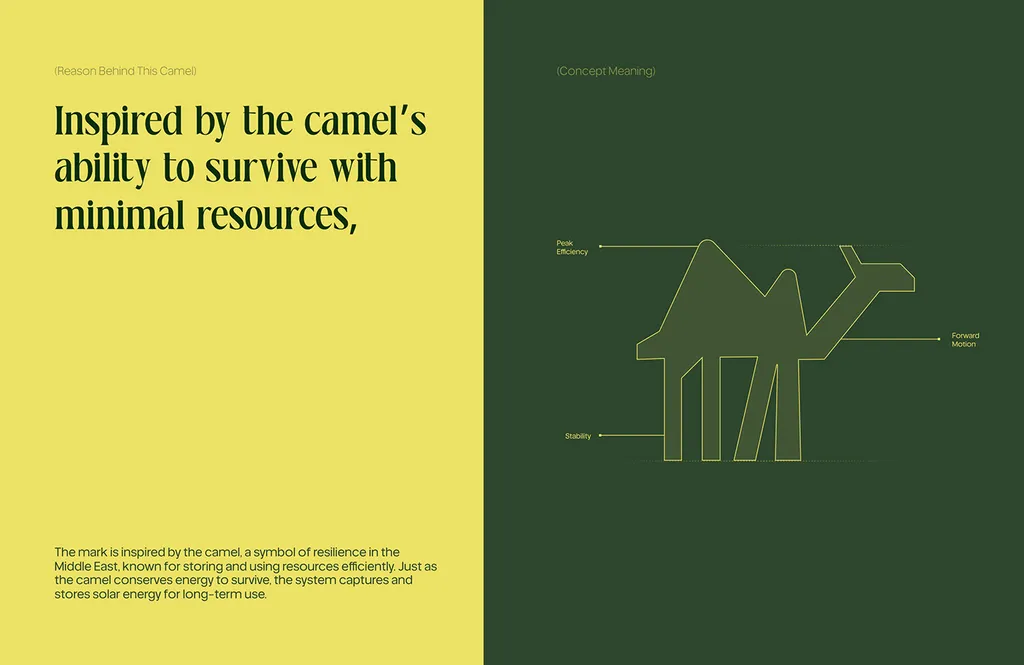
For ZAYAN, a solar energy company, the logo page explains the camel. The animal is a symbol of resilience in the Middle East, known for storing and using resources well, and ZAYAN’s systems store solar energy for later use in the same way. A line drawing of the mark labels its parts for stability, peak efficiency and forward motion. The page answers the question people ask when they first see the logo: why a camel?
Part 6: Rules (8–20 pages)
This part is the brand guidelines themselves: the logo, color, type, imagery and voice rules, with examples. Each section, with a fill-in template, is covered in brand guidelines: what to include.
Part 7: Applications (4–10 pages)
The brand on the touchpoints that matter most to this company: a deck, a social post, stationery, signage, vehicles, packaging, a website or app screen. Applications show the system working and give people something to copy.
Part 8: Close (1–2 pages)
Where the files live (a link to the brand kit), who owns the brand, who approves new uses, and the date of the last update.
Brand book examples, public and from real projects
Public brand books are rarer than public guidelines, because the strategy part is often internal. Two things stand out when you look at examples:
- Many famous “brand books” are mostly rules. NASA’s 1976 Graphics Standards Manual, one of the most cited brand documents, sets out a visual communications system: publications, vehicle markings, signboards and the logotype. It’s a standards manual, not a story.
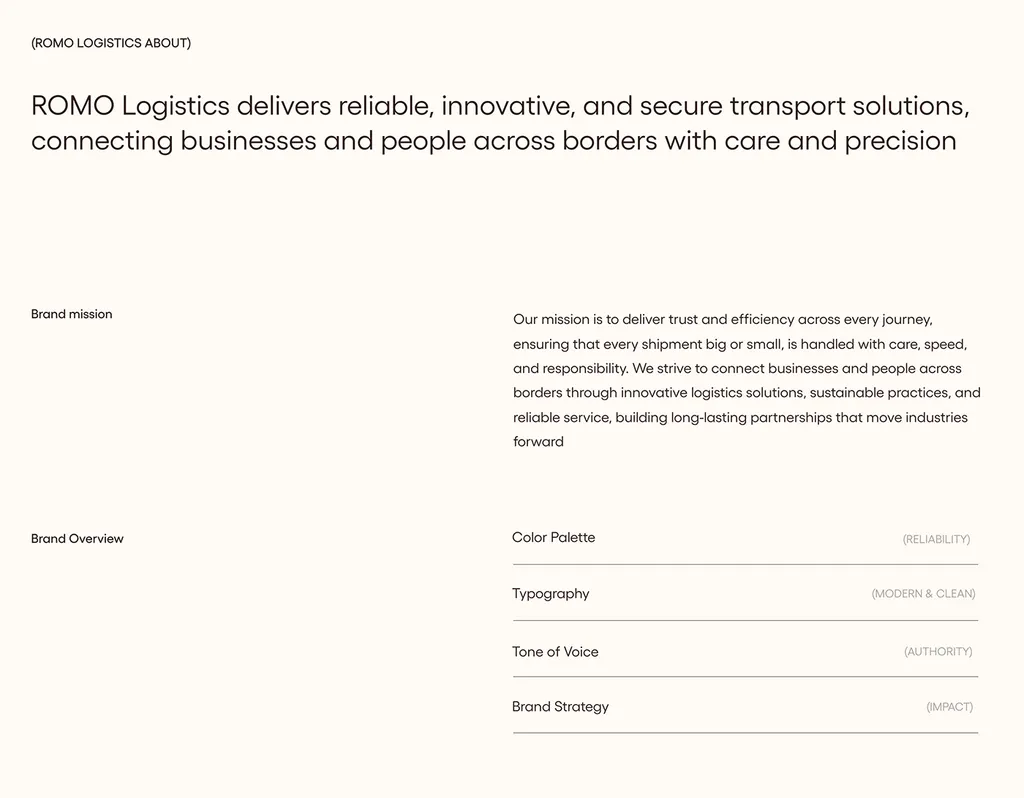
- The story pages are usually short. The ZAYAN and ROMO Logistics books open with a one-line statement of what the company does, a short paragraph (a company description for ZAYAN, a mission for ROMO) and an overview of the identity’s themes. Then they move straight to the identity. For most companies, that’s enough story.

The full ZAYAN identity, guidelines and applications are in the ZAYAN case study.
Brand book design: how do you make one people read?
People read a brand book from front to back rather than search it, so its design matters more than a guideline document’s.
- One idea per page or spread. A headline that states the point, a short paragraph and an image.
- Use the brand to design the book. Its colors, type and imagery on every page; the book is an application of the brand.
- Number the parts. “3.2 Values” is easier to point to than “the values page.”
- Show, then tell. An application or example before the rule.
- Keep the strategy short. If the purpose needs a page to explain, it isn’t finished.
- Make a reading copy and a working copy. A designed PDF to read, plus editable files for whoever updates the book.
- Date it. Put the version and date on the contents page.
Do you need a brand book?
| Your situation | What usually fits |
|---|---|
| Pre-launch or very early, founders do everything | Guidelines (even one page) plus a short positioning statement |
| Growing team, first agency or freelancers | Brand guidelines with a 3–5 page story and strategy section in front |
| Hiring fast, several teams or offices, franchise or partner network | A full brand book plus detailed guidelines |
| After a rebrand | A brand book, so everyone understands what changed and why |
If you’re not sure where your strategy stands, settle that first. A brand book can only write down a strategy that exists; brand strategy is the work that decides it.
How to create a brand book
My process has four stages, and each one produces part of the book:
- Discovery. A call, an audit of the current brand and market research.
- Strategy. Positioning, audience, personality and messaging, with creative directions.
- Identity. The logo, color, type and imagery, refined through feedback rounds.
- Handover. The guidelines and files: PDF, PowerPoint and Illustrator files plus a Figma library with source files.
The story and strategy pages come out of the first two stages, and the identity and rules pages out of the last two.
Get a brand book designed
If you have a logo and colors and need the rules written down, brand guidelines take 1–2 weeks with 3 revision rounds, priced in a fixed written proposal after a free 30-minute call. If the strategy pages need deciding too, brand strategy takes 2–3 weeks. A full brand identity ($3,499, 2–3 weeks) includes the identity and guidelines.
Book a free 30-minute call in your time zone. Tell me who will use the book (staff, agencies, partners or investors), and I’ll tell you whether you need a brand book, guidelines, or both in one document.
FAQ
What is a brand book?
A brand book is the reference document for a brand. It covers who the company is and why it exists, then how the brand looks and sounds, with the rules for using it and examples of it in use.
What is the difference between a brand book and brand guidelines?
A brand book covers the why and the how: strategy and story as well as the rules. Brand guidelines are usually the rules alone. Some companies and designers use the two terms for the same document, so agree the contents, not the name.
Is a brandbook the same as a brand book?
Yes. Brandbook, brand book, brand bible and brand manual are spellings and names for the same kind of document.
What should be in a brand book?
Eight parts: an opening (cover, contents, a short letter), the story, the strategy (purpose, values, audience, positioning), personality and voice, the identity explained, the rules, applications, and a closing page with files and contacts.
How long is a brand book?
The outline in this article comes to roughly 25–50 pages for a company with several teams. A startup can cover its story and strategy in three to five pages placed in front of its guidelines.
Who needs a brand book?
Companies where people outside the founding team make brand decisions: growing teams, franchise and partner networks, companies working with several agencies, and any company just after a rebrand.
Can I make a brand book myself?
You can write the story and strategy pages yourself, and a template helps. The identity, rules and applications need a designer, because they depend on design decisions and working files.
Sources
- NASA: NASA Graphics Standards Manual (2015 post about the 1976 manual)
- Frontify: Brand Guidelines: What They Are & How to Create Them
- Bynder: Brand guidelines: What they are, how to create them & examples
- Helms Workshop: What are Brand Guides? What is a Brand Book?
- Venngage: How To Create Brand Style Guidelines (updated 30 October 2026)
- Oamii: Brand Book vs. Brand Style Guide (20 January 2025)